The second-annual IBM Quantum Developer Conference (QDC) took place just last month, and we spent the three-day event highlighting our progress along the IBM Quantum Roadmap. We debuted new quantum chips, announced powerful software capabilities, and showed off the groundbreaking R&D shaping the future large-scale, fault-tolerant quantum computing. But none of these was the real star of the show.
That’s because it was our wonderful quantum community that formed the living, beating heart of IBM Quantum Developer Conference 2025. Guided by the theme of Quantum Advantage Together, the event brought together 200+ developers, researchers, advocates, students, and leaders from the Qiskit community—the largest open-source quantum community in the world—to explore the latest advances from IBM Quantum. Through seminars, lightning talks, a poster showcase, and a set of highly competitive coding challenges inspired by the year’s most impactful community-led research, our partners and peers across the quantum community played a vital role in shaping this year’s QDC programming.
Watch the IBM Quantum Developer Conference seminars on YouTube.
Explore the IBM Quantum Developer Conference coding challenges on GitHub.
The quantum community’s participation at QDC[25] took many forms, but all of them shared one important quality: a basis in rigorous, high-quality, innovative quantum research in quantum simulation and quantum optimization. Below, we take a look at the outstanding community-led work that drove so much of this year’s QDC event.
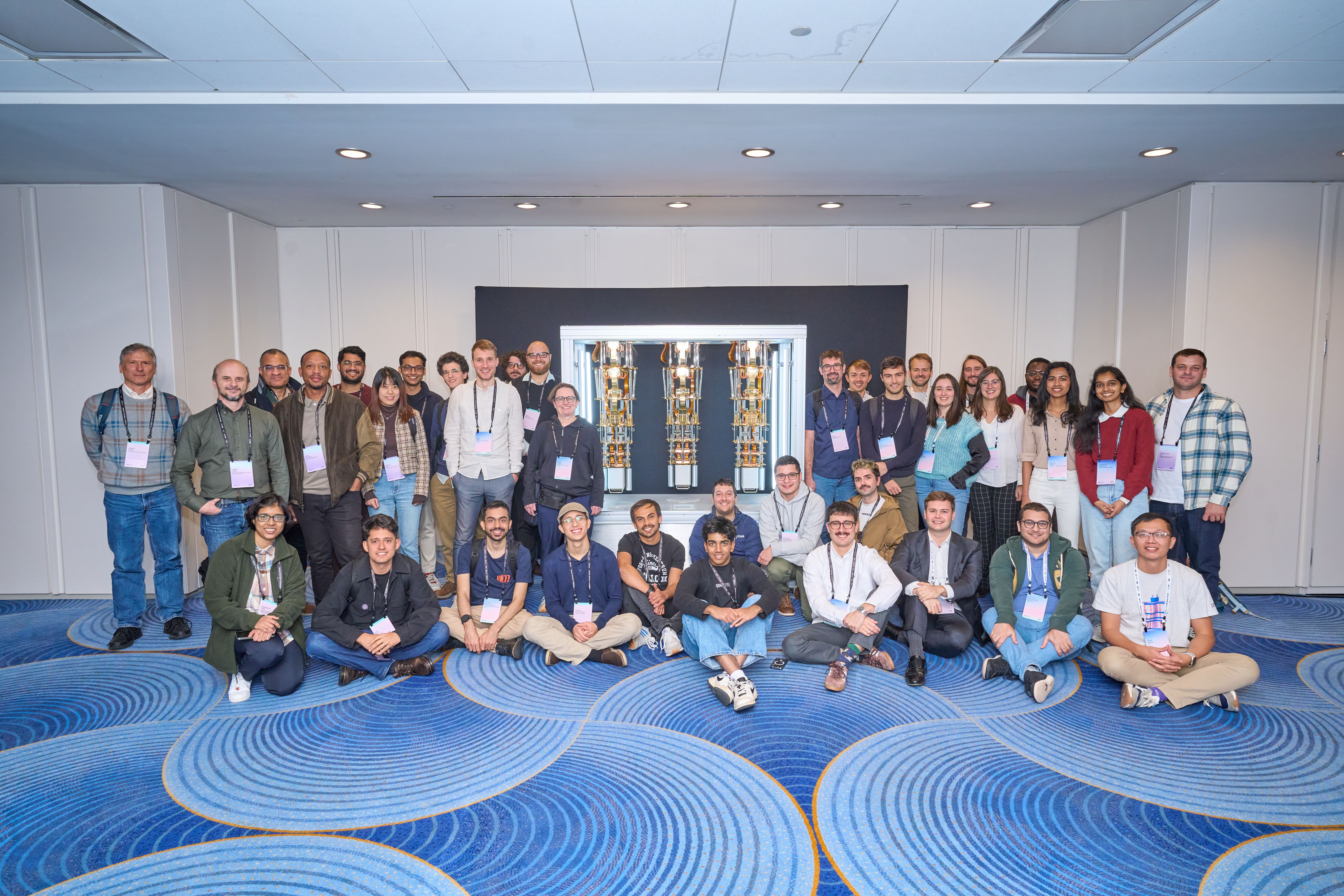
Qiskit Advocates at IBM Quantum Developer Conference 2025
Quantum simulation
We believe the first demonstrations of quantum advantage in quantum simulation will arrive in 2026, thanks to advances in hardware, algorithms, and quantum + HPC (high-performance computing) infrastructure that are helping researchers explore new ground in chemistry and fundamental physics.
Our partners and peers in the quantum community took to the QDC main stage to deliver four fascinating invited talks showcasing their work in quantum simulation. Speakers include:
-
Cleveland Clinic’s Danil Kaliakin, whose talk explored how Cleveland Clinic developed a sophisticated workflow—now available as an open-source Qiskit Function template—leveraging a quantum simulation method known as sample-based quantum diagonalization (SQD) to simulate molecular systems in chemical solvents.
-
Enrique Rico Ortega, a physicist associated with BasQ, University of the Basque Country, and CERN, who showed how IBM quantum computers can enable simulations of fundamental physics such as quantum chromodynamics and lattice gauge theories.
-
California Institute of Technology researcher and IBM Quantum Credits Program awardee Roland Farrell, whose work centers on using quantum computers to simulate the dynamics of subatomic particles known as Hadrons in a simplified model of quantum chromodynamics—the theory that describes the strong nuclear force.
-
The InQubator for Quantum Simulation's (IQuS) Nikita Zemlevskiy, another IBM Quantum Credits Program awardee who explains how IQuS researchers are using dynamic circuits to build simulations of high-energy particle collisions on IBM Quantum hardware.
In many cases, the research covered in these talks also served as direct inspiration for some of our QDC coding challenges, including challenges based on:
-
Scattering and particle creation in 1D Ising field theory, a simulation challenge inspired by invited speaker Roland Farrell’s work in the John Preskill lab at CalTech. Participants set out to study the time evolution of two localized single-particle states within a 1-dimensional Ising field theory as they evolve towards and scatter off each other. Congratulations to challenge winners Benjamin Tirado (CSIC/DIPC/BasQ, Qiskit Advocate), Talha Azfar (RPI), Suman Devarasetti (U.S. Bank), Marc Maußner (infoteam Software AG, Qiskit Advocate), Kevin Robinson (Hewani Data, Qiskit Advocate), and Namita Shah (University of Michigan).
-
Hadron dynamics in the Schwinger model, a simulation challenge inspired by Farrell’s work as a doctoral student under University of Washington professor Martin Savage, where participants simulate the propagation (or “spreading”) of a hadron wavepacket in the Schwinger model, a simplified model of quantum chromodynamics. Congratulations to challenge winners Tushar Pandey (DataRobot, Texas A&M University), Zhen Li (Cleveland Clinic), Christopher Mastandrea (University of California, Merced), Jean Utke (Allstate), Gayathree M. Vinod (IITM, Qiskit Advocate), and Adam Winick (Q-CTRL).
-
Compute solute-solvent interactions using sample-based quantum diagonalization, a challenge based on Cleveland Clinic’s work integrating the SQD method with established implicit solvation models. Congratulations to challenge winners Konrad Wojciechowski (PCSS), Jose Hernandez (Florida State University), Patrick Hopf (Technical University of Munich), Paul Wang (Morgan State University), and Piotr Rydlichowski (PCSS).
-
Real-Time Dynamics in a (2+1)-D Gauge Theory, a challenge based on the same paper detailed in Enrique Rico Ortega invited talk, which explored quantum computing methods for simulations of fundamental physics—such as the gauge theories that describe the strong nuclear force. Congratulations to challenge winners George Opsahl (Portland State University), Dragos Grosu (FreeYa Mind), Jigyasa Sharma (Columbia University), Maxence Grandadam (Haiqu), and Michael Rose (University of Chicago).
-
Sample-based Krylov quantum diagonalization (SKQD), a challenge based on research from Oak Ridge National Laboratory, where participants use the SKQD workflow to tackle ground state energy calculations. Congratulations to challenge winners Raúl Ignacio Guerrero Avilés (Tecnalia/BasQ, Qiskit Advocate), Temitope Adeniyi (Cleveland State University), Aritro Chatterjee (Purdue University), Álvaro Nodar Villa (Global Data Quantum, Qiskit Advocate).
Quantum optimization
While most invited speakers focused on quantum simulation, others presented on the exciting progress we’re seeing in the field of quantum optimization. Recent efforts by the Quantum Optimization Working Group and other community stakeholders have delivered promising results suggesting that quantum advantage in optimization could be well within reach. Invited speakers covering optimization include:
-
E.ON Digital Technology’s Corey O’Meara, whose talk highlighted how the European energy company is exploring quantum methods for peer-to-peer energy trading on local grids using a mathematical technique known as the Birkhoff decomposition.
-
Purdue University’s David Bernal Neira, who introduced attendees to the “Intractable Decathlon,” a community benchmarking effort created by the Quantum Optimization Working Group and previously covered on the IBM Quantum blog.
The Quantum Optimization Working Group and its intractable decathlon helped to inspire three of our eight coding challenges as well, including challenges based on:
-
The market split problem, a resource allocation task that becomes computationally intractable even for relatively small instances, and one of the ten problem classes that make up the quantum optimization working group’s intractable decathlon. Congratulations to challenge winners Khanyisa Noganta (University of the Witwatersrand, Vodacom Group), Alain Chancé (MolKet SAS), Kyla Koos (Keybank), Manuel Martin Cordero (Global DataQuantum), and Nancy Ihechu (University of Missouri-Columbia).
-
The maximum independent set problem, where our goal is to find the largest set of vertices in a graph such that no two vertices in the set are connected by an edge—another problem taken from the intractable decathlon. Congratulations to challenge winners Alejandro Montanez Barrera (Forschungszentrum Jülich, Qiskit Advocate), Harshit Gupta (qBraid, Qiskit Advocate), Pablo Viñas Martinez (CSIC, Qiskit Advocate), and Daniel Sierra-Sosa (Catholic University of America, Qiskit Advocate), whose work will be submitted to the optimization working group’s open-source Quantum Optimization Benchmarking Library (QOBLIB).
-
Quantum Approximate Multi-Objective Optimization (QAMOO), a challenge based on the quantum optimization working group’s recent publication in Nature Computational Science, which showed QMOO is a contender for near-term demonstrations of quantum advantage. Congratulations to challenge winners Alejandro Montanez Barrera (Forschungszentrum Jülich, Qiskit Advocate), Harshit Gupta (qBraid, Qiskit Advocate), Pablo Viñas Martinez (CSIC, Qiskit Advocate), and Daniel Sierra-Sosa (Catholic University of America, Qiskit Advocate).
Overall challenge winners
In addition to our individual challenge winners, congratulations as well to our overall challenge winners, whose teams scored highest across all four challenges in their challenge tracks. Winners are pictured below accepting their awards from IBM VP of Quantum Algorithms and Scientific Partnerships, Katie Pizzolato.
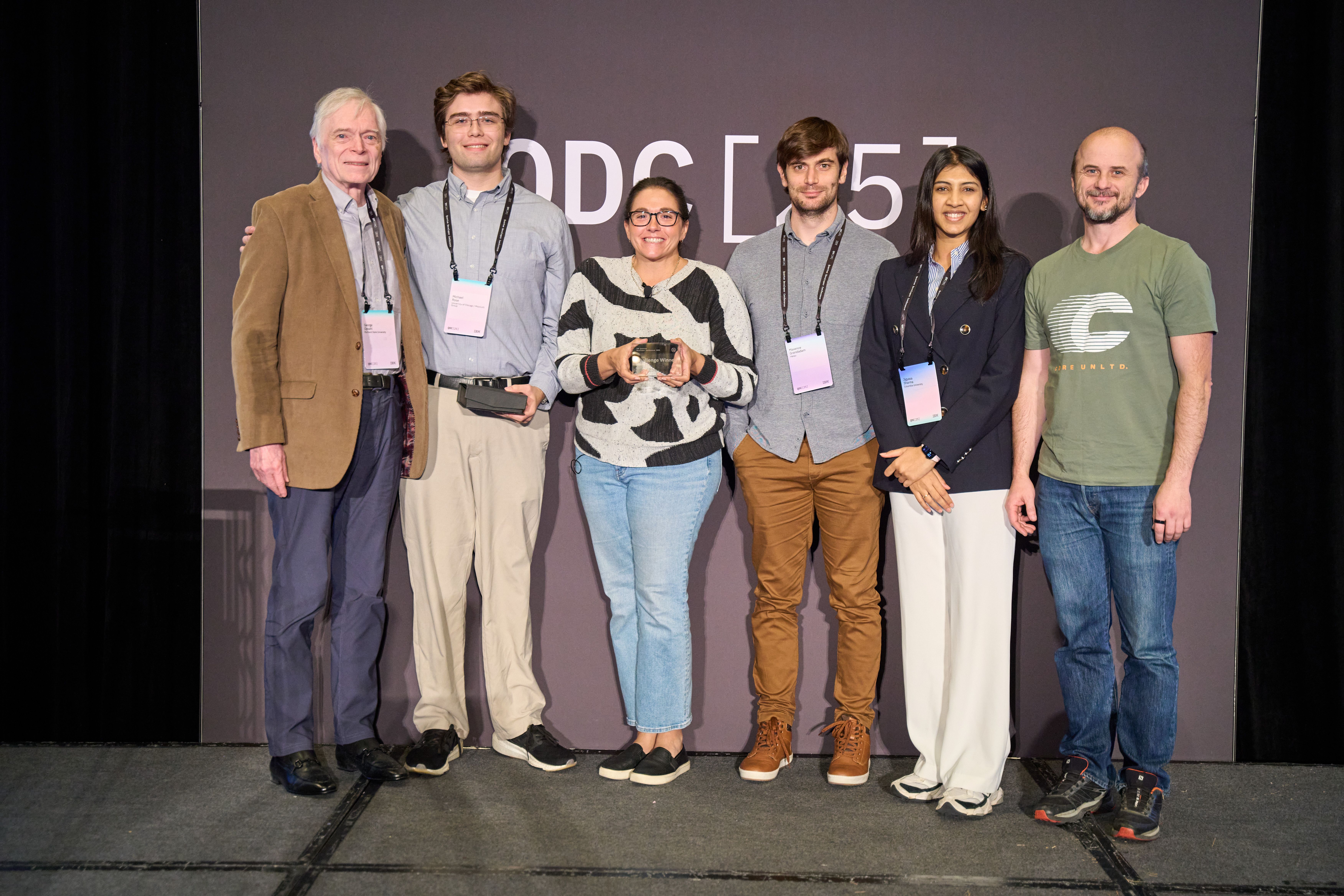
L to R: George Opsahl (Portland State University), Michael Rose (University of Chicago), Maxence Grandadam (Haiqu), Jigyasa Sharma (Columbia University), and Dragos Grosu (FreeYa Mind), whose team was named the overall winner across the market split, SKQD, real-time dynamics, and scattering coding challenges.
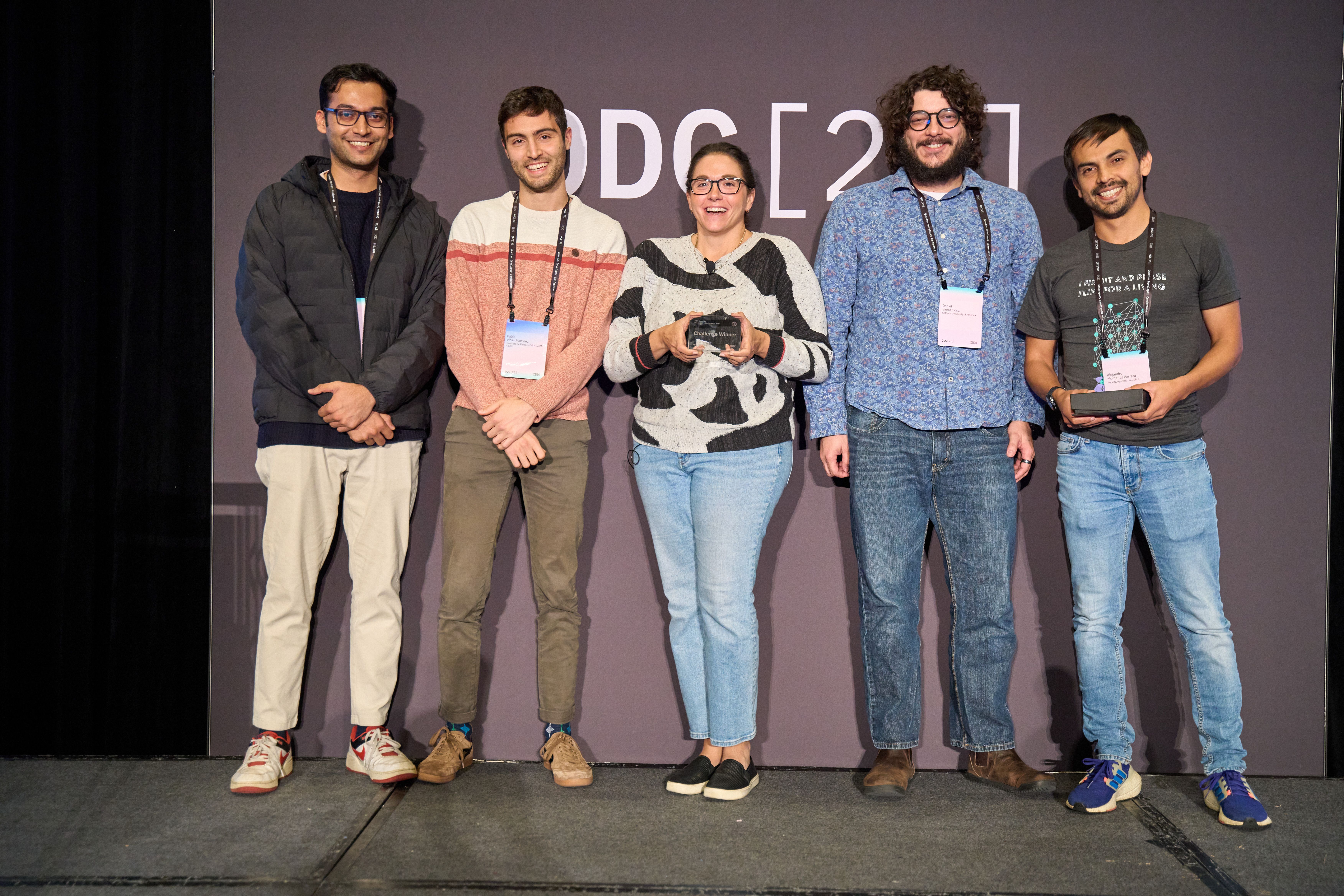
L to R: Harshit Gupta (qBraid, Qiskit Advocate), Pablo Viñas Martinez (CSIC, Qiskit Advocate), Daniel Sierra-Sosa (Catholic University of America, Qiskit Advocate), and Alejandro Montanez Barrera (Forschungszentrum Jülich, Qiskit Advocate), whose team was named overall winner across the maximum independent set, QAMOO, hadron dynamics, and implicit solvent challenges.
Lightning talks and poster showcase
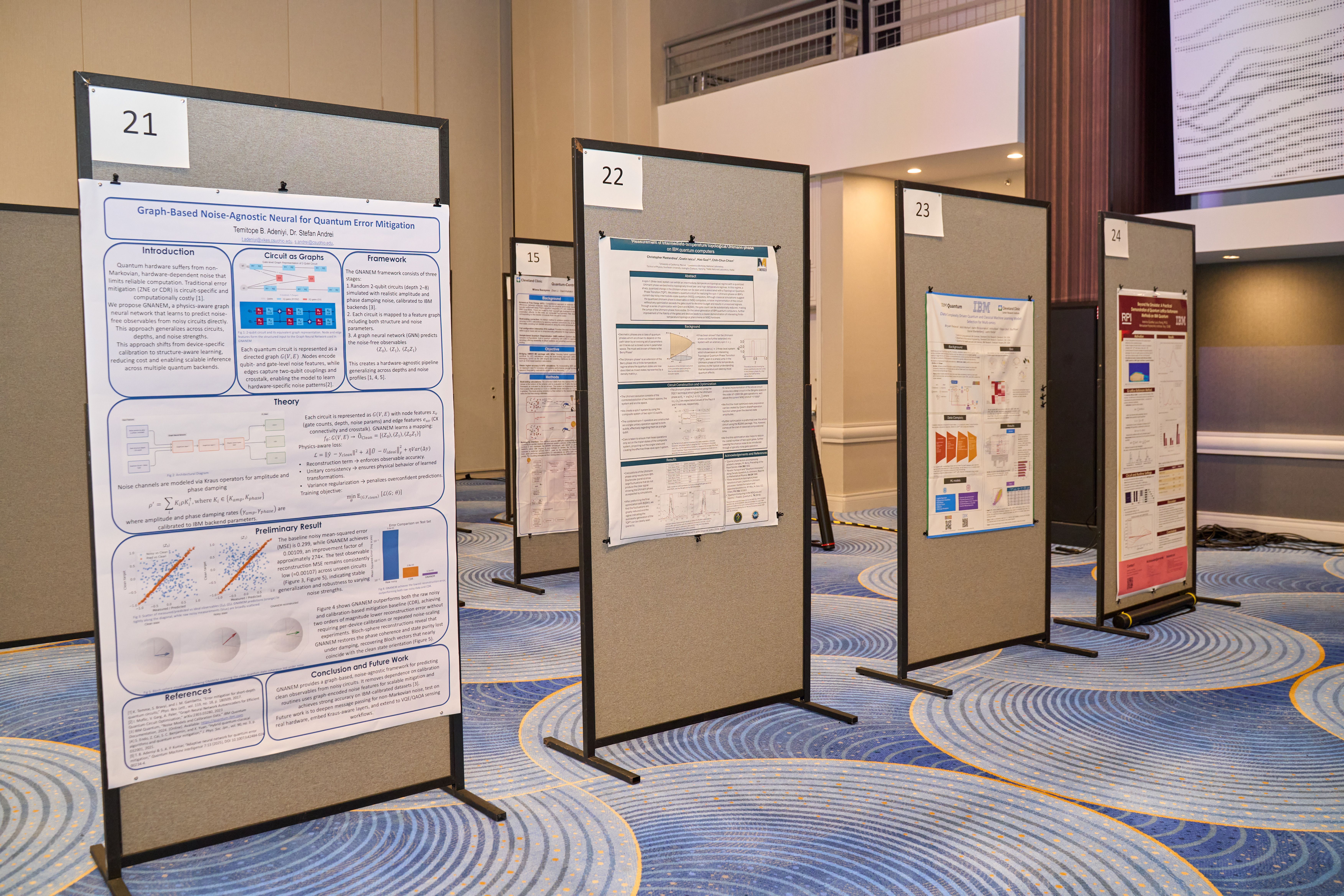
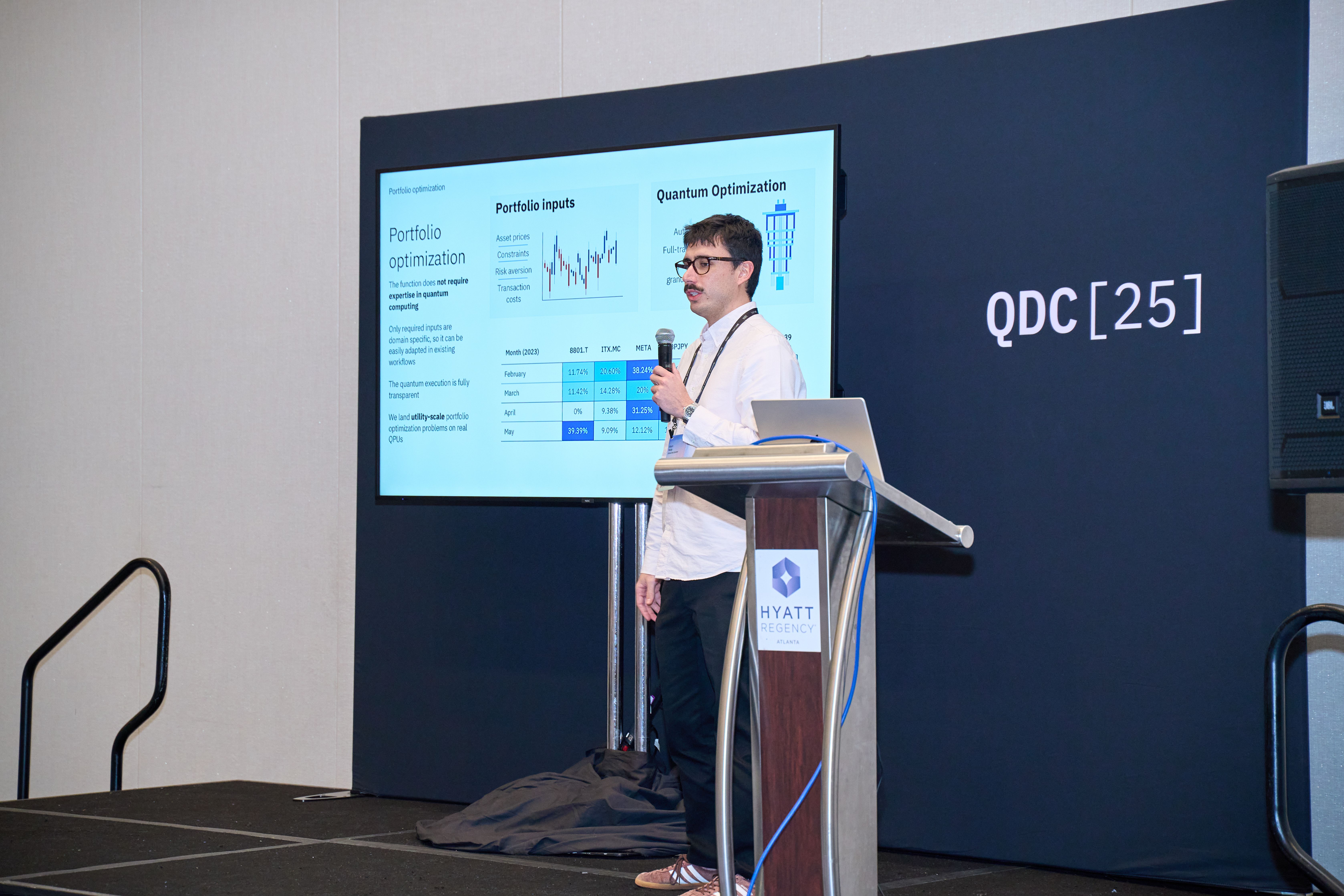
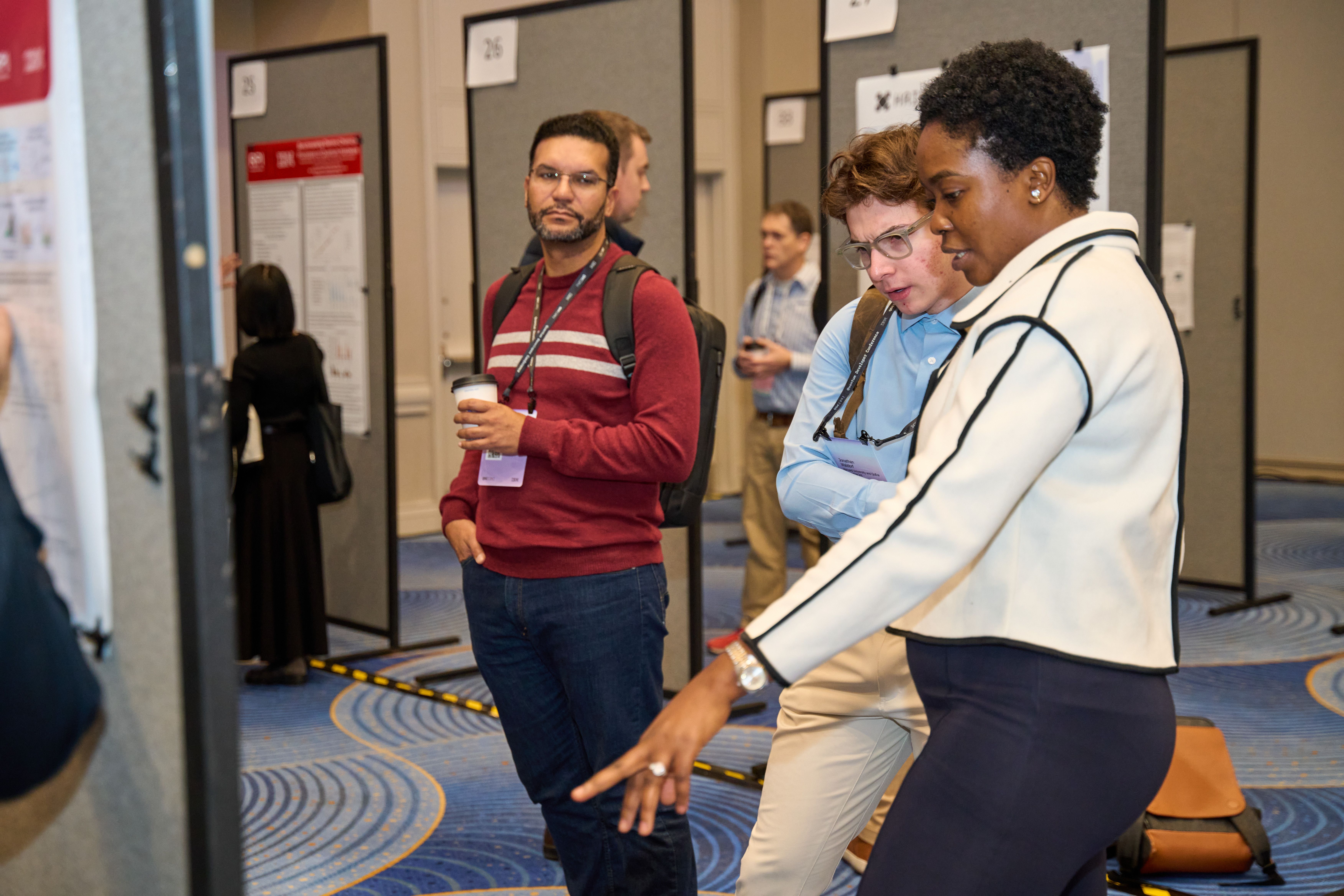
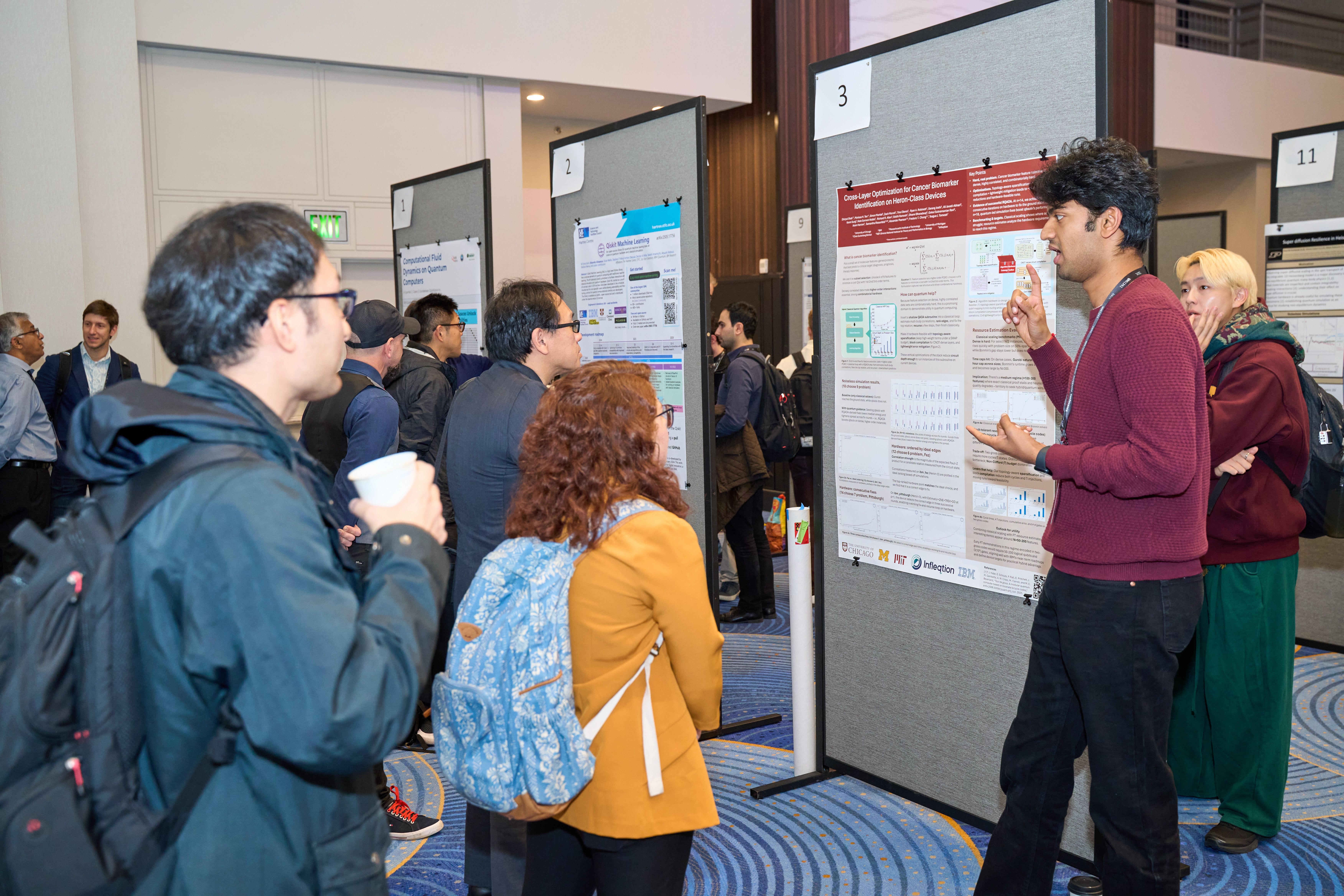
The quantum community didn’t just make a strong showing through invited talks and coding challenges. It also took on a starring role in the QDC Exhibit Hall, where lightning talks and a sprawling poster showcase highlighted emerging capabilities and promising research across academia, enterprise, startups, and our Qiskit Functions partners.
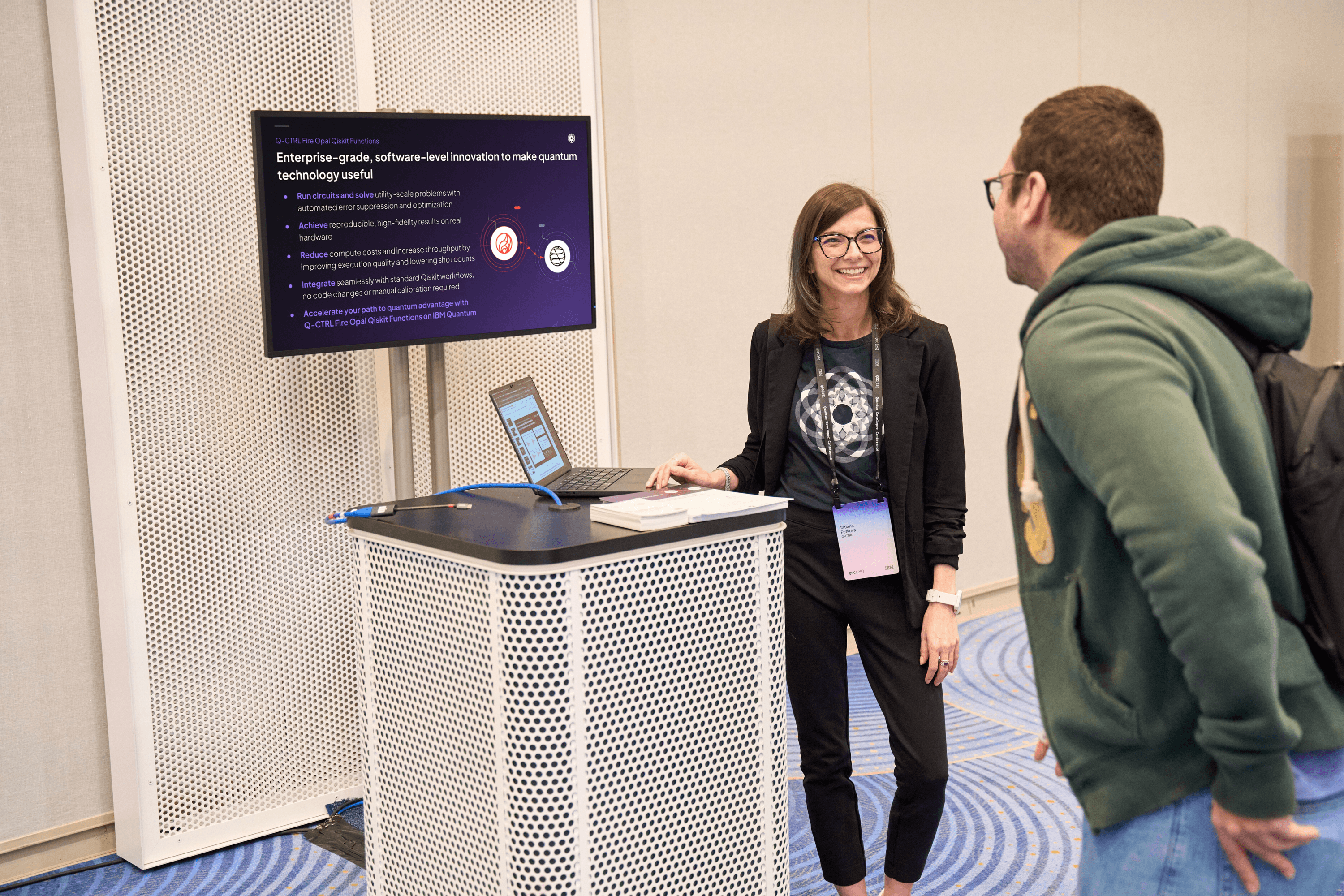
Lightning talks included rapid fire presentations from developers, researchers, and leaders at organizations and startups including Algorithmiq, Ansys, BlueQubit, ColibriTD, Global Data Quantum (GDQ), Kipu Quantum, KPMG, MathWorks, ParityQC, Q-CTRL, Qedma, Qunova Computing, and SAS.
Meanwhile, the poster showcase included 40+ posters created by researchers from organizations like Cleveland Clinic, RIKEN, Rensselaer Polytechnic Institute (RPI), STFC Hartree Centre, the Jülich Supercomputing Centre at Forschungszentrum Jülich, University of Chicago, University of Missouri, Universidad de Navarra, and more.
Posters covered a wide range of topics, from novel quantum error mitigation and quantum circuit optimization techniques to applications research in simulation, optimization, and quantum machine learning.
It takes a community
We’d like to extend our sincerest thanks to the 200+ developers, researchers, students, and quantum community leaders who helped make this year’s IBM Quantum Developer Conference such a success. This community has accomplished remarkable things using IBM Quantum hardware and software, and we expect to see them reach even greater heights as we push towards the first demonstrations of quantum advantage in 2026.
Of course, the attendees who joined us at QDC[25] represent just a small slice of our global quantum community. That’s why we’re thrilled that we can make the seminars and coding challenges from this year’s event freely available online. We hope you’ll take a look at the resources linked above, and consider applying to join us at the next QDC event.