
Key Takeaways:
- IBM has deployed an IBM Quantum System Two with an IBM Quantum Nighthawk r2 processor at the University of Chicago's Hyde Park Labs to support the National Quantum Algorithm Center (NQAC) and the wider Illinois quantum ecosystem.
- IBM is an anchor partner of the NQAC in Chicago, which was created by the State of Illinois in concert with the Illinois Quantum and Microelectronics Park (IQMP). IQMP will be a quantum computing campus on the former US Steel South Works site on Chicago's Southeast Side, and will eventually house the new computer and NQAC.
- The IBM Quantum System Two sits at street level behind floor-to-ceiling windows at Hyde Park Labs on 53rd Street. IQMP CEO Harley T. Johnson calls it "probably the most publicly visible quantum computer in the world."
- The University of Illinois, University of Chicago, and other key research and business institutions in the region are already conducting important research that advances quantum computing as a technology, science, and industry.
- Johnson and Mason emphasize that Illinois' quantum leadership is rooted in decades of investment in scientific and engineering talent. Across the Midwest, universities, national laboratories, and technology companies have helped develop generations of researchers, engineers, and entrepreneurs.
Harley T. Johnson wants Chicago to be the Silicon Valley of quantum computing.
Johnson is a professor of mechanical science and engineering at the University of Illinois Urbana-Champaign (U of I.) and CEO of the Illinois Quantum and Microelectronics Park (IQMP). He is part of a cohort of leaders spanning academia, government, and industry who are working to establish Chicago as the hub of America’s quantum computing industry.
That effort has a physical center. With a $500 million investment from the state of Illinois under Governor JB Pritzker, as well as support from IBM, U of I., the University of Chicago, and other partner organizations, the IQMP will be a massive campus on a pier that once housed a U.S. Steel South Works plant on Chicago’s Southeast Side.
As part of that project, the state established the National Quantum Algorithm Center (NQAC), a Chicago-based collaborative initiative focused on advancing quantum algorithms and applications to support the emerging quantum computing industry. IBM is an anchor partner.
To support the algorithm center and surrounding quantum ecosystem, IBM has unveiled a newly installed IBM Quantum System Two with an IBM Quantum Nighthawk r2 processor at UChicago’s Hyde Park Labs. The system will operate at UChicago before eventually relocating to the IQMP campus, which will serve as the long-term home of both the NQAC and the new quantum computer.
Pritzker and Johnson joined a group of Illinois leaders for the ribbon cutting including UChicago President Paul Alivisatos, Chairman of the Illinois Economic Development Corporation John Atkinson, Assistant Director and Chief Workforce Officer of the Illinois Department of Commerce and Economic Opportunity Stacia Edwards, P33 CEO Brad Henderson, U of I. Chancellor Charles Isbell, and UChicago Vice President of Research Nadya Mason. IBM Director of Research Jay Gambetta, and Director of Quantum Algorithm Centers Hanhee Paik stood with them to unveil the quantum computer at a ceremony on November 6.
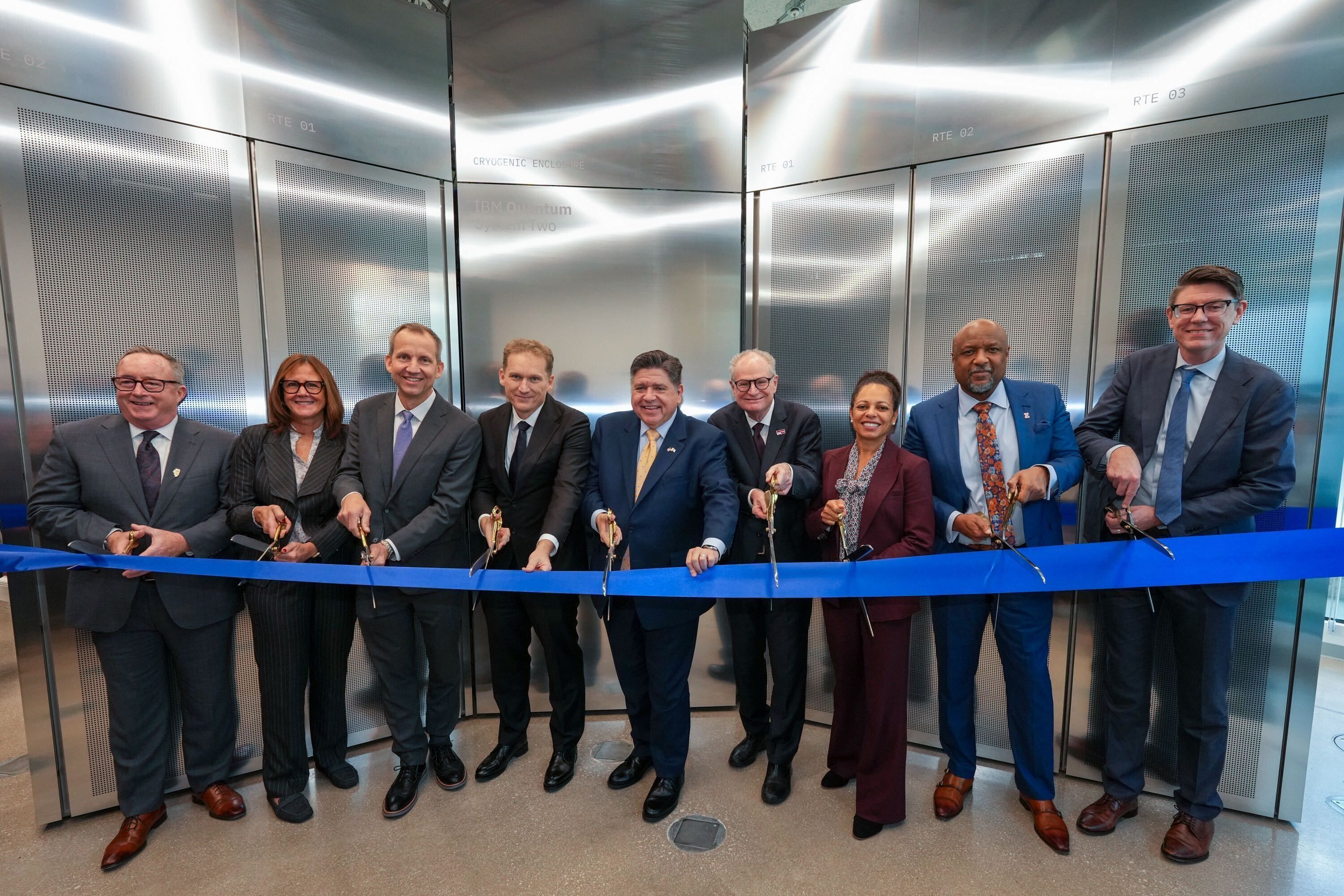
Mason has been a researcher and leader in the quantum field for decades and has played a key role in building Chicago’s quantum ecosystem.
She said that the arrival of the IBM Quantum System Two will accelerate the work and increase the excitement for quantum computing that’s already taken root in the region.
Johnson said it’s important to him that the computer will have such a prominent location in the city.
“It’s probably the most publicly visible quantum computer in the world,” Johnson said.
Sitting at ground level behind floor-to-ceiling windows at Hyde Park Labs on 53rd Street, the mirrored panels of the IBM Quantum System Two will reflect the faces of students from the public high school just a block away as they walk past and peer through the glass.
"Imagine getting to say, ‘My daughter goes to school every day and passes a real quantum computer.’ That’s mind blowing,” Johnson said.
Already, Mason said, adults are getting inspired by the possibilities the new quantum computer represents.
“For our graduate students, having access to a quantum computer is incredible,” she said.
There are many students and researchers in the Pritzker School of Engineering at UChicago with deep expertise in quantum information science and engineering. But in the lead up to the ribbon cutting, Mason said she’s received questions from professors and administrators in physics, other fields of engineering, and even fields like medicine, all interested in applying quantum to their own domains. The presence of a leading quantum computer in such a public place is a powerful source of inspiration as well as a practical tool.
The IBM Quantum System Two is new, but Illinois’ quantum momentum isn’t
Paik compared the coalition driving quantum computing in Illinois to “the Avengers”—super-heroes working together to achieve great collective goals. Organizations including the Illinois Department of Commerce and Economic Opportunity, the University of Chicago, the University of Illinois, the Chicago Quantum Exchange, the Chicago technology and innovation hub P33, and the Illinois Economic Development Corporation have spent years building the foundations for what is now emerging on Chicago's South Side.
Paik noted that numerous leaders, including Johnson and Mason, have helped make this progress possible, and highlighted Governor Pritzker's leadership as instrumental to the effort's success.
The region is also home to important quantum computing research. In 2026, a joint team from the University of Chicago and IBM demonstrated quantum advantage on a structured computational task, offering an alternative to traditional random circuit sampling benchmarks. Running on an IBM quantum system, the experiment leveraged 70 logical qubits to complete a calculation in approximately 15 minutes, surpassing the practical capabilities of today's leading classical simulation methods while providing a built-in mechanism for verification.
Illinois is also advancing the convergence of quantum and high-performance computing (HPC). Researchers at U of I., the National Center for Supercomputing Applications (NCSA), and IBM integrated NCSA's DeltaAI supercomputer with an IBM Quantum system, bringing quantum-centric supercomputing capabilities to the state.
Following the announcement of the expanded collaboration in April 2026, the joint team delivered its first demonstration within six months: a computation of Cu₃C₆O₆, a strongly correlated kagome-lattice metal, using the integrated DeltaAI and IBM Quantum systems. The results will be presented at SC26 in November, highlighting the pace of innovation enabled by this collaboration.
Beyond these scientific and technical advances, Illinois is increasingly focused on translating quantum innovation into real-world impact. The NQAC plays a key role in this effort, bringing together industry, academic, and government partners to develop quantum-enabled solutions for meaningful business and societal challenges. Through the NQAC Grand Challenge program, member organizations are exploring applications across sectors including drug discovery, advanced manufacturing, energy, finance, and logistics.
The accomplishments highlighted above represent only a snapshot of the innovation taking place across Illinois. Below are additional examples that illustrate how Illinois is advancing quantum computing, algorithms, and applications.
The frontier of quantum algorithms and applications research in Illinois
Joanna Wang is a fifth-year PhD candidate in professor Laura Gagliardi's group at the UChicago Pritzker School of Molecular Engineering. In July, she was first author on a paper published in the Proceedings of the National Academy of Sciences (PNAS) that showed how a classical chemistry method can hand its hardest calculations to a quantum computer.
The Schrödinger equation describes the behavior of molecules at the quantum scale, but chemists cannot solve it exactly for most real-world molecular systems, and therefore rely on a range of approximations. The accuracy of those approximations varies from one problem to the next. That means researchers are unable to generate the numerically exact electronic-structure solutions that could play important roles in fields ranging from manufacturing to materials science to medicine, which can delay and add cost to important discoveries.
The computational cost of modeling a molecule explodes as the molecular system grows. So computational chemists using classical methods are forced to rely on approximations. One method, the “localized active space self-consistent field method (LASSCF),” carves a molecule into fragments and performs exact, computationally expensive calculations only where electrons interact most strongly. This method is powerful, but limited. Wang said classical computers allow practical fragment calculations up until 18 electrons distributed across 18 orbitals.
The team at UChicago and IBM swapped in sample-based quantum diagonalization (SQD), a powerful quantum-centric supercomputing approach for solving chemistry problems, as the fragment solver. The resulting method, LASSQD, resembles LASSCF in important ways. It picks fragments, sends a circuit for each one to IBM quantum hardware, recombines the results, updates the orbitals classically, and repeats until the answer converges.
That swap enabled the research team to model a 26-electron, 24-orbital fragment of an iron porphyrin complex—a system too large for practical exact diagonalization calculations. On smaller systems, LASSQD matched LASSCF to within 1 kilocalorie per mole. Where another SQD-based fragmentation method unveiled this year is optimized for long molecules like proteins, Wang said the group’s approach targets catalysts and metal-containing molecules, where strongly interacting electrons resist conventional classical approximation.
Wang said her work now is finding practical applications for LASSQD.
"For us, it has to be chemically meaningful," Wang said. "Our group doesn't want to do something just because we can do it."
Wang's and Gagliardi's teams, together with IBM researchers, are making LASSQD more broadly available through open-source development, allowing researchers to leverage and build upon this computational tool to advance quantum algorithms.
Illinois is at the forefront of industrial applications for quantum computing. In April, the NQAC announced the first five Grand Challenges program awards, which fund postdoctoral researchers building quantum applications for real industry problems. Each team pairs an Illinois academic group with a quantum computing company and an end user. P33, Northwestern University, and the Discovery Partners Institute at U of I. fund the awards.
IBM is the quantum partner on two of the five awarded projects, including NQAC Grand Challenge participants Deloitte and AbbVie, who earned funding to work with IBM and Northwestern University to build quantum molecular simulation approaches for researchers engaging in drug discovery. EPRI and U of I. were also awarded, and are working with IBM to explore how quantum optimization algorithms could lead to more efficient power grids.
A promising future for quantum computing in Illinois
Illinois sits at the center of a longstanding hub of engineering and scientific talent. National laboratories, universities, and technology companies all over the Midwest have trained generations of researchers and builders.
Silicon Valley, Johnson pointed out, was built in large part by engineers trained in the Midwest who later moved west to build classical computing companies. Johnson said that IQMP is intended to help more of the talent growing in Chicagoland stay in the region while also attracting quantum entrepreneurs from all over the world to build in Chicago.
Already, he said, you can walk down the street in downtown Chicago and run into some of the best quantum computing minds in the world. As the ecosystem grows in the coming years, he expects to see many quantum pure-play businesses, as well as enterprises who see the value in quantum, set up operations in the region. He believes that growth will drive economic development well beyond IQMP, benefitting the city, the state, and the broader Midwest.
Mason said IBM’s long-term commitment has been essential to the growth of Chicago’s quantum ecosystem.
“IBM has been a very special partner,” Mason said. “They've been there since the very beginning, not just investing in computing and their own labs, but understanding that they do better as a company by supporting the whole ecosystem of ‘aha!’ moments happening in places like university labs.”
Johnson said IBM’s involvement carries particular significance because of the company’s early and sustained commitment to IQMP.
“Having IBM as an anchor of our activities in Chicago is extremely meaningful,” Johnson said. “It shows the gravitas of what we’re building here. That means something to the people of this city.”


