
Key Takeaways:
- IBM and NVIDIA are integrating the open-source Quantum Resource Management Interface (QRMI) with Slurm’s Hierarchical Resources (HRES) feature to give Slurm, the high-performance computing (HPC) workload manager NVIDIA develops, more visibility into quantum resources and workloads.
- IBM, RIKEN, and NVIDIA researchers used ROQUO, RIKEN's new GPU supercomputer, to bring an SQD calculation of an iron–sulfur cluster within 4.3 millihartree of DMRG, a classical method known for its high accuracy, 79× closer than earlier SQD work.
- IBM and NVIDIA, together with Fermi National Accelerator Laboratory (Fermilab), will launch a modular quantum computing co-design platform to explore computationally demanding problems in high-energy and nuclear physics.
- IBM and AMD announced Pelagos, an open-source framework that tests quantum error correction decoders against billions of simulated error patterns on GPUs.
- Managed workflows help researchers deploy, reuse, and run quantum-classical workflows on managed, high-performance classical infrastructure.
- Cleveland Clinic, RIKEN, and IBM are finalists for the 2026 ACM Gordon Bell Prize for simulating protein-ligand complexes of up to 12,635 atoms with quantum and classical computers working together.
- IBM Quantum Nighthawk r2 runs up to 100,000 samples per second, a 25× throughput gain over IBM Quantum Heron. Researchers can start on IBM quantum computers today with the free IBM Quantum Open Plan.
This year, IBM and partners demonstrated quantum advantage. The next job is making quantum computers practical tools for science.
We are on that path, which runs through high-performance computing (HPC) centers. In an HPC-plus-quantum paradigm, quantum processors, CPUs, and GPUs work together, with each compute tool managing the part of a problem it handles best. But maturing these integrations requires software that fits into existing HPC workflows, integrating highly performant quantum hardware with classical HPC, and access for the researchers who will use them.
IBM and partners are bringing new progress on each of these fronts to SC26, the International Conference for High Performance Computing, Networking, Storage, and Analysis, November 15–20 in Chicago. In particular, we are unveiling new open-source tools that support QPU-GPU integrations across classical hardware vendors, and working with AMD and NVIDIA on software and platforms that bring together advanced classical and quantum hardware for quantum error correction.
Integrating quantum computing and HPC
Cleveland Clinic, RIKEN, and IBM are finalists for the 2026 ACM Gordon Bell Prize for outstanding achievement in supercomputing. They earned the spot by simulating protein-ligand complexes of up to 12,635 atoms, the largest molecules known to be simulated with quantum computers.
This work is an example of quantum-HPC integration. Classical computers broke each complex into clusters and solved the simpler, less entangled ones. To solve the more complex and entangled clusters, the workflow used IBM Quantum Heron processors at Cleveland Clinic and RIKEN alongside classical HPC as part of a method called sample-based quantum diagonalization (SQD). The team has since automated the workflow using ROQUO, RIKEN’s new supercomputer built on NVIDIA GB200 NVL4 systems.
ROQUO also powers new research from IBM, RIKEN, and NVIDIA. The team used SQD to study Fe₄S₄, an iron–sulfur cluster found inside the proteins of living cells. Its strongly interacting electrons make it hard to simulate. The researchers started SQD from a broken-symmetry reference state, a starting approximation that better captures the magnetic interactions between the cluster's iron atoms.
The results came within 4.3 millihartree of the accuracy achieved with the density-matrix renormalization group (DMRG), a classical simulation method known for its high accuracy. That's 79× closer than the team's earlier closed-loop SQD result on the same cluster.
In Illinois, a team from the University of Illinois Urbana-Champaign (U of I.), the National Center for Supercomputing Applications (NCSA), and IBM connected NCSA's DeltaAI supercomputer to an IBM quantum computer. Within six months of expanding their collaboration in April, they used the combined system to model Cu₃C₆O₆, a strongly correlated kagome-lattice metal. Its structure forms a pattern of corner-sharing triangles, and its electrons interact too strongly for standard approximations to describe. The team will present the results at SC26.
Platforms for error correction research
Error correction research needs the same mix of quantum and classical hardware. Error-correcting codes spread information across many qubits and check them over and over for signs of trouble. A decoder reads each round of checks, works out which errors occurred, and has to keep pace with the quantum processor.
That's why ORNL, IBM, and AMD put its classical hardware right next to the qubits in the co-design platform for quantum error correction they launched on November 5. IBM hosts the platform at its site in Poughkeepsie, New York. It pairs IBM Quantum Nighthawk r2 processors with Umbra, the HPC system of the U.S. Department of Energy (DOE) Quantum Science Center at ORNL, built on AMD Instinct™ MI355X GPUs and 5th Gen AMD EPYC™ CPUs. Researchers use it to develop and test decoders and error correction workflows on real quantum hardware without building that infrastructure themselves.
Researchers also test decoders using simulators. That lets them study how a decoder would perform on future quantum computers, or how its performance would change alongside properties like physical error rates. They simulate billions of possible error patterns, feed them into the decoder, and observe how well it corrects them. This takes a lot of classical compute time.
IBM and AMD built a new tool called Pelagos to speed them up. The open-source tool runs these tests using GPUs. We wrote Pelagos using the Triton framework, so it runs on both AMD and NVIDIA GPUs. Pelagos allowed decoder tests to run up to 97× faster than they would on a single CPU core.
Pelagos also enables researchers to distribute decoder simulation workloads across multiple GPUs. While more GPUs can mean more simulation power, orchestrating complex workloads across multiple GPUs can be challenging. Pelagos does this well. The team found that it ran the GPU decoding portion of the workload 7.5× faster across eight AMD Instinct™ MI300X and MI355X accelerators than it did with a single GPU.
The team also ran Pelagos on Lux, an AMD-powered system at ORNL. An accompanying survey paper reviews decoding methods using CPUs, GPUs, FPGAs, and specialized accelerators.
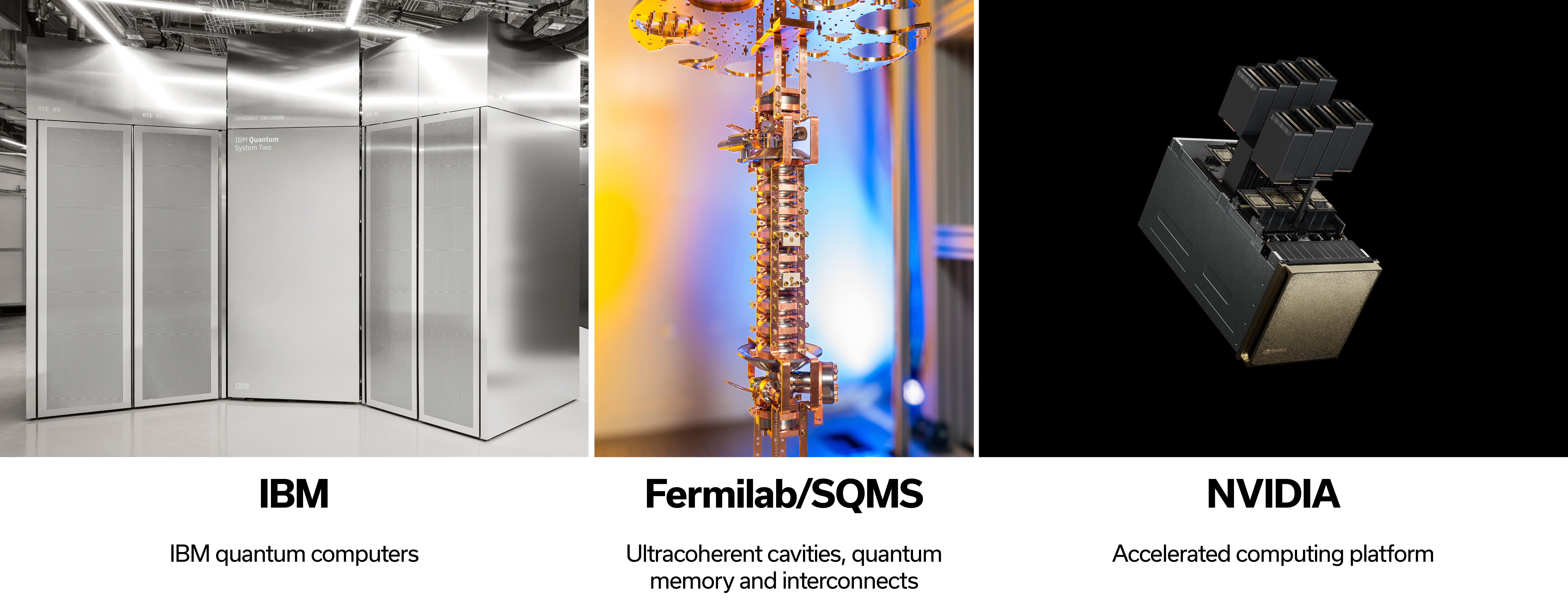
Soon IBM and NVIDIA, together with Fermi National Accelerator Laboratory (Fermilab), will launch a modular quantum computing co-design platform to explore computationally demanding problems in high-energy and nuclear physics. This work aligns with the DOE's Quantum Genesis initiative, which aims to deploy the world's first fault-tolerant, scientifically relevant quantum computing capability by 2028.
Putting quantum to work through the tools HPC workers already use
HPC centers run on schedulers. Slurm, the open-source workload manager that many centers use to queue jobs, decides which job gets which CPUs and GPUs, and when. A quantum processor that sits outside that system leaves researchers to stitch their hybrid jobs together by hand.
QRMI is a thin layer of open-source middleware that lets the scheduler treat a quantum processing unit (QPU) as another resource alongside CPUs and GPUs. With the Slurm plugin for QRMI, a researcher can now request a QPU in a job script much as they would a GPU.
NVIDIA, which acquired Slurm's lead developer, SchedMD, in December 2025, is working with IBM to integrate QRMI with Slurm’s Hierarchical Resources (HRES) feature. In practice, this means people with expertise in HPC already have much of the expertise they need to run hybrid workflows, in ways that feel familiar.
Meanwhile, AMD is working on the classical side of these workflows. In one study with an AMD co-author, moving SQD's classical diagonalization step onto GPUs sped it up about 100-fold per node.
The next step is making hybrid workflows repeatable. IBM recently introduced managed workflows in IBM Quantum Functions. Teams can run and reuse quantum-classical workflows on high-performance infrastructure that IBM manages.
How you can take advantage of this progress today
You can start today with the free IBM Quantum Open Plan on the IBM Quantum Platform.
Academic researchers whose novel, utility-scale projects need more time can apply to IBM Quantum Credits for project-based hardware access. Teams with deadline-driven workloads can buy time through the Flex Plan, and HPC centers that want their own system can work with IBM on a dedicated on-premises quantum computer, like those at RIKEN and Cleveland Clinic.
Where to find IBM at SC26
IBM will be at booth 1806 throughout the conference. IBM researchers and partners will lead workshops and tutorials all week, including “Workload-manager-agnostic QPU integration with QRMI,” the Gordon Bell finalist talk, and “OpenQSE: Building an open quantum-HPC software ecosystem.” See the full schedule here.


