Blog summary:
-
The open-source Quantum Advantage Tracker lets researchers compare quantum and classical methods in real time, enabling a collaborative path toward validated advantage.
-
Rapid-fire community exchanges—much quicker than traditional publishing cycles—drive continuous updates, corrections, and refinements to benchmark experiments.
-
Recent submissions from BlueQubit show how quantum and classical performance can trade places as methods improve, underscoring the need for verification.
-
With 30+ submissions from leading institutions, the Tracker is fostering progress grounded in openness, rigorous testing, and shared exploration of quantum and classical capabilities.
The Quantum Advantage Tracker is a first-of-its-kind, open community effort established to help researchers monitor promising candidates for quantum advantage and systematically evaluate how they stack up against leading classical-only methods. Now, just a few months after its launch, something remarkable is happening. The quantum and classical communities’ leading research organizations and brightest minds are throwing their hats into the ring, engaging in a spirited back-and-forth that will help shape the future of computation.
These developments have made one thing clear: quantum advantage—the point at which quantum computing is shown to be faster, more accurate, or more cost-effective than all classical alone methods for solving some problem in a way that can be rigorously validated—will not come from a single announcement. No single researcher or organization can expect to achieve quantum advantage in a vacuum.
Instead, quantum advantage must emerge through community and collaboration—a back-and-forth exchange between quantum and classical. As one puts forward advantage candidates, the community works to rigorously pressure test those claims, exploring every cutting-edge quantum or classical method that may be able to match the other’s performance, and even developing new methods to do so.
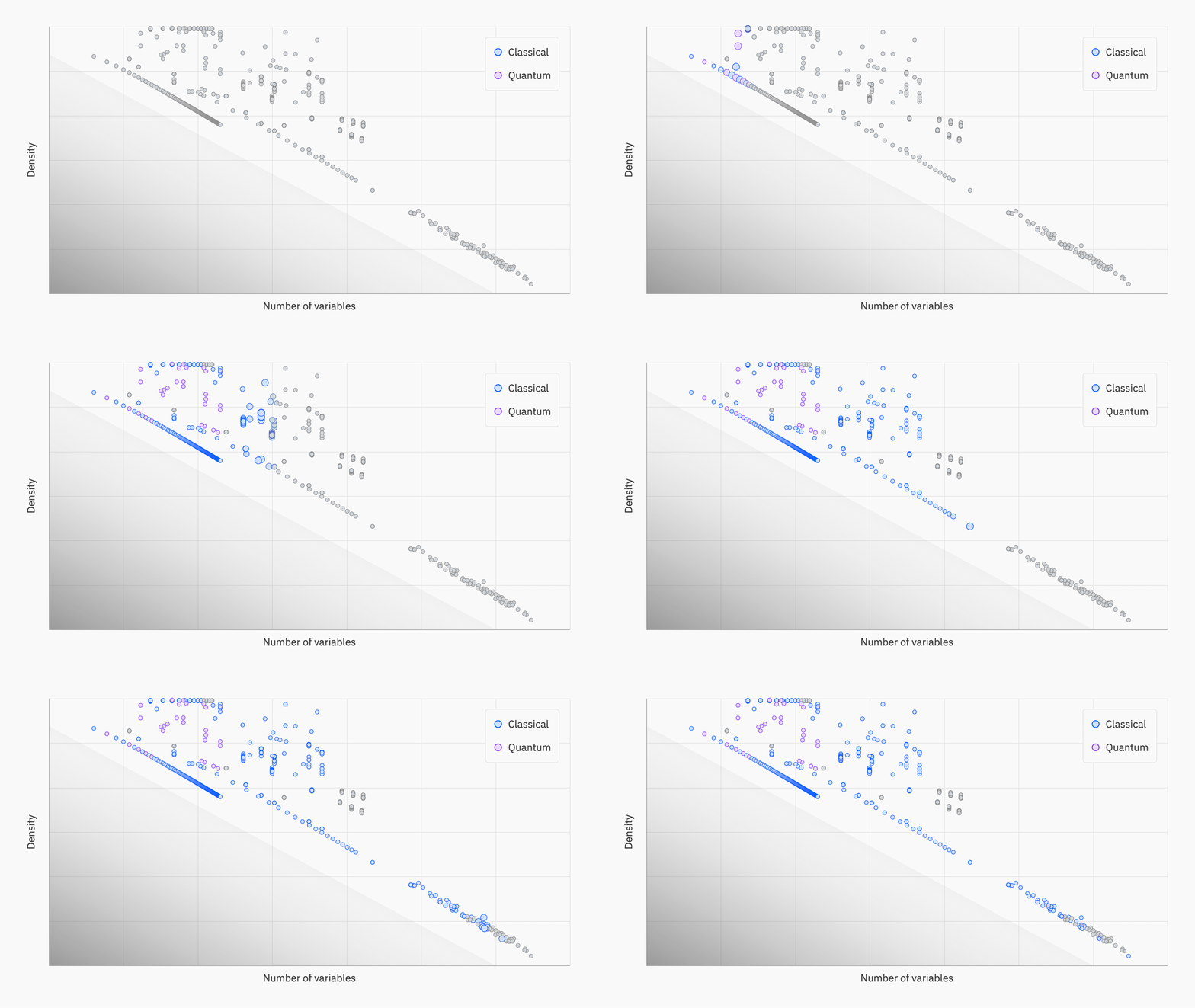
We have now seen 30 submissions on the tracker with experiments run on IBM and Quantinuum hardware, and researchers from leading organizations—Flatiron Institute, BlueQubit, Algorithmiq, Caltech, Los Alamos National Lab, and more—contributing as submitters as well as reviewers.
The tracker aims to support a pace of scientific exchange far faster than traditional publications. Instead of waiting for a new paper every time someone improves their classical method or reruns an experiment on improved hardware, researchers can update results, respond to feedback, and refine claims quickly.
This is a new, open, and accelerated way of doing and reporting science, and we are seeing the dialogue move far faster than the paper-driven cycle. Below, we’ll review an example of how that dialogue is playing out.
Ready to join the journey to verified quantum advantage? Sign up for a free account on IBM Quantum Platform and start running circuits today.
Exploring a heuristic advantage candidate with peaked circuits
A compelling example of the back-and-forth between quantum and classical methods comes from quantum startup BlueQubit, whose researchers have been exploring a type of sampling problem known as peaked circuits using both classical simulations and experiments conducted on Quantinuum’s trapped-ion devices and IBM’s superconducting quantum computers.
Peaked circuits are a variant of random circuits engineered to produce a concentrated, high-probability output bit string, introduced by Aaronson and Zhang1 to address the verifiability challenge of traditional random circuit sampling (RCS). Despite multiple RCS experiments reported across hardware platforms, the absence of verification prevents these demonstrations from constituting valid examples of quantum advantage, as discussed in Ref. 22.
As Aaronson and Zhang succinctly state in Ref. 11, “Over a decade after its proposal, the idea of using quantum computers to sample hard distributions has remained a key path to demonstrating quantum advantage. Yet a severe drawback remains: verification seems to require exponential classical computation.” In contrast, for peaked circuits the identity of the high-probability (“peak”) string is known at the time the circuit is constructed, enabling efficient verification of the peak finding using both quantum and classical methods.
In October, just before the launch of the Advantage Tracker, BlueQubit published quantum and classical results for a peaked-circuit problem instance3. Their quantum experiment, executed on Quantinuum trapped-ion hardware with all-to-all connectivity, delivered an accurate result in about two hours. Their classical method was unable to complete the task in a practical timeframe and they could only extrapolate the classical method’s runtime to 3.2 million years, underscoring how the circuit complexity can overwhelm even state-of-the-art classical simulation methods. BlueQubit would later submit these results to the Advantage Tracker shortly after its launch.

Around the same time, BlueQubit was also working with IBM to explore the same problem instance on IBM Quantum hardware with heavy-hex connectivity. In November, experimental runs on ibm_boston with roughly 4,000 2-qubit entangling gates began to show hints of runtime separation over state-of-the art classical methods from BlueQubit. A second classical method from IBM researchers would then outperform both these methods within a few days.
In December, improvements in gate calibrations led to a 2x increase in median fidelities across the layout on ibm_boston, enabling successful peak-finding on even larger versions of these circuits with 5,000 gates. At this point, the same classical methods from BlueQubit could no longer find the peak, and classical runtimes were estimated at almost 4 months, compared to under 12 minutes on the quantum processor.
By February, new classical methods dramatically changed the picture, delivering accurate simulations of BlueQubit’s problem instances with runtimes ranging from just an hour to mere seconds. These new methods surpassed quantum runtimes on both IBM and Quantinuum hardware—a rapid reversal illustrating why open, iterative testing on the tracker is so important. However, this is just science working—these results will motivate novel circuit design for peaked circuits, and lead to subsequent testing on quantum hardware and classical simulators.
The road to advantage runs through community
This back-and-forth highlights why the Quantum Advantage Tracker matters: it enables continuous community feedback, rapid correction, and iterative understanding without requiring a new paper for each round of exploration. A runtime separation is exciting, but the more important thing about the BlueQubit example and the other submissions so far is how they also refocus attention on the importance of validation. These are crucial steps toward trusted and meaningful demonstrations of quantum advantage.
The Quantum Advantage Tracker welcomes every researcher, organization, and hardware team ready to test ideas, challenge assumptions, and push the fundamental limits of computation. By submitting your work, you join a growing community that is building the future of the field on data, not hype. Are you exploring a promising quantum method? Is your team pushing classical techniques further than you ever expected? Add your latest results today and help chart the path to trusted, verified advantage.