Key takeaways
- Quantum Optimization Benchmarking Library (QOBLIB) provides community-driven framework for tracking progress toward quantum advantage in optimization.
- New Nature Computational Science publication establishes QOBLIB as a foundational resource for quantum optimization benchmarking.
- And new QOBLIB website makes it easier to explore benchmarks, compare results, and contribute new findings.
- More than 2,000 submitted results highlight growing participation from researchers across the quantum and classical optimization communities.
- Open benchmarking efforts like QOBLIB are helping identify where quantum computing may deliver practical value beyond early demonstrations of advantage.
IBM and its partners recently announced a trio of landmark results—three separate experiments in which trusted quantum computations have yielded the first clear demonstrations of quantum advantage. It’s a milestone the community has worked toward for years, and its arrival raises an important new question: Now that we’ve seen quantum computers demonstrate real computational advantage over classical methods, where will we put these capabilities to work?
Optimization is quickly emerging as one of the most compelling places to look. It wasn’t a focus in last week’s advantage demonstrations, but it sits high on the list of domains where researchers expect to see the next breakthroughs. Recent research from the Quantum Optimization Working Group has produced promising algorithmic candidates for near-term advantage, while the growing community around our Quantum Optimization Benchmarking Library (QOBLIB) has brought much-needed rigor and collaboration to the search. Today, that effort is building momentum with a foundational publication in Nature Computational Science, a new website, and a fresh slate of results submitted by partners across the ecosystem.
These updates aren’t just housekeeping for a growing research repository—they’re a model for where the quantum community is heading next. Proving that quantum advantage is possible was one challenge; discovering where it will deliver real-world value is another. That work calls for open, rigorous, community-driven collaboration rather than isolated effort.
QOBLIB is built for exactly that. As one of the first quantum optimization benchmarking frameworks of its kind, it gives the optimization community a shared, transparent way of seeing which problem classes are drawing closest to practical quantum advantage. More than that, it brings classical and quantum researchers together in pushing those problems further. It’s an approach we expect will extend well beyond optimization in the months and years ahead.What other community initiatives are benchmarking the path to quantum advantage? QOBLIB isn’t the only open-source, community-driven effort working to benchmark the road to advantage. Another is the Quantum Advantage Tracker, which monitors promising advantage candidates across disciplines and evaluates them against leading classical methods.
What is QOBLIB?
The Quantum Optimization Benchmarking Library (QOBLIB) is an open-source, community-driven collection of ten challenging optimization problem classes—an “intractable decathlon”—along with the metrics, baselines, and tooling researchers need to test and compare quantum and classical methods on equal footing.QOBLIB was developed by the Quantum Optimization Working Group with contributions from organizations such as Zuse Institute Berlin, Technische Universität Berlin, Purdue University, the National University of Singapore, E.ON Digital Technology GmbH, Kipu Quantum, Forschungszentrum Jülich, the University of Southern California, IBM Quantum, and additional partners from academia and industry.
First shared as an arXiv preprint and open-source GitHub repository in 2025, QOBLIB was built to help the community track progress toward quantum advantage in optimization. The ten problem classes were chosen because they become hard for state-of-the-art classical solvers even at relatively small sizes, yet remain within reach of near-term quantum hardware.
Read the paper in Nature Computational Science and learn more about the founding of QOBLIB.
Why the search for advantage runs through benchmarking
Most of the optimization algorithms researchers use in practice—classical and quantum alike—are heuristics: methods that generally return good solutions across problem classes, but which offer no a priori performance guarantees for any given instance. That makes rigorous benchmarking essential. In optimization, you cannot prove quantum advantage with theory. You have to demonstrate it.
That’s a high bar. Credible claims of advantage in optimization require more than simply outperforming one classical approach. You need to beat the strongest classical methods available, and the classical optimization community has produced many formidable approaches over decades of research. No single researcher or research group can run that gauntlet alone.
QOBLIB brings the community together around a shared set of challenging, practically motivated problem classes, common evaluation standards, and transparent baselines. The open-source Quantum Advantage Tracker has already shown the value of this model, which will continue to be essential in the post-advantage landscape. Benchmarking efforts like these will help researchers make fair comparisons and track real progress not just in optimization but across disciplines.
Introducing the QOBLIB website
Alongside the new publication, we’ve built a dedicated QOBLIB website, making it easier than ever to explore the benchmarks, see how the field is progressing, and contribute your own results.
The site is organized around the ten problem classes and their instances, over 1,200 in total with 500+ already solved to optimality. A complexity-landscape visualization maps every instance by size and density, so you can quickly see where the hardest and most interesting problems lie.
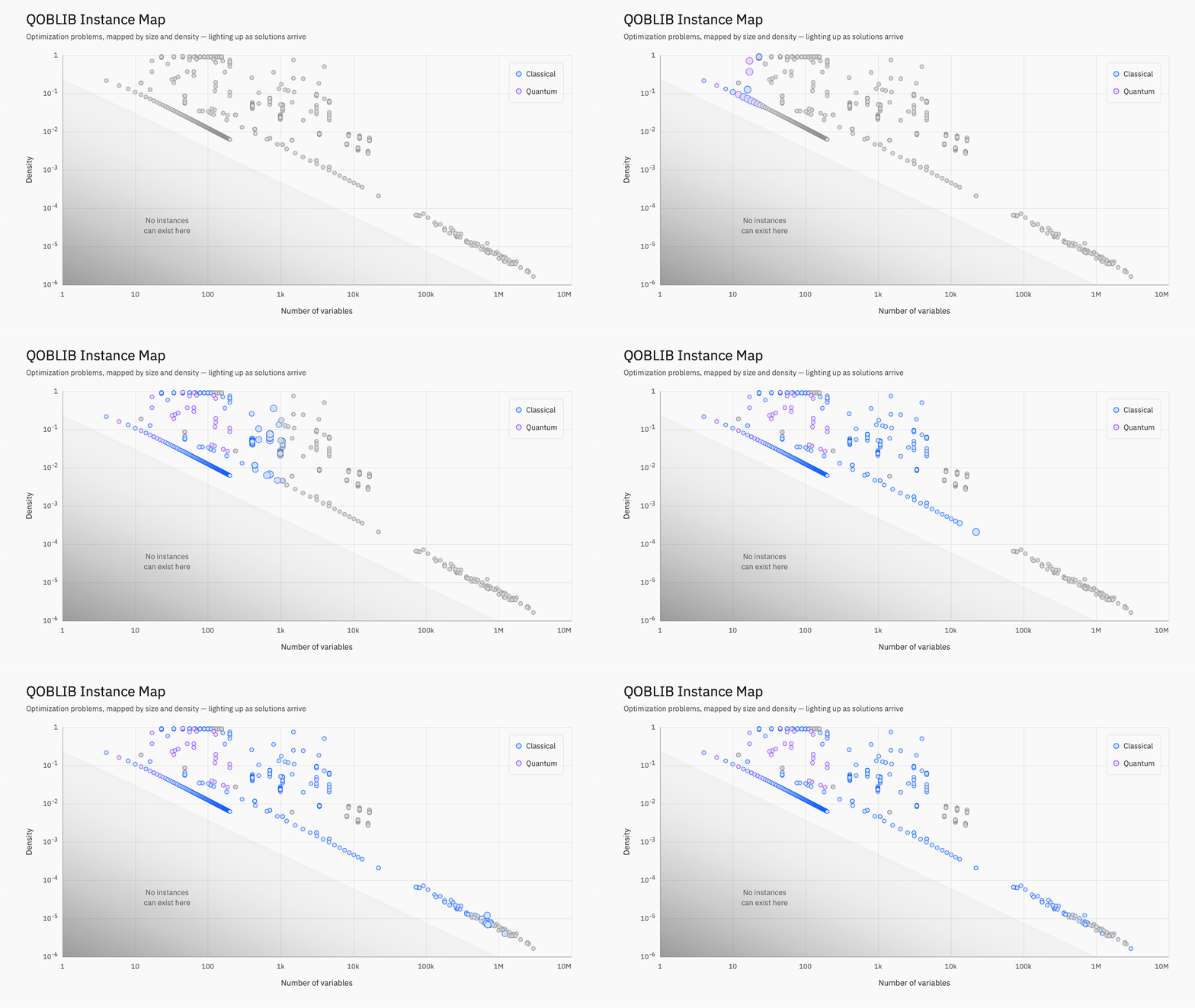
It also includes a live page that tracks the best-known result for each instance, along with who achieved it and their affiliation. This makes the library a public, running account of the state of the art. This means anyone can see how their methods compare with others, and every contributor gets visible credit for their work.
Most importantly, contributing is easy. A guided Submission Builder walks you through the process, validates results, and exports files ready to open as a pull request, lowering the barrier to entry for classical and quantum researchers alike.
Ready to join the effort? Explore the problem classes and build a submission of your own at the QOBLIB website.
A growing community
When QOBLIB first launched, a central goal was to draw contributions from across the research community. Now, we’re seeing that happen in real time.
With 2,000+ results already submitted and logged, the library has evolved into a living resource that reflects the field’s latest progress. And it’s growing again with a fresh slate of quantum contributions from leading organizations across the quantum ecosystem, including E.ON, Forschungszentrum Jülich, and the STFC Hartree Centre. New results have also been submitted by Aqarios, Global Data Quantum, JIJ, Kipu Quantum, ParityQC, Q-CTRL, Qoro and Qunova, all members of the IBM Quantum Startup Program.Is your organization building quantum optimization solutions? Learn more about the IBM Quantum Startup Program and explore available offerings from our startup partners in the Qiskit Functions Catalog.
Taken together, these contributions show where the field stands today. They give us a sense of how quantum approaches are gaining traction, and how much ground still separates them from the best classical solvers. And because that gap is itself a moving target—with both quantum and classical methods constantly improving—measuring the state of the art is what allows us to measure progress.
Progress isn’t only quantum. QOBLIB was built to track both quantum and classical paradigms side by side, so it also captures how classical methods have advanced since the library’s launch. This is essential for QOBLIB’s success: A claim of quantum advantage is only as strong as the classical baseline behind it, and that baseline keeps climbing.
The market split problem is a good example. Since QOBLIB’s launch, the largest solved market split problem instances in the repository have grown from roughly 60 to 110 variables, i.e., the size of problems solved nearly doubled. That raises the bar that quantum methods must clear to demonstrate advantage, but it also makes any future advantage claim in that problem class much more credible.
Add your results
The search for quantum advantage in optimization is a community effort, and it advances with every result you contribute. If you work in optimization, whether classical or quantum, we want your results. Best known solutions, quantum runs, and even informative negative results all help improve our understanding of where quantum methods stand today.
In addition to result submissions, also welcome suggestions for new problem classes. Deciding what belongs in QOBLIB is a conversation in which the whole community should take part. The selection process is necessarily rigorous, but we’re always happy to consider new ideas, and we look forward to your contributions.
Are you a faculty member or professional researcher pursuing quantum optimization research that requires hardware access beyond the IBM Quantum Open Plan? The IBM Quantum Credits program offers free access to IBM’s most advanced quantum systems for high-impact, utility-scale projects.
- Read the paper in Nature Computational Science →
- Explore the QOBLIB website →
- Build and submit your results →
- Apply for IBM Quantum Credits →
Our goal is a demonstration of quantum advantage in optimization that earns the confidence of both the quantum and classical research communities. That's a milestone none of us will reach alone, but every benchmark you contribute brings it closer.


