
Key takeaways:
- Quantum error mitigation and error correction are both extending the path to useful quantum computing before full fault-tolerant quantum computing, with emerging error-correction techniques already demonstrating ~10x lower effective error rates than the underlying physical hardware.
- Hybrid error-correcting techniques can improve reliability while reducing the resources required for useful computations. Current results show 63x reduction in the inferred sampling overhead compared to error mitigation techniques alone.
- Conditional methods enable partially fault-tolerant architectures to reach universal quantum computation while avoiding some of the significant resource overheads of traditional fault-tolerant approaches.
- Hierarchical codes provide a route to substantially reduced error rates without the need to build greater complexity into the chip, relaxing the physics and engineering requirements for reaching trillions of operations.
- IBM Quantum Platform and Qiskit provide quantum information scientists access to every layer of the stack, from pulse-level capabilities through compilation and execution, enabling new approaches to quantum error correction and device characterization.
Quantum error mitigation and quantum error correction are often framed as tools for different eras of quantum computing: mitigation for near-term devices and correction for scalable fault tolerance. In practice, however, we see a continuous path from error mitigation to error correction. Optimizing across a spectrum of error-correcting techniques is key to scaling from trusted quantum computations to applications that matter for the world.
Removing errors on quantum computations typically involves a tradeoff between time (samples) and space (qubits). The most time-efficient means of removing errors is quantum error correction, where quantum information is encoded into logical qubits so errors can be corrected during or after a circuit is executed. While full quantum error correction can enable reliable computations with a single shot, it comes with a significant overhead of qubits and gates. For this reason, it requires more complex hardware than is available today—hardware with lower error rates, long-range connections, and real-time decoders.
On the other end of the continuum is error mitigation, where circuits are run repeatedly to reduce or eliminate the effect of noise. These repeated samples incur cost at a rate that is exponential relative to the amount of noise in the system—an overhead that can be reduced by incorporating classical HPC. Error mitigation methods such as shaded lightcones, propagated noise absorption, and tensor network error mitigation trade bias and classical runtime in exchange for lower quantum sampling costs, allowing larger circuit volumes to be error-mitigated at fixed error rates.
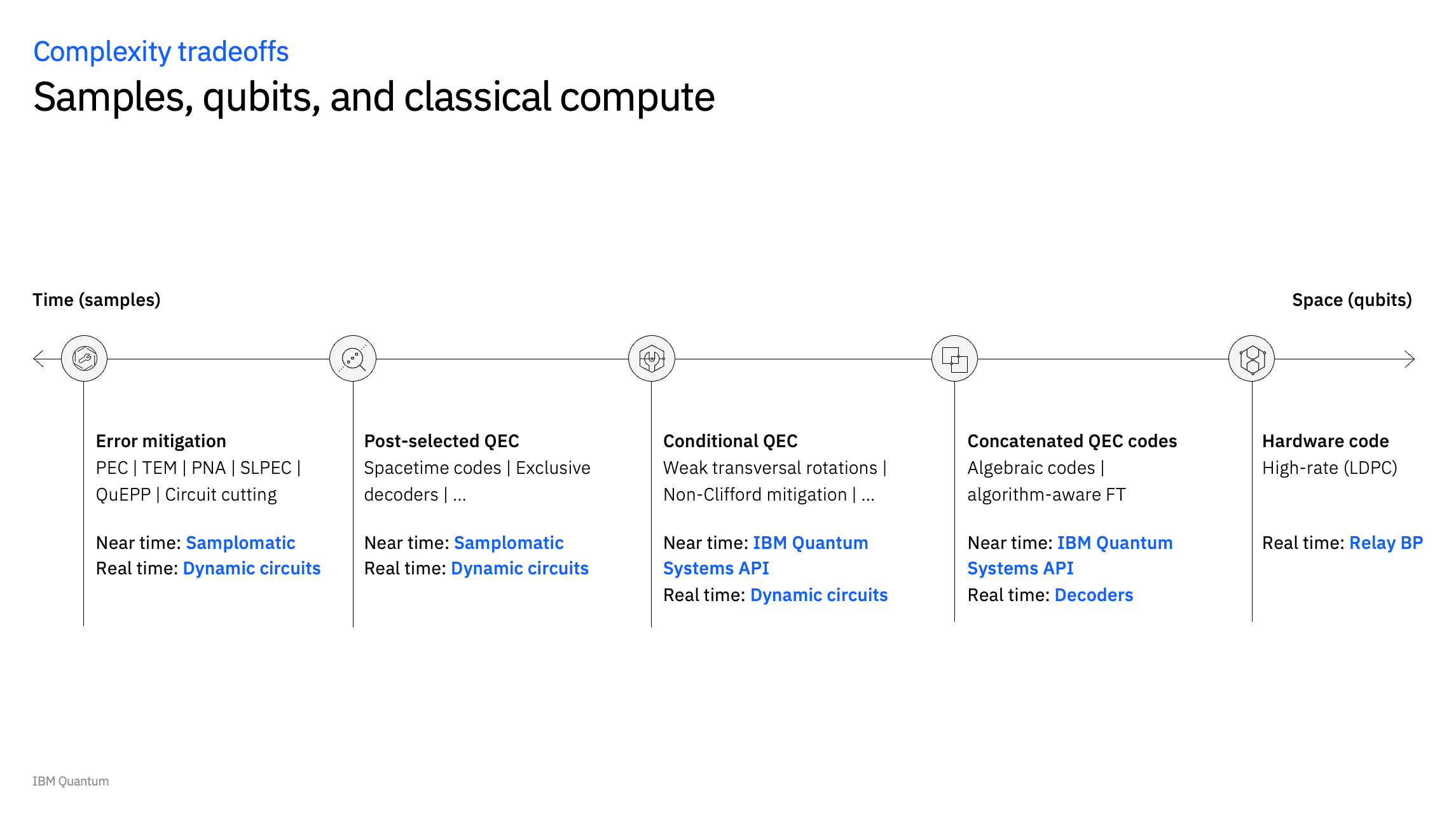
Recently, error mitigation techniques like probabilistic error cancellation (PEC) have enabled researchers to run computations on today’s quantum hardware that are beyond the reach of classical verification while also validating the accuracy of the outputs, opening a new era of quantum advantage through trusted computations. By learning and validating a representative noise model, we can trust that mitigating the errors gives us unbiased results.
As we move from computations on physical qubits toward logical computations, quantum error-correcting codes will remove errors more efficiently—but not entirely. Charting the path to useful quantum computing therefore requires that we combine error mitigation, detection, and correction techniques to derive the optimal tradeoff between hardware capabilities and cost. What ultimately matters for useful quantum computation is not what constitutes a logical qubit, but the size of the circuit you can run with the available error-correcting tools.
Explore the continuum from error mitigation to error correction yourself with the tutorials and learning resources on IBM Quantum Platform. New users can create a free account and get started today.
Hybrid QEC/QEM methods: The bridge to 100M operations
Conventional quantum error correction is spatially demanding, as it encodes quantum information into more qubits than might be reachable with current technology. To bridge the gap between error-mitigated and fault-tolerant quantum computers, we need hardware-efficient implementations of error-correcting techniques. Spacetime codes offer such an approach, distributing low-weight Pauli checks across both space and time in a quantum circuit so that they are amenable to implementation in current quantum hardware.
Post-selected quantum error correction based on spacetime codes uses ancilla qubits to encode and perform the computation in a different vector space than the raw qubits, giving us a logical circuit. When a hardware run does not satisfy all of the low-weight Pauli checks, it is flagged as having errors and discarded. This method offers a means of removing errors with a sampling overhead that is quartically better than PEC, making it a useful tool for running increasingly complex circuits.1
To that end, a recent demonstration encoding 64 logical qubits in spacetime codes using 76 physical qubits, doped with 314 T gates, yielded a roughly 10x effective improvement in gate error rates after syndrome post-selection for a hard-to-simulate circuit with 2,336 CZ gates, while also maintaining a fidelity lower bound of 0.349 with 95% confidence.2 The open-source toolkit Qiskit Paulice enables researchers to start implementing this protocol today so they can experiment with resource tradeoffs to boost the fidelity of sampled distributions.Read our recent blog to learn more about Qiskit Paulice.
While post-selection simplifies the noise model, it does not remove errors entirely—some noise still evades the symmetry checks. A new preprint reveals that combining this error-detecting protocol with PEC can counteract quantum noise more effectively than either technique alone, while also producing converged expectation values using far fewer shots than PEC requires on its own.3 By layering post-selected quantum error correction with PEC, researchers can explore the potential for hybrid QEC/QEM approaches to scale advantage experiments into practical applications before full fault tolerance.Access the tutorial to try it for yourself.
The same principles apply when we’re working at the level of logical qubits. Quantum error-correcting codes remove errors only up to a point, depending on their code distance and the noise on the hardware. By learning the residual noise affecting the circuit, we expect to extract better performance from logical qubits.
IBM provides the quantum error-correcting stack to experiment across mitigation, detection, and correction techniques. We allow a fine level of access beyond regular gates and measurements. These pulse-level capabilities include control over timing of pulses, access to customized calibrations for individual gates, and soft information from measurements beyond the binary classification.
With dynamical decoupling, users can add pulse sequences to idle qubits to flip them around the Bloch sphere, canceling the effect of noise channels. Dynamic circuits, which combine real-time classical processing with mid-circuit measurements and feed-forward operations, enable continuous adaptation based on measurement outcomes obtained during circuit execution, allowing corrective actions to be applied in real time. This control infrastructure is already available through the IBM Quantum Compute Service for researchers to start exploring today.Learn more about dynamic circuits in our documentation.
Additionally, our directed execution model now provides even more control and transparency—without sacrificing performance. Released as a beta service late last year, the directed execution model made error mitigation configurable on the client side to enable experimentation with advanced error mitigation capabilities. Now the interface is becoming even more flexible, adding tools to streamline common tasks such as debugging and noise learning while still leveraging the runtime environment that enables circuits to be executed efficiently on large systems.
When used in tandem with packages such as qiskit-noise-learning, qiskit-mitigation, and Samplomatic, the directed execution model allows quantum information scientists to design custom noise learning protocols, implement modular error mitigation strategies, and customize sampling randomizations, respectively. In addition, researchers can now use the Executor primitive to return state information together with kerneled results (known as IQ points), exposing soft information about measurement outcomes.
By making richer measurement data available, this capability enables new avenues of research in quantum error correction and device characterization. Researchers can move beyond binary measurement outcomes to incorporate confidence information into decoding, state verification, and leakage analysis, unlocking more sophisticated approaches to understanding and improving quantum systems.
Conditional quantum error correction
As we begin to run gates at the logical level, Clifford gate errors become cheap to mitigate while non-Clifford operations (for example, T gates) are more expensive. Typical approaches to implementing fault-tolerant T gates rely on magic state injection and magic state distillation, which require a hardware complexity likely unavailable until the fault-tolerant era. Conditional quantum error correction methods offer a stepping-stone to full error correction by enabling the provisional application of quantum error-correcting codes based on noise channel information.
For example, one promising research direction explores a framework for implementing encoded Clifford + T circuits by protecting Clifford gates with error correction and then mitigating errors from noisy encoded T gates.4 This is accomplished using the quasiprobability method, in which a noisy quantum computer simulates a noise-free quantum computer, producing the correct expected values of measurement observables. Because only the T gates require error mitigation, the mitigation overhead becomes much more manageable, enhancing the potential for early error-corrected machines to produce useful quantum computations.
A second research thread considers whether the requirements for transversal gates—operations common in fault-tolerant quantum computing—can be relaxed to avoid the overhead of rotation synthesis, magic state factories, and teleportation routing.5 Rather than insisting that transversal gates be applied perfectly every time, this approach employs weak transversal rotations that are resolved conditionally based on the measurement of code syndromes. The rotations are implemented directly on the encoded qubits, allowing incorrect syndrome branches to be discarded, or repeated until successful. By executing rotation gates more naturally and in parallel while avoiding many of the overheads of magic state distillation, this technique could reduce runtime by tens to hundreds of times compared to conventional Clifford + T approaches, opening a new pathway to fault-tolerant quantum computing with far less overhead.
Hierarchical quantum error correction
Progressing along the QEC continuum, algebraic codes rely on mathematical structures like polynomials, vector spaces, and finite fields to protect quantum information while enabling simpler decoding and lower qubit counts. Although algebraic codes can become cumbersome for larger quantum systems, for which qLDPC codes offer a more attractive option, they present many potential benefits as outer codes in hierarchical QEC architectures.
Concatenated (hierarchical) codes layer algebraic codes on top of qLDPC codes, extending the protection of the qLDPC codes without requiring larger modules. With this approach, the inner code’s own logical operations supply the long-range connectivity the outer code needs—so that connectivity comes from the code, not from additional hardware.6 That trade relaxes a major engineering constraint at a modest overhead: concatenating quantum Reed-Solomon codes over a high-rate inner code reaches the regime of 1012 logical operations with a physical error rate of 10-3 using a module with significantly reduced engineering complexity.
While real-time hierarchical quantum error correction is not directly accessible with current-generation systems, our reference architecture for quantum-centric supercomputing shows how future systems could enable this mode of operation using co-located classical systems comprised of CPUs, GPUs, and/or specialized accelerators interacting with the QPU.7 As the programmatic boundary between the tightly coupled real-time layer and the rest of the system architecture, the IBM Quantum Systems API will foster the ability to run timely feedback from syndrome measurements or between layers of a code hierarchy. As this architecture evolves, deepening the integration between quantum and classical computing systems, it will increasingly support research on hybrid error-correcting schemes and outer codes for hierarchical error correction.
Our north star remains fault tolerance
From error mitigation to error correction, there is a spectrum of techniques that are ripe for exploration to advance useful quantum computation before fault tolerance. IBM offers the platform necessary to optimize tradeoffs across this spectrum and improve the reliability of computations, supporting the transition from error-handling methods that require many samples but fewer qubits to those that require many qubits but fewer samples. Even in the era of fault-tolerant quantum computing, we expect error mitigation and post-selection to work together with qLDPC error correction to provide better logical performance with the same hardware.
Fault tolerance remains our north star, and we continue to make steady progress toward realizing our first fault-tolerant quantum computer, IBM Quantum Starling. In the meantime, our newly released IBM Quantum Nighthawk r2 offers a platform to explore quantum error correction in conjunction with capabilities from Qiskit and the IBM Quantum Compute Service. Incorporating components from our fault-tolerant roadmap such as high-speed, independent qubit reset, Nighthawk r2 accelerates cycles of learning for making critical physical circuit elements closely tied to those necessary for hardware codes.
With hardware and software progress enabling trusted quantum computations through logical encoding, it’s clear that quantum computing has entered its logical circuit era. What matters now is the complexity of the work that can be achieved using available error-correcting techniques. Just how these capabilities will evolve and integrate to create the optimal quantum error correction stack remains an open question for the community. You can explore that question today using open-source Qiskit tools and the enhanced directed execution model available through the IBM Quantum Compute Service.


