Blog summary:
- Qiskit Functions make it easier than ever for researchers to run large‑scale quantum experiments without deep quantum expertise.
- The addition of new functions and tutorials help users solve problems across use cases in chemistry, optimization, PDEs, and machine learning.
- New features make running, debugging, and analyzing quantum workflows faster and more intuitive.
- Academic, startup, and enterprise teams are already scaling experiments to record qubit and gate counts using Qiskit Functions.
- Premium and Flex Plan users can request free trials for any Qiskit Function.
- Eligible Premium Plan organizations can request a free one-year license between now and 31 March.
Qiskit Functions launched in 2024—a year earlier than predicted by that year’s IBM Quantum Roadmap—and in 2025 we made it bigger, better, and even easier to use. Now, to kick off 2026, we’re taking a look at some of the new features and functions that are making the Qiskit Functions Catalog a one-stop shop for applications researchers looking to quickly get up and running with large-scale quantum experiments.
The Qiskit Functions Catalog is a collection of abstractions developed by our partners in the IBM Quantum ecosystem to help accelerate quantum applications research. These abstractions—the Qiskit Functions—are pre-built software services that automate key portions of the typical quantum workflow. That means researchers can spend less time learning the ins and outs of deploying quantum workloads, and more time exploring the value that quantum methods may bring to their use cases.
Today, the Qiskit Functions Catalog includes nearly a dozen functions in areas like quantum error-handling, partial differential equations, chemistry simulation, optimization, and machine learning. They fall into two overarching categories:
-
Application functions are built to help applications researchers quickly and easily get started exploring quantum methods for their use cases, no prior quantum computing experience necessary. You submit classical inputs, and the function maps your problem to quantum circuits and executes your workload at full system scale.
-
Circuit functions are built for those who work more directly with quantum circuits. You pass in abstract circuits and observables, and the circuit function optimizes, executes and post-processes your inputs with a unique blend of capabilities covering transpilation, error suppression, error mitigation, and flexible time vs. accuracy trade-offs to suit your needs.
Premium and Flex Plan users can start exploring Qiskit Functions today by requesting a free trial for any function in the Qiskit Functions Catalog here. Just select the function you’re interested in and click the blue “Request a free trial” button to get started.
Additionally, eligible organizations on the IBM Quantum Premium Plan can request a free one-year license for Qiskit Functions any time between now and 31 March. Plan administrators can contact their IBM Quantum engagement manager to learn more.
New user-friendly features and resources
Since day one, we’ve worked closely with our Qiskit Functions partners to deliver improvements that simplify the process of running, debugging, and analyzing experiments. These updates are designed to help you iterate faster and gain deeper insights with less friction. They include:
Improvements to run more concurrent experiments: You can run up to 4 concurrent experiments to speed up your research iterations. While each experiment runs, you’ll have detailed visibility into its current state across quantum and classical stages—such as mapping, hardware optimization, execution on the QPU, and post-processing.
Smarter analysis and resource insights: Once your experiment completes, the new workload summary provides a detailed view of how CPUs, GPUs, and QPUs were used throughout your workflow. These insights—along with advanced classical error mitigation techniques—help you make informed trade-offs between classical and quantum resources in your experiments, and you can pull them directly from your job results with a single line of code:
job.result()['metadata']['resource_usage']Here’s an example of what your workload summary might look like in practice.
{
    'RUNNING: OPTIMIZING_FOR_HARDWARE': {'CPU_TIME': 0.915754},
    'RUNNING: WAITING_FOR_QPU': {'CPU_TIME': 18.804865},
    'RUNNING: POST_PROCESSING': {'CPU_TIME': 10.433445},
    'RUNNING: EXECUTING_QPU': {'QPU_TIME': 159.0}}
}Coming soon—more real-time visibility: In the near future, you’ll also be able to fetch real-time logs enriched with useful metadata at each stage, like two-qubit reduction after transpilation. And if something goes wrong, clear error messages will help you quickly diagnose and restart your experiment.
Brand new tutorials: Over the past year, we’ve published a number of high-quality tutorials with detailed code examples that walk you through the process of using Qiskit functions to solve specific problems. They include:
- Solve the Market Split problem with Kipu Quantum's Iskay Quantum Optimizer
- Simulate 2D tilted-field Ising with the QESEM function
- Quantum Phase Estimation with Q-CTRL's Qiskit Functions
- Model a flowing non-viscous fluid using QUICK-PDE
- Hybrid quantum-enhanced ensemble classification (grid stability workflow)
Expanding functions roster helps research organizations speed up productivity
Alongside these improvements, the Qiskit Functions Catalog has continued to build its roster of functions to enable diverse applications across industries and research domains. In 2025, we saw many examples of how Qiskit Functions both new and old are helping academics, startups, and even enterprise research organizations scale experiments in days rather than months—and we expect to see even more in the year ahead.
For example, in academia, researchers from Yonsei University are leveraging Qunova’s HI-VQE function to scale to larger molecule sizes when generating potential energy surface curves—accelerating progress in quantum chemistry research. In new research, the Yonsei team was able to extend their experiments to up to 44 qubits and over 96 two-qubit CNOT gates with the HI-VQE function. University of Tokyo researchers saw similar benefits from Qedma’s QESEM function, using it in their study of quantum many body scars to scale their experiments up to 25 qubits and 1440 two-qubit gates (across 60 Trotter steps).
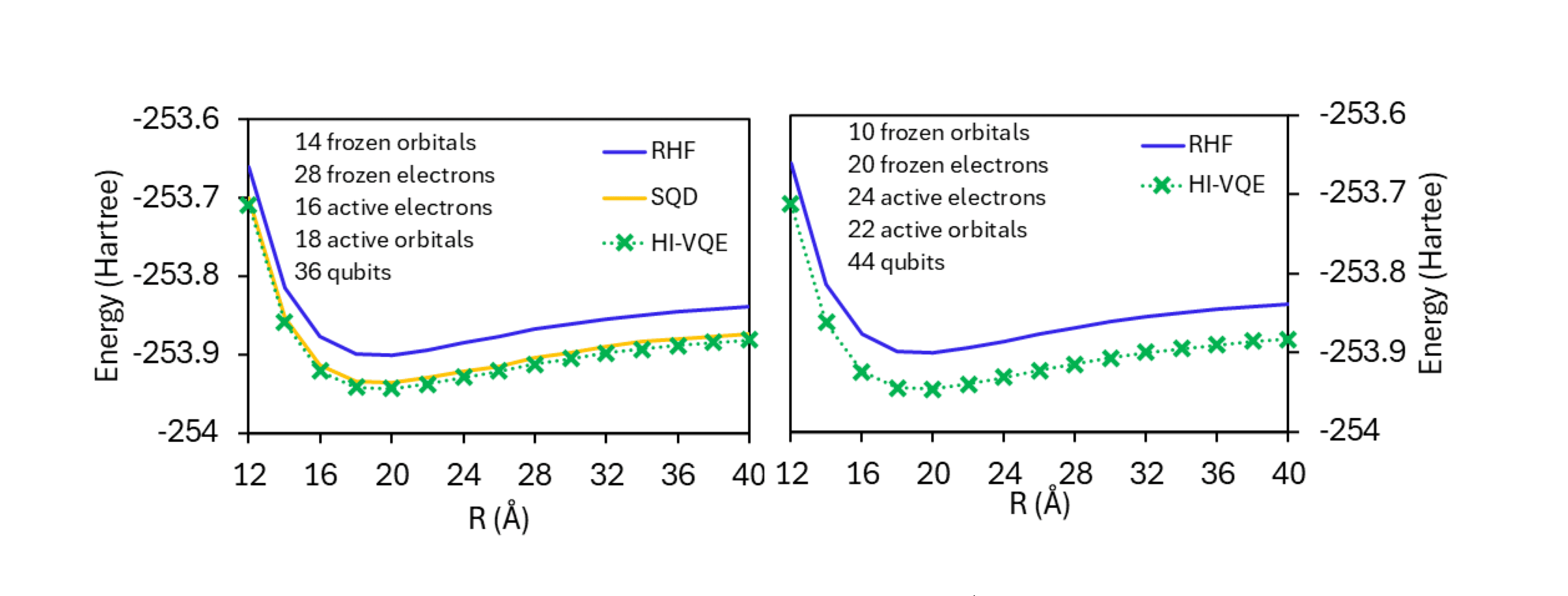
Figure 4 from the recent paper by researchers at Yonsei University and IBM. "Ground-state energy profiles of the pyridine-Li⁺ complex obtained using RHF, SQD, and HI-VQE methods for two different active-space configurations. The left panel corresponds to 16 active electrons in 18 active spatial orbitals (16e,18o), mapped onto 36 qubits, while the right panel shows results for 24 active electrons in 22 active spatial orbitals (24e,22o), mapped onto 44 qubits. ...The HI-VQE method successfully produces smooth and stable potential energy curves, demonstrating its scalability and reliability for systems beyond the reach of classical and other sample-based quantum algorithms."
In enterprise, teams at E.ON, SoftBank, Mitsubishi Chemical, and Qubit Pharmaceuticals have used Q-CTRL’s Performance Management and Optimization Solver functions to achieve better results and scale experiments beyond previous benchmarks.
- E.ON, for example, used the Performance Management function to achieve a clear, optimal solution to a real-world design problem called the DC-DC boost converter filter.
- SoftBank used it to accurately measure the spectral gap of a supersymmetric Hamiltonian, traditionally a computational bottleneck.
- Mitsubishi Chemical used it to extend Quantum Phase Estimation algorithmic circuits to a scale of up to 52 qubits and 5,000+ two-qubit gates, a world record.
- Meanwhile, Qubit Pharmaceuticals recently used Q-CTRL’s Optimization Solver to execute a drug-discovery workload at up to 123 qubits and 2,000 two-qubit gates, solving real hydration-site prediction tasks and delivering outcomes matching classical precision.
Last year, we predicted that circuit functions would play a key role in accelerating new application development. That prediction is already coming true. One of our startup partners, ColibriTD, is using Q-CTRL’s Performance Management circuit function to scale its differential equation solver to 144 qubits while improving accuracy by 61%.
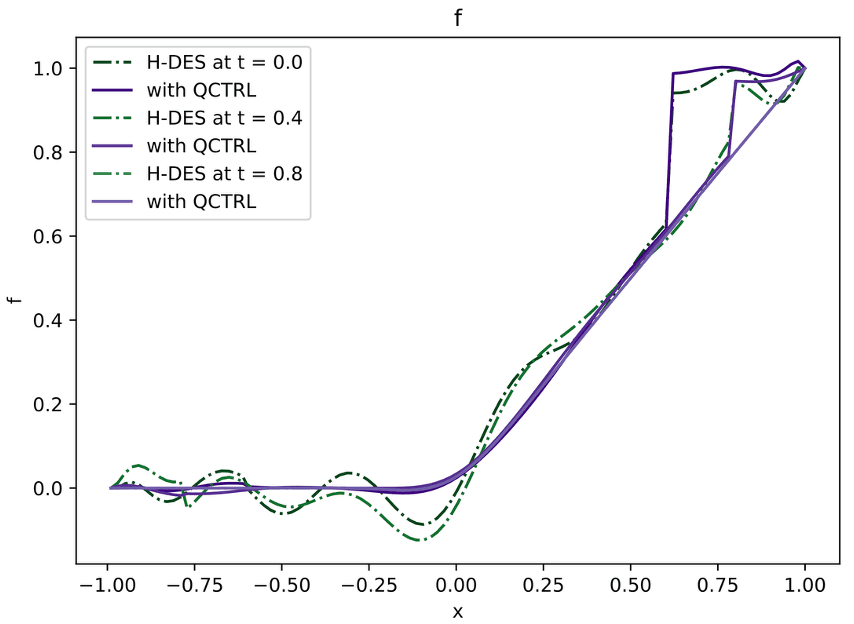
ColibriTD scaled its QUICK-PDE application function to 144 qubits and improved accuracy by 61% during exploration with Q-CTRL Performance Management circuit function.
Examples like these highlight how Qiskit Functions are enabling industry and academic researchers to dive into utility-scale quantum experiments, explore valuable application areas, and push the boundaries of what’s possible with quantum computing.
Functions in action
Let’s take a look at some example code from Qubit Pharmaceuticals to illustrate how functions like Q-CTRL’s Optimization Solver make running classical problems on quantum hardware simple. The following code loads the Optimization Solver from the Functions Catalog and then reads the optimization problem — in this case a classical QUBO matrix representing a binary optimization task:
from qiskit_ibm_catalog import QiskitFunctionsCatalog

catalog = QiskitFunctionsCatalog(channel="ibm_quantum_platform",instance=instance, token=token)

solver = catalog.load("q-ctrl/optimization-solver")

with open('Q_matrix_nparray_3b7eL_71_variables.pkl', 'rb') as file:
qubo_matrix = pickle.load(file)Next, we convert the QUBO matrix into a polynomial cost function, run it with the solver on the ibm_pittsburgh backend, and obtain our results:
n_var = len(qubo_matrix)
variables = symarray("n", n_var)
cost = Poly(0, *variables)

for i in range(n_var):
    # linear terms
    cost += qubo_matrix[i, i] * variables[i]
    # quadratic terms
    for j in range(i+1, n_var):
        cost += 2 * qubo_matrix[i, j] * variables[i] * variables[j]

cost_function = Poly(cost, *variables)

job = solver.run(
    problem=str(cost_function),
    backend_name="ibm_pittsburgh",
)

result = job.result()
plot_top_bitstrings_cost(result['final_bitstring_distribution'], cost_function, top_k=50)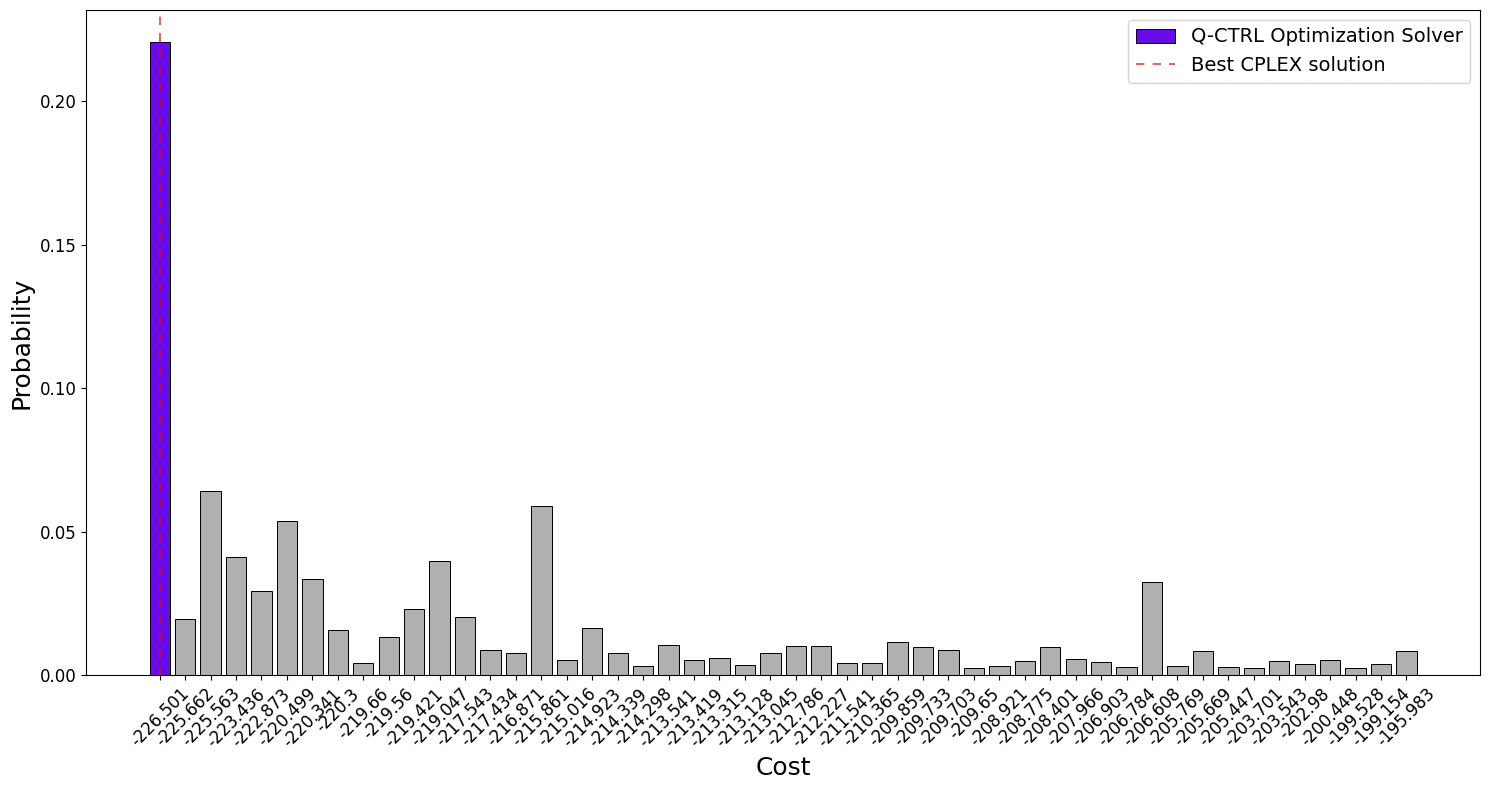
Just two years ago, executing a problem like this on a quantum computer would have required hand-constructed quantum circuits and a sophisticated understanding of the inner workings of quantum hardware. With Qiskit Functions, we can abstract away the complexity of building quantum workloads and accomplish the same task with a single function call.
In other words, researchers can focus on exploring the potential for quantum advantage in their domains, without needing to become quantum computing experts in the process.
Free trials for Premium and Flex Plan users
Ready to explore these new capabilities? As a reminder, Premium and Flex Plan users can get started with free trials across the entire Qiskit Functions Catalog. Additionally, eligible organizations on the IBM Quantum Premium Plan can request a free one-year license for Qiskit Functions any time between now and 31 March. Visit the Qiskit Functions Catalog here to get started.
We’ve built Qiskit Functions to make quantum experimentation faster, easier, and more accessible. Now is the perfect time to try them out and see how collaboration across our ecosystem can help unlock quantum advantage.