
Embrace
Embrace the ecosystem opportunity in strategic intent and business platform design as a driver of accelerated digital transformation
The ability to apply AI, automation, blockchain, the Internet of Things, 5G, cloud, and quantum computing at scale has made the promise of Cognitive Enterprises real.
As we place this revolution in the context of an increasingly virtual world, we see even more power arising from the ecosystems, digital workflows, and networked organizations that are made possible. The Virtual Enterprise is emerging, supported by a “Golden Thread” of value that animates the enterprise and binds ecosystem participants.
Over the past few years, we have moved toward a tipping point where enterprises across the world have looked to leverage technology holistically to transform their business models. We have seen digital transformation move from the front or edge of the organization to deep into the core. At the same time, technologies such as AI, automation, Internet of Things (IoT), blockchain, and 5G have reached a level of maturity that can be leveraged at scale to drive real impact on business outcomes.
Organizations across all industries are seeking to become technology, platform, and experience companies. We have called this evolution the emergence of Cognitive Enterprises, which are brought to life by the imagining of market-making platforms, the shaping of Intelligent Workflows, and a deeper focus on experience and humanity.
The COVID crisis has had its impact on these Cognitive Enterprises. It has accelerated digital transformation journeys; reinforced the importance of applying exponential technologies to produce more efficient, effective, and flexible processes; and clarified the case for the leverage of hybrid cloud infrastructures to deliver adaptive consumption models and services. We have seen that the three main building blocks of the Cognitive Enterprise have been stretched by the new reality.
Market-making business platforms have had to digitize even more quickly and extend their remit wider into new ecosystems and partners; Intelligent Workflows have had to prioritize the use of extreme automation and AI to meet mass customer and employee connectivity and service needs; and new definitions of experience and humanity have emerged from the need to keep customers, employees, and citizens safe and healthy.
The truth is that the virtualization which has been forced by the pandemic is actually a key transformational theme that has been becoming more and more important anyway. We see this recent experience as accelerating the emergence of the Virtual Enterprise as the next generation of organization and operating model. It builds upon the drivers that we have seen for a while and takes the potential to the next level. The Virtual Enterprise re-evaluates the need for physical assets, infrastructure and captive talent and opens the potential for extreme digitalization as well as extended value chains and new partnership approaches.
The truth is that the virtualization which has been forced by the pandemic is actually a key transformational theme that has been becoming more and more important anyway. We see this recent experience as accelerating the emergence of the Virtual Enterprise as the next generation of organization and operating model. It builds upon the drivers that we have seen for a while and takes the potential to the next level. The Virtual Enterprise re-evaluates the need for physical assets, infrastructure and captive talent and opens the potential for extreme digitalization as well as extended value chains and new partnership approaches.
The extremes of virtual access to customers and work colleagues over the past year have also accelerated a reset of the human-technology interface. New tools and ways of working have become commonplace overnight.
The digital channel has become a primary source of engagement, unleashing new potential for markets and access, as well as creating new challenges for recreating empathy, sense of belonging, and human connection. Working relationships and collaboration have also been tested and enabled by ever-advancing software and technology solutions.
The pandemic experience has also reinforced the degree to which everything is connected around the world and the impact humanity has on itself and the planet. The Virtual Enterprise therefore operates in an environment where purpose, intent, and wider societal impact have come to the fore.
The potential to align ecosystems as solutions to the big issues of climate, health, and equality is real. As sustainability and stakeholder capitalism become C-suite imperatives, the new technology-enabled business models that are emerging have a critical role to play.
Enterprises battling disruption are extending partner platforms to promote agility and resilience —and opening new revenue streams as a result. Learn more
Businesses use discovery tools to assimilate data from beyond the core—on politics, the environment, and other industries—to protect and extend continuity and resilience. Learn more
Agile organizations are transmitting experiences, information, and relationships across ecosystems to drive experimentation and decision-making, which can unlock exponential value. Learn more
The Virtual Enterprise is reinforcing the extent of connectedness around the world and the impact humans have on each other and the planet. Learn more
The Virtual Enterprise makes the most of the accelerated reset of human-technology interfaces that became the norm during the pandemic. Learn more
Open, secure hybrid cloud technology forms the foundation of the Virtual Enterprise, generating unprecedented strategic and financial benefits for organizations. Learn more

As part of its efforts to create a sustainable world without hunger, Norway-based Yara International ASA has built a digital farming platform, Atfarm/FarmX, supporting sustainable farming globally. One of the world’s largest mineral fertilizer producers and a global leader in digital farming solutions, mineral fertilizer producers and a global leader in digital farming solutions, Yara created the platform to connect and empower independent farmers across the globe.
By providing holistic digital services and instant agronomic advice, Yara ultimately helps avoid deforestation and increase food production on existing farmland. For example, the platform provides timely and accurate crop yield forecasts and nitrogen and water management recommendations, supported by hyperlocal minute weather data.
The cloud-agnostic platform follows a pay-as-you-go commercial model and delivers cutting-edge data services. It uses IoT sensors and AI to provide farmers with hyperlocal weather forecasting, crop damage predictions, and real-time fertilization suggestions.
Already accessed by more than 3 million farmers, the platform has enabled Yara to expand its business model and create a competitive differentiator—all while supporting sustainable operations. It has also paved the way for other advanced technologies that can empower farmers, such as blockchain for transparency and trust in trade transactions.
The platform covers over 10 million hectares of arable farm land
Yara has attracted over 3 million farmers in the past two years
Irrigation on-demand solutions provide savings in water consumption up to 20%
See how Yara has embraced the Virtual Enterprise model

Schlumberger, which provides leading digital solutions and deploys innovative technologies to enable performance and sustainability for the global energy industry, is accelerating customers’ move to the cloud with its DELFI cognitive E&P environment, where customers’ teams can collaborate freely across boundaries—breaking down traditional data silos.
By providing access to the company’s cutting-edge exploration and production (E&P) solutions and applications, the DELFI environment enables energy companies to create new data-driven workflows and adopt game-changing technologies like AI, analytics, and automation. Customers and partners worldwide can integrate their deployment of the DELFI environment with the OSDU™ Data Platform, the industry standard for energy data.
Expected reduction in customers’ total cost of ownership to be 10 to 20%
“Write once, deploy anywhere” ensures faster development of applications, workflows, and overall platform for customer-specific requests leading to improvement in volume and velocity of service introduction and deployment
Will expand the global addressable market from under 50% today to potentially almost the entire world
Schlumberger, which provides leading digital solutions and deploys innovative technologies to enable performance and sustainability for the global energy industry, is accelerating customers’ move to the cloud with its DELFI cognitive E&P environment, where customers’ teams can collaborate freely across boundaries—breaking down traditional data silos.
By providing access to the company’s cutting-edge exploration and production (E&P) solutions and applications, the DELFI environment enables energy companies to create new data-driven workflows and adopt game-changing technologies like AI, analytics, and automation. Customers and partners worldwide can integrate their deployment of the DELFI environment with the OSDU™ Data Platform, the industry standard for energy data.
Expected reduction in customers’ total cost of ownership to be 10 to 20%
“Write once, deploy anywhere” ensures faster development of applications, workflows, and overall platform for customer-specific requests leading to improvement in volume and velocity of service introduction and deployment
Will expand the global addressable market from under 50% today to potentially almost the entire world


The biggest strategic idea of the Virtual Enterprise is the combination of platform thinking with the concept of ecosystems. The Virtual Enterprise makes ecosystems the heart of its strategy to enhance innovation, make markets, and massively enhance capabilities. It requires leadership to have a clear vision of the growth potential that comes from creating strategic relationships with other organizations, as well as the competitive advantage that comes from orchestrating the extended business platform in which others wish and need to participate.
The openness of the ecosystem increases its reach and value creation potential while enabling those entities that are “in the club” to share in maximum business outcomes, within industry contexts as well as with new cross-industry combinations.
The potential for ecosystems to connect with customers and participants is given a new release through the power of digital connectivity and the sharing of information and new combinations of data. And thanks to technology architectures built on open, secure standards and software-defined networks, such engagement is increasingly straightforward.
Externalized business processes and extended workflows, differentiated through the combined power of applied technologies, create new market opportunities and go-to-market opportunities for all participants. We can see industry and cross-industry platforms and ecosystems providing solutions and standards that individual organizations cannot.
Many of the bigger challenges facing the world need this kind of collaboration. Whether it is for extended public-private partnerships (such as those that provide vaccine solutions for the pandemic) or the alignments of players that drive sustainable impact on climate change or food security, the power of open, extended, and secure platforms is very evident.
Blockchain consortia have been one class of industry and cross-industry ecosystem play that has arisen over the past few years. They help participants trust the data as they remove cost, drive efficiency, and securely “know” all the participants throughout the workflows.
The applications that have emerged first have been in areas such as supply chain, provenance, and identity. We can imagine that the combination of secure and reliable identification of participants and status of transactions—combined with the immediacy of real-time synchronization—will only enhance the viability and creativity in the shaping of platforms and ecosystems.


The scale of the strategic leap that can come from open, ecosystem, and platform thinking is very considerable and can go to the core of the way an organization looks at itself. Virtualization and new connectivity models allow smaller participants, such as SMBs and even individuals, to participate in such extended ecosystem plays as they become more attractive and add higher value.
As a first step toward a platform business model, many organizations that market physical products or services are creating new digital experiences that enhance the originals. For example, digital services that support physical blood monitoring could send alerts to trigger pharmacological testing.
The power of digital solutions to drastically reduce barriers to entry and create new cost benchmarks is real, too—as the opportunity expands to replace expensive capital expenditure with shared operating expense. Automation and zero-touch approaches reinforce this potential.
The cultural implications of being an effective virtual participant in ecosystems are huge. Ecosystems need to become the primary social system and focal of interaction and energy of the participating organizations. The persona of an organization and its core competence need to be aligned to this intent. Leadership teams need to develop mutual trust as they make joint commitments and create an open culture, which means letting go of many aspects of proprietary ownership and control.
We have seen that the exigencies of the COVID crisis have forced levels of trust among entities, while also exposing the weakness in looser, purely commercial value chains and dependencies. The power of using open and secure Intelligent Workflows as the Golden Thread of the new cross-organizational models will help to avoid the platform or ecosystem falling foul of its weakest link.
The biggest strategic idea of the Virtual Enterprise is the combination of platform thinking with the concept of ecosystems. The Virtual Enterprise makes ecosystems the heart of its strategy to enhance innovation, make markets, and massively enhance capabilities. It requires leadership to have a clear vision of the growth potential that comes from creating strategic relationships with other organizations, as well as the competitive advantage that comes from orchestrating the extended business platform in which others wish and need to participate.
The openness of the ecosystem increases its reach and value creation potential while enabling those entities that are “in the club” to share in maximum business outcomes, within industry contexts as well as with new cross-industry combinations.
The potential for ecosystems to connect with customers and participants is given a new release through the power of digital connectivity and the sharing of information and new combinations of data. And thanks to technology architectures built on open, secure standards and software-defined networks, such engagement is increasingly straightforward.
Externalized business processes and extended workflows, differentiated through the combined power of applied technologies, create new market opportunities and go-to-market opportunities for all participants. We can see industry and cross-industry platforms and ecosystems providing solutions and standards that individual organizations cannot.
Many of the bigger challenges facing the world need this kind of collaboration. Whether it is for extended public-private partnerships (such as those that provide vaccine solutions for the pandemic) or the alignments of players that drive sustainable impact on climate change or food security, the power of open, extended, and secure platforms is very evident.
Blockchain consortia have been one class of industry and cross-industry ecosystem play that has arisen over the past few years. They help participants trust the data as they remove cost, drive efficiency, and securely “know” all the participants throughout the workflows.
The applications that have emerged first have been in areas such as supply chain, provenance, and identity. We can imagine that the combination of secure and reliable identification of participants and status of transactions—combined with the immediacy of real-time synchronization—will only enhance the viability and creativity in the shaping of platforms and ecosystems.
The scale of the strategic leap that can come from open, ecosystem, and platform thinking is very considerable and can go to the core of the way an organization looks at itself. Virtualization and new connectivity models allow smaller participants, such as SMBs and even individuals, to participate in such extended ecosystem plays as they become more attractive and add higher value.
As a first step toward a platform business model, many organizations that market physical products or services are creating new digital experiences that enhance the originals. For example, digital services that support physical blood monitoring could send alerts to trigger pharmacological testing.
The power of digital solutions to drastically reduce barriers to entry and create new cost benchmarks is real, too—as the opportunity expands to replace expensive capital expenditure with shared operating expense. Automation and zero-touch approaches reinforce this potential.
The cultural implications of being an effective virtual participant in ecosystems are huge. Ecosystems need to become the primary social system and focal of interaction and energy of the participating organizations. The persona of an organization and its core competence need to be aligned to this intent. Leadership teams need to develop mutual trust as they make joint commitments and create an open culture, which means letting go of many aspects of proprietary ownership and control.
We have seen that the exigencies of the COVID crisis have forced levels of trust among entities, while also exposing the weakness in looser, purely commercial value chains and dependencies. The power of using open and secure Intelligent Workflows as the Golden Thread of the new cross-organizational models will help to avoid the platform or ecosystem falling foul of its weakest link.
Schlumberger, which provides leading digital solutions and deploys innovative technologies to enable performance and sustainability for the global energy industry, is accelerating customers’ move to the cloud with its DELFI cognitive E&P environment, where customers’ teams can collaborate freely across boundaries—breaking down traditional data silos.
By providing access to the company’s cutting-edge exploration and production (E&P) solutions and applications, the DELFI environment enables energy companies to create new data-driven workflows and adopt game-changing technologies like AI, analytics, and automation. Customers and partners worldwide can integrate their deployment of the DELFI environment with the OSDU™ Data Platform, the industry standard for energy data.
Expected reduction in customers’ total cost of ownership to be 10 to 20%
“Write once, deploy anywhere” ensures faster development of applications, workflows, and overall platform for customer-specific requests leading to improvement in volume and velocity of service introduction and deployment
Will expand the global addressable market from under 50% today to potentially almost the entire world
Nonprofit multispecialty academic medical center Cleveland Clinic, ranked #1 in heart care, is partnering with IBM to establish the Discovery Accelerator, a center that will use hybrid cloud, AI, and quantum computing technologies to fundamentally increase the pace of discovery in healthcare and life sciences. Cleveland Clinic researchers will use advanced computational technology to generate and analyze massive amounts of data to enhance research in genomics, single cell transcriptomics, clinical applications, chemical and drug discovery, and population health—including new approaches to public health threats like COVID-19 pandemic. The center will rely on next-generation IBM technologies and innovations like deep search, AI and quantum-enriched simulation, generative models, and AI-driven autonomous chemical synthesis.
10-year collaborative program brings accelerated methods of discovery to fuel advances in healthcare and life sciences
Cloud access to more than 20 IBM quantum systems
1,000+ qubits to be deployed in 2023
Nonprofit multispecialty academic medical center Cleveland Clinic, ranked #1 in heart care, is partnering with IBM to establish the Discovery Accelerator, a center that will use hybrid cloud, AI, and quantum computing technologies to fundamentally increase the pace of discovery in healthcare and life sciences. Cleveland Clinic researchers will use advanced computational technology to generate and analyze massive amounts of data to enhance research in genomics, single cell transcriptomics, clinical applications, chemical and drug discovery, and population health—including new approaches to public health threats like COVID-19 pandemic. The center will rely on next-generation IBM technologies and innovations like deep search, AI and quantum-enriched simulation, generative models, and AI-driven autonomous chemical synthesis.
10-year collaborative program brings accelerated methods of discovery to fuel advances in healthcare and life sciences
Cloud access to more than 20 IBM quantum systems
1,000+ qubits to be deployed in 2023


The Virtual Enterprise is fundamentally one that looks forward and outward. It does not seek to innovate or drive decisions based on history and internal information, but through the combination of predictive and prospective analysis based on massive access to data and new kinds of crowd and swarm intelligence.
The Virtual Enterprise is also more rigorous, pursuing a deeper scientific discovery approach to innovation. And with COVID vaccines currently being developed and tested in months instead of years, scientific discovery is the concept du jour. What if we could apply a similar accelerant to business innovation?
Experimentation, simulation, and testing of hypotheses have long formed the core of scientific discovery. For the Virtual Enterprise, access to exponential technologies such as AI, IoT, and quantum computing enables analogous processes for business—faster than ever before—and across many different industries.


All this can now be executed in real time through ecosystems and Intelligent Workflows, allowing the Virtual Enterprise to identify and mine new value pools faster and better. Agile development and the IBM Garage approach are great examples of how we see the power of experimentation evolving from co-creation, through co-execution, to co-operation to achieve impact at scale.
Data scientists leverage open architectures in the Virtual Enterprise and its ecosystems that multiply the benefits of data sharing, including micro-insights only possible with extreme digitization. Neural networks and other techniques allow decomposition of the most critical and complex problems, facilitating identification of exciting and novel new solutions.
As AI and machine learning enable ever better pattern recognition, workflow optimization solutions become clearer and more powerful, further perpetuating golden workflow threads throughout the enterprise, its platforms, and its ecosystems. Cross-industry partnerships and consortia can also be amplified by smart application of scientific methods to drive ecosystem-wide innovations.
In a similar fashion, quantum computers—which are capable of analyzing in minutes problems that would take traditional computers centuries to complete—also open the potential to revolutionize areas such as logistics and materials or drug discovery. Quantum-powered workflows and accelerated discovery processes can help the Virtual Enterprise rethink and recast existing workflows entirely, yielding new methodologies, efficiencies, and ways to engage customers, partners, and employees. Extended Intelligent Workflows will be established to offload specific tasks to quantum computers and the innovation that will stem from it.
Data-led innovation operates at multiple levels in the Virtual Enterprise. It can be at the base level of insights driven from a particular analysis of customer data that prompts the reshaping of a service proposition. It can be within the context of a workflow, where continual monitoring and mining of the activities and performance within a process can highlight areas for improvement and prompt automated or human intervention.
It can also take place at the platform level, where deeper combined opportunities can be imagined from pulling on data sources from across the enterprise and business partners to identify marketplace gaps and product or service innovations. It is in broad ecosystems, however, that the biggest potential for ideation and breakthrough can be seen, where the sheer scale of data, inputs, and participants drives acceleration of not just the idea origination process, but more importantly, the execution and scaling of the inventions. It is for this reason that virtual models and ecosystems will increasingly be the solution to the biggest challenges that we face.
The Virtual Enterprise is fundamentally one that looks forward and outward. It does not seek to innovate or drive decisions based on history and internal information, but through the combination of predictive and prospective analysis based on massive access to data and new kinds of crowd and swarm intelligence.
The Virtual Enterprise is also more rigorous, pursuing a deeper scientific discovery approach to innovation. And with COVID vaccines currently being developed and tested in months instead of years, scientific discovery is the concept du jour. What if we could apply a similar accelerant to business innovation?
Experimentation, simulation, and testing of hypotheses have long formed the core of scientific discovery. For the Virtual Enterprise, access to exponential technologies such as AI, IoT, and quantum computing enables analogous processes for business—faster than ever before—and across many different industries.
All this can now be executed in real time through ecosystems and Intelligent Workflows, allowing the Virtual Enterprise to identify and mine new value pools faster and better. Agile development and the IBM Garage approach are great examples of how we see the power of experimentation evolving from co-creation, through co-execution, to co-operation to achieve impact at scale.
Data scientists leverage open architectures in the Virtual Enterprise and its ecosystems that multiply the benefits of data sharing, including micro-insights only possible with extreme digitization. Neural networks and other techniques allow decomposition of the most critical and complex problems, facilitating identification of exciting and novel new solutions.
As AI and machine learning enable ever better pattern recognition, workflow optimization solutions become clearer and more powerful, further perpetuating golden workflow threads throughout the enterprise, its platforms, and its ecosystems. Cross-industry partnerships and consortia can also be amplified by smart application of scientific methods to drive ecosystem-wide innovations.
In a similar fashion, quantum computers—which are capable of analyzing in minutes problems that would take traditional computers centuries to complete—also open the potential to revolutionize areas such as logistics and materials or drug discovery. Quantum-powered workflows and accelerated discovery processes can help the Virtual Enterprise rethink and recast existing workflows entirely, yielding new methodologies, efficiencies, and ways to engage customers, partners, and employees. Extended Intelligent Workflows will be established to offload specific tasks to quantum computers and the innovation that will stem from it.
Data-led innovation operates at multiple levels in the Virtual Enterprise. It can be at the base level of insights driven from a particular analysis of customer data that prompts the reshaping of a service proposition. It can be within the context of a workflow, where continual monitoring and mining of the activities and performance within a process can highlight areas for improvement and prompt automated or human intervention.
It can also take place at the platform level, where deeper combined opportunities can be imagined from pulling on data sources from across the enterprise and business partners to identify marketplace gaps and product or service innovations. It is in broad ecosystems, however, that the biggest potential for ideation and breakthrough can be seen, where the sheer scale of data, inputs, and participants drives acceleration of not just the idea origination process, but more importantly, the execution and scaling of the inventions. It is for this reason that virtual models and ecosystems will increasingly be the solution to the biggest challenges that we face.
Nonprofit multispecialty academic medical center Cleveland Clinic, ranked #1 in heart care, is partnering with IBM to establish the Discovery Accelerator, a center that will use hybrid cloud, AI, and quantum computing technologies to fundamentally increase the pace of discovery in healthcare and life sciences. Cleveland Clinic researchers will use advanced computational technology to generate and analyze massive amounts of data to enhance research in genomics, single cell transcriptomics, clinical applications, chemical and drug discovery, and population health—including new approaches to public health threats like COVID-19 pandemic. The center will rely on next-generation IBM technologies and innovations like deep search, AI and quantum-enriched simulation, generative models, and AI-driven autonomous chemical synthesis.
10-year collaborative program brings accelerated methods of discovery to fuel advances in healthcare and life sciences
Cloud access to more than 20 IBM quantum systems
1,000+ qubits to be deployed in 2023
Founded by a consortium of major banks in Europe, we.trade uses blockchain technology to connect buyers, sellers, banks, insurers, and logistics organizations with greater data intelligence and traceability. This first-of-a-kind platform simplifies cross-border trading, fosters greater trust and transparency, and opens new markets for participants by reducing barriers to engage within the ecosystem.
The we.trade platform streamlines the trade finance lending workflow, reducing friction and supporting companies as they expand into new markets. In addition to providing traders with trusted access to insurance, credit rating, and logistics services, the platform helps reduce counterparty risk, automate transactions, and integrate the end-to-end trade ecosystem.
80% reduction in transaction processing costs
Grown to include 17 banks across 15 countries since 2019
Track and trace for 400+ couriers
Founded by a consortium of major banks in Europe, we.trade uses blockchain technology to connect buyers, sellers, banks, insurers, and logistics organizations with greater data intelligence and traceability. This first-of-a-kind platform simplifies cross-border trading, fosters greater trust and transparency, and opens new markets for participants by reducing barriers to engage within the ecosystem.
The we.trade platform streamlines the trade finance lending workflow, reducing friction and supporting companies as they expand into new markets. In addition to providing traders with trusted access to insurance, credit rating, and logistics services, the platform helps reduce counterparty risk, automate transactions, and integrate the end-to-end trade ecosystem.
80% reduction in transaction processing costs
Grown to include 17 banks across 15 countries since 2019
Track and trace for 400+ couriers



Intelligent Workflows are the glue or backbone of the Virtual Enterprise creating the Golden Thread of purpose, intent, and value. Participants who operate along the workflow, whether they are inside the organization, in partnerships, or beyond across its ecosystems, need to be aligned to that intent, and they must provide an integrated, consistent experience.
These workflows are ultimately in service of end customers, who experience their collective value. COVID certainly drove home the importance of Extended Intelligent Workflows in delivering transformational experiences at pace and scale.
The effectiveness of the Extended Intelligent Workflow is dependent on the clock speed, accuracy, and security of all the participants who engage. The openness and plug compatibility of the workflow set the boundaries for the extension of value creation and leverage. We have seen the power of looking at workflows within the enterprise and using them to straddle the historic process siloes.
The more we extend the scope of a workflow and the greater the end-to-end connectivity is among the workflow’s customers and contributing participants, the greater the business outcomes will be. By extending this scope deeper into customers, suppliers, and other stakeholders, the value potential of the Virtual Enterprise can be exponentially amplified.
As Extended Intelligent Workflows become true platforms with attributes that attract mass participants, they become the instantiation of the Virtual Enterprise and its related platforms and ecosystems. The opportunity to identify improvement potential by applying combinations of exponential technologies, implemented to operate along the extended workflows, drives business model transformation and next-level performance. As such, workflows define competitive advantage and differentiation of the modern extended enterprise.
Virtualization becomes another class of exponential technology that can drive new performance opportunities. The potential to transform physical assets to digital entities; Capex to Opex; and people, teams, and offices to new models of participation exposes new value pools.
We have seen productivity improvements arise from remote-working models and massive delayering of organizations, and process complexity from digital zero-touch approaches. Those, combined with extreme automation and pervasive leverage of bots, have opened up new workflow improvement opportunities, as has the development of more comprehensive “digital twin” models.
The potential to take location out of the equation is huge and opens up new labor-cost pools, virtual Centers of Excellence, and the redefinition of spaces within which Intelligent Workflows operate. Whole new extreme digital business models can be imagined, such as marketplaces, aggregators, and technology-powered consortia, straddling geographic boundaries.
Data fuels the Intelligent Workflow, where new adjacencies and combinations of data will be uncovered. Data standards and leverage of open protocols can extend the potential for experimentation and innovation with partners. This creates one of the drivers for the open hybrid cloud architectures as the speed of data access becomes mission-critical for new real-time processes.
To yield maximum benefits, workflows need to be aligned, whether they are inside the organization, in partnerships, or beyond, in a shared purpose. They need to straddle silos and provide consistent experiences as a whole. The effectiveness of the workflow and, by implication, the Virtual Enterprise depends on the speed, accuracy, and security of every organization and individual who engages.
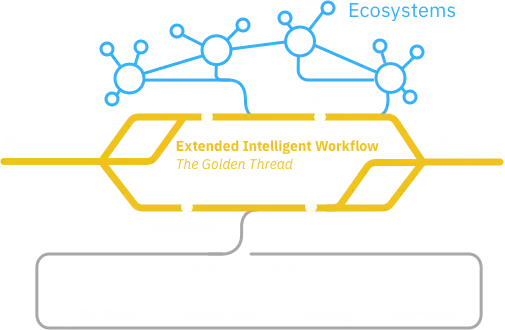

Reinvention of Extended Intelligent Workflows can move beyond that of the virtual knowledge worker into the world of engineering and manufacturing. IoT and sensing bring information from the edge of the enterprise—or within the heart of the machines that make things—into the workflow for further automation, insight, and prediction.
As the Golden Thread of the Virtual Enterprise, the extended workflow becomes the transmission mechanism for the experience and values of the ecosystem that it is threaded through. Workflows become the backbone of trusted information and relationships and the repository of the automated rules and algorithms that drive crucial, in-the-moment decision making.
Intelligent Workflows are the glue or backbone of the Virtual Enterprise creating the Golden Thread of purpose, intent, and value. Participants who operate along the workflow, whether they are inside the organization, in partnerships, or beyond across its ecosystems, need to be aligned to that intent, and they must provide an integrated, consistent experience.
These workflows are ultimately in service of end customers, who experience their collective value. COVID certainly drove home the importance of Extended Intelligent Workflows in delivering transformational experiences at pace and scale.
The effectiveness of the Extended Intelligent Workflow is dependent on the clock speed, accuracy, and security of all the participants who engage. The openness and plug compatibility of the workflow set the boundaries for the extension of value creation and leverage. We have seen the power of looking at workflows within the enterprise and using them to straddle the historic process siloes.
The more we extend the scope of a workflow and the greater the end-to-end connectivity is among the workflow’s customers and contributing participants, the greater the business outcomes will be. By extending this scope deeper into customers, suppliers, and other stakeholders, the value potential of the Virtual Enterprise can be exponentially amplified.
As Extended Intelligent Workflows become true platforms with attributes that attract mass participants, they become the instantiation of the Virtual Enterprise and its related platforms and ecosystems. The opportunity to identify improvement potential by applying combinations of exponential technologies, implemented to operate along the extended workflows, drives business model transformation and next-level performance. As such, workflows define competitive advantage and differentiation of the modern extended enterprise.
Virtualization becomes another class of exponential technology that can drive new performance opportunities. The potential to transform physical assets to digital entities; Capex to Opex; and people, teams, and offices to new models of participation exposes new value pools.
We have seen productivity improvements arise from remote-working models and massive delayering of organizations, and process complexity from digital zero-touch approaches. Those, combined with extreme automation and pervasive leverage of bots, have opened up new workflow improvement opportunities, as has the development of more comprehensive “digital twin” models.
The potential to take location out of the equation is huge and opens up new labor-cost pools, virtual Centers of Excellence, and the redefinition of spaces within which Intelligent Workflows operate. Whole new extreme digital business models can be imagined, such as marketplaces, aggregators, and technology-powered consortia, straddling geographic boundaries.
Data fuels the Intelligent Workflow, where new adjacencies and combinations of data will be uncovered. Data standards and leverage of open protocols can extend the potential for experimentation and innovation with partners. This creates one of the drivers for the open hybrid cloud architectures as the speed of data access becomes mission-critical for new real-time processes.
To yield maximum benefits, workflows need to be aligned, whether they are inside the organization, in partnerships, or beyond, in a shared purpose. They need to straddle silos and provide consistent experiences as a whole. The effectiveness of the workflow and, by implication, the Virtual Enterprise depends on the speed, accuracy, and security of every organization and individual who engages.
Reinvention of Extended Intelligent Workflows can move beyond that of the virtual knowledge worker into the world of engineering and manufacturing. IoT and sensing bring information from the edge of the enterprise—or within the heart of the machines that make things—into the workflow for further automation, insight, and prediction.
As the Golden Thread of the Virtual Enterprise, the extended workflow becomes the transmission mechanism for the experience and values of the ecosystem that it is threaded through. Workflows become the backbone of trusted information and relationships and the repository of the automated rules and algorithms that drive crucial, in-the-moment decision making.
Founded by a consortium of major banks in Europe, we.trade uses blockchain technology to connect buyers, sellers, banks, insurers, and logistics organizations with greater data intelligence and traceability. This first-of-a-kind platform simplifies cross-border trading, fosters greater trust and transparency, and opens new markets for participants by reducing barriers to engage within the ecosystem.
The we.trade platform streamlines the trade finance lending workflow, reducing friction and supporting companies as they expand into new markets. In addition to providing traders with trusted access to insurance, credit rating, and logistics services, the platform helps reduce counterparty risk, automate transactions, and integrate the end-to-end trade ecosystem.
80% reduction in transaction processing costs
Grown to include 17 banks across 15 countries since 2019
Track and trace for 400+ couriers
Shell, with its long-standing customer relationships across the mining ecosystem, joined forces with IBM to launch Oren, the sector’s first digital B2B marketplace. It was created to accelerate the adoption of digital services in mining by curating solutions and services—including those aimed at sustainability—and connecting buyers and sellers on an open platform.
Designed with ease-of-use in mind, Oren makes the daunting task of digital transformation accessible by offering a one-stop-shop of solutions, services, and bespoke integrated solutions. Oren guides and supports mining companies along a strategic path to sustainability by delivering long-term digital roadmaps to digitizing their operations, increasing efficiency, reducing emissions, and enhancing their societal license to operate.
1st B2B digital marketplace for the mining industry
Over 60 ready-to-use solutions
Ecosystem tools to assist in achieving net-zero and decarbonization targets
Shell, with its long-standing customer relationships across the mining ecosystem, joined forces with IBM to launch Oren, the sector’s first digital B2B marketplace. It was created to accelerate the adoption of digital services in mining by curating solutions and services—including those aimed at sustainability—and connecting buyers and sellers on an open platform.
Designed with ease-of-use in mind, Oren makes the daunting task of digital transformation accessible by offering a one-stop-shop of solutions, services, and bespoke integrated solutions. Oren guides and supports mining companies along a strategic path to sustainability by delivering long-term digital roadmaps to digitizing their operations, increasing efficiency, reducing emissions, and enhancing their societal license to operate.
1st B2B digital marketplace for the mining industry
Over 60 ready-to-use solutions
Ecosystem tools to assist in achieving net-zero and decarbonization targets



The lessons from the COVID crisis about the interconnectedness of the globe and the role of nature and its relationship to humanity came against the backdrop of a renewed focus on sustainability and the setting of new environmental, social, and governance goals for business that were emerging even before the pandemic. We have seen that the shifts to more virtual work models, less travel, and lower levels of urban activity and global physical trade have made a meaningful impact on carbon in the atmosphere.
The evolution toward the Virtual Enterprise reinforces this trend and can be part of a more structural shift to a sustainable planet. The connection of business intent to a wider intent has arisen as corporations seek to drive up stakeholder capital and as customers and employees seek to make purchases and work choices based upon the values of the organization with which they are interacting.
The extended ecosystems of the Virtual Enterprise that operate with their automated Intelligent Workflows, remodeled asset mixes, and smart leverage of data have the potential to live up to this new level of impact. The partnerships that will characterize them will be made up of participants with shared values.
This is all happening against a rising focus on stakeholder capitalism where the purpose of the enterprise has been extended to its societal impact. All the big issues that the world faces—from health, climate, and food security to inequality—are now being targeted by growing partnerships and ecosystems.
We see companies vying to take the lead in shaping new transformative platforms and opening new joint venture and innovative partnership models. The Virtual Enterprise is the perfect vehicle to facilitate these moves with its open approach into which the modules of impact across ecosystems can be inserted and organized.
The advent of the Virtual Enterprise also lends itself to the integration of sustainability into a company’s fiber. Organizations can weave sustainability into their content, value propositions, business partnerships, and customer engagement strategies to truly make a difference by influencing how humans treat each other and the planet, encouraging behaviors that contribute to a positive ecological footprint. In addition, they can take advantage of this unique point in time through the creation of innovative products and services linked specifically with sustainability efforts.
Virtualization has the potential to play a huge role in our joint sustainability journey. It can support decarbonization through digital access, remote working, and reduction in office space and commuting and can underpin and reinforce the circular economy through the power of exponential technologies. For example, analytics applied to extended supply chain provenance and predictability can reduce waste and align consumption to sourcing and help organize for reuse. New engines for carbon reduction and renewable energy will arise as climate progress is embedded deeper in the measures and metrics of success for all entities.
We already see examples of digital twins being applied to simulate sustainable practices in big infrastructure. We have examples of Hong Kong Airport and the Port of Rotterdam, where the combination of operational technology innovation, renewable outputs, and human-machine interactions are driving better outcomes for these organizations, their ecosystems, and the world as a whole. The digital twin approach is becoming a fundamental solution to designing, modeling, and monitoring the impact of decisions on the real world.
Ways of working will be changed forever, and the explicit recognition of health and wellness of employees and stakeholders will remain a high priority. As the Virtual Enterprise develops new networks of activity and team models, it will need to recognize this in terms of the health backbones, certifications, and provision that underpin them. Technology will play a huge role in this, and the relationship between the employee and employer with its organizational IT—which we have seen transformed over the past year—will be taken to a much richer level. The enterprise will be brought into the homes of employees, resulting in a new relationship among work, employees, their families, and the community as a whole.


The lessons from the COVID crisis about the interconnectedness of the globe and the role of nature and its relationship to humanity came against the backdrop of a renewed focus on sustainability and the setting of new environmental, social, and governance goals for business that were emerging even before the pandemic. We have seen that the shifts to more virtual work models, less travel, and lower levels of urban activity and global physical trade have made a meaningful impact on carbon in the atmosphere.
The evolution toward the Virtual Enterprise reinforces this trend and can be part of a more structural shift to a sustainable planet. The connection of business intent to a wider intent has arisen as corporations seek to drive up stakeholder capital and as customers and employees seek to make purchases and work choices based upon the values of the organization with which they are interacting.
The extended ecosystems of the Virtual Enterprise that operate with their automated Intelligent Workflows, remodeled asset mixes, and smart leverage of data have the potential to live up to this new level of impact. The partnerships that will characterize them will be made up of participants with shared values.
This is all happening against a rising focus on stakeholder capitalism where the purpose of the enterprise has been extended to its societal impact. All the big issues that the world faces—from health, climate, and food security to inequality—are now being targeted by growing partnerships and ecosystems.
We see companies vying to take the lead in shaping new transformative platforms and opening new joint venture and innovative partnership models. The Virtual Enterprise is the perfect vehicle to facilitate these moves with its open approach into which the modules of impact across ecosystems can be inserted and organized.
The advent of the Virtual Enterprise also lends itself to the integration of sustainability into a company’s fiber. Organizations can weave sustainability into their content, value propositions, business partnerships, and customer engagement strategies to truly make a difference by influencing how humans treat each other and the planet, encouraging behaviors that contribute to a positive ecological footprint. In addition, they can take advantage of this unique point in time through the creation of innovative products and services linked specifically with sustainability efforts.
Virtualization has the potential to play a huge role in our joint sustainability journey. It can support decarbonization through digital access, remote working, and reduction in office space and commuting and can underpin and reinforce the circular economy through the power of exponential technologies. For example, analytics applied to extended supply chain provenance and predictability can reduce waste and align consumption to sourcing and help organize for reuse. New engines for carbon reduction and renewable energy will arise as climate progress is embedded deeper in the measures and metrics of success for all entities.
We already see examples of digital twins being applied to simulate sustainable practices in big infrastructure. We have examples of Hong Kong Airport and the Port of Rotterdam, where the combination of operational technology innovation, renewable outputs, and human-machine interactions are driving better outcomes for these organizations, their ecosystems, and the world as a whole. The digital twin approach is becoming a fundamental solution to designing, modeling, and monitoring the impact of decisions on the real world.
Ways of working will be changed forever, and the explicit recognition of health and wellness of employees and stakeholders will remain a high priority. As the Virtual Enterprise develops new networks of activity and team models, it will need to recognize this in terms of the health backbones, certifications, and provision that underpin them. Technology will play a huge role in this, and the relationship between the employee and employer with its organizational IT—which we have seen transformed over the past year—will be taken to a much richer level. The enterprise will be brought into the homes of employees, resulting in a new relationship among work, employees, their families, and the community as a whole.
Shell, with its long-standing customer relationships across the mining ecosystem, joined forces with IBM to launch Oren, the sector’s first digital B2B marketplace. It was created to accelerate the adoption of digital services in mining by curating solutions and services—including those aimed at sustainability—and connecting buyers and sellers on an open platform.
Designed with ease-of-use in mind, Oren makes the daunting task of digital transformation accessible by offering a one-stop-shop of solutions, services, and bespoke integrated solutions. Oren guides and supports mining companies along a strategic path to sustainability by delivering long-term digital roadmaps to digitizing their operations, increasing efficiency, reducing emissions, and enhancing their societal license to operate.
1st B2B digital marketplace for the mining industry
Over 60 ready-to-use solutions
Ecosystem tools to assist in achieving net-zero and decarbonization targets
Leading national telecom company Orange France needed to develop new customer offerings on digital channels. The company developed a comprehensive Orange Campus program to enhance employees’ digital competencies.
Using co-creation studios, Orange France formed a vision of how human talent and technology can work together seamlessly. In the process, 150 current roles were narrowed down to 30 top roles, and 80 digital competencies for tomorrow’s workforce were identified. Orange France reorganized training paths and boosted career mobility by helping employees acquire new—and critical—digital skills.
50% of the workforce involved in transformation have achieved new digital skills through the Orange Campus
150% increase in customer sales on digital channels with +10 NPS points
30% increase in digital channel self service with full digital assistance
Leading national telecom company Orange France needed to develop new customer offerings on digital channels. The company developed a comprehensive Orange Campus program to enhance employees’ digital competencies.
Using co-creation studios, Orange France formed a vision of how human talent and technology can work together seamlessly. In the process, 150 current roles were narrowed down to 30 top roles, and 80 digital competencies for tomorrow’s workforce were identified. Orange France reorganized training paths and boosted career mobility by helping employees acquire new—and critical—digital skills.
50% of the workforce involved in transformation have achieved new digital skills through the Orange Campus
150% increase in customer sales on digital channels with +10 NPS points
30% increase in digital channel self service with full digital assistance


The most obvious characteristics of the Virtual Enterprise are the new interfaces among the people, the ecosystem, and the exponential technologies they access. As location becomes less important, the opportunity to access skills and capabilities from anywhere becomes real. This extended access to people across your organization, from partner organizations and the wider crowd through the ecosystems, has huge potential. At the same time, the effectiveness of this extended and dynamic collaboration requires robust and defined workflows, and easy-to-use tools and systems.
For people, the Virtual Enterprise is both an opportunity and a threat. There is a chance to bring your skills to bear in new areas through the power of global connectivity, but likewise the access to skills that can out-perform your own is easier too. Thus, it steps up the imperative for continuous and extended learning, as well as the alignment of agile approaches. The concept of the employee is open to reconsideration in a manner that extends beyond the gig economy to a deliberate structural approach to organization and capability building. The Virtual Enterprise will thus need a clear, reinvented, and open workforce strategy.
Virtual Enterprises need to be entities where leaders, employees, and stakeholders have a renewed trust in data and technology as key drivers of decision making and the core rules of the operating model. Digital workers and bots will make more decisions that have greater impact. Being able to build these in a way that is both predictable, contextual, and progressive will be a challenge.
Very importantly, the Virtual Enterprise has the potential to be a massive accelerator of inclusion and diversity as different divisions, organizations, geographies, and backgrounds get to engage in the extended workflows that are created. There is an opportunity to create new “on ramps” to the global economy for those who are currently excluded through trusted open platforms and extended workflows. Barriers to entry can be lowered and virtual models can remove the need for migration to access economic activity. But the openness potential in this area is not simply driven by the technology or platform attractiveness.
There needs to be a deep underlying openness in the culture and values of the organization and its ecosystem to accept and appreciate the diversity of contributions and diversity of people. Poorly considered or narrow definitions of the Virtual Enterprise team can actually damage the diversity of the group if group think thrives in remote, disconnected bubbles.
As extreme automation, digitization, and algorithms become the norm and people are fragmented into more remote work environments, there is, of course, a risk that the humanity of the Virtual Enterprise will come under pressure. We can see that some of the new work models have already stretched the ability of teams and individuals to cope with the blurred worlds of home and work.
We have seen technologies such as video meetings dominate the virtual interactions of all of us. While the “transaction” of co-working has been possible, the glue of empathy, collaboration, and networking is being eroded.
We miss the serendipity of water-cooler moments while the mental health challenges of extended lonely remote interactions remain hidden from Zoom, Teams, or Webex.
The Virtual Enterprise and its leadership will need to proactively tackle these challenges. Putting the “human” back in the machine is crucial while authentic executive interventions come at a premium. A more hybrid work environment is becoming the new normal, with new rules of engagement for teams and organizations with regard to ways and locations of working, supervision, and leadership.


Office location, design, and scaling will become a more complex and important factor for businesses. The balance between open spaces and privacy will need to evolve with the workflows and the tools that each worker uses. Enterprise leadership will need to roll out these new tools of the trade as a strategic imperative, providing a clear path to competitive advantage.
Building a strong corporate culture will require a new playbook as the enterprise becomes increasingly virtual. Leaders will be challenged to instill a positive corporate identity among a workforce that spans the globe and includes employees who only meet virtually. Clear communication, leading by example, and continuous feedback to foster employee growth will be crucial to establishing a winning culture.
The most obvious characteristics of the Virtual Enterprise are the new interfaces among the people, the ecosystem, and the exponential technologies they access. As location becomes less important, the opportunity to access skills and capabilities from anywhere becomes real. This extended access to people across your organization, from partner organizations and the wider crowd through the ecosystems, has huge potential. At the same time, the effectiveness of this extended and dynamic collaboration requires robust and defined workflows, and easy-to-use tools and systems.
For people, the Virtual Enterprise is both an opportunity and a threat. There is a chance to bring your skills to bear in new areas through the power of global connectivity, but likewise the access to skills that can out-perform your own is easier too. Thus, it steps up the imperative for continuous and extended learning, as well as the alignment of agile approaches. The concept of the employee is open to reconsideration in a manner that extends beyond the gig economy to a deliberate structural approach to organization and capability building. The Virtual Enterprise will thus need a clear, reinvented, and open workforce strategy.
Virtual Enterprises need to be entities where leaders, employees, and stakeholders have a renewed trust in data and technology as key drivers of decision making and the core rules of the operating model. Digital workers and bots will make more decisions that have greater impact. Being able to build these in a way that is both predictable, contextual, and progressive will be a challenge.
Very importantly, the Virtual Enterprise has the potential to be a massive accelerator of inclusion and diversity as different divisions, organizations, geographies, and backgrounds get to engage in the extended workflows that are created. There is an opportunity to create new “on ramps” to the global economy for those who are currently excluded through trusted open platforms and extended workflows. Barriers to entry can be lowered and virtual models can remove the need for migration to access economic activity. But the openness potential in this area is not simply driven by the technology or platform attractiveness.
There needs to be a deep underlying openness in the culture and values of the organization and its ecosystem to accept and appreciate the diversity of contributions and diversity of people. Poorly considered or narrow definitions of the Virtual Enterprise team can actually damage the diversity of the group if group think thrives in remote, disconnected bubbles.
As extreme automation, digitization, and algorithms become the norm and people are fragmented into more remote work environments, there is, of course, a risk that the humanity of the Virtual Enterprise will come under pressure. We can see that some of the new work models have already stretched the ability of teams and individuals to cope with the blurred worlds of home and work.
We have seen technologies such as video meetings dominate the virtual interactions of all of us. While the “transaction” of co-working has been possible, the glue of empathy, collaboration, and networking is being eroded.
We miss the serendipity of water-cooler moments while the mental health challenges of extended lonely remote interactions remain hidden from Zoom, Teams, or Webex.
The Virtual Enterprise and its leadership will need to proactively tackle these challenges. Putting the “human” back in the machine is crucial while authentic executive interventions come at a premium. A more hybrid work environment is becoming the new normal, with new rules of engagement for teams and organizations with regard to ways and locations of working, supervision, and leadership.
Office location, design, and scaling will become a more complex and important factor for businesses. The balance between open spaces and privacy will need to evolve with the workflows and the tools that each worker uses. Enterprise leadership will need to roll out these new tools of the trade as a strategic imperative, providing a clear path to competitive advantage.
Building a strong corporate culture will require a new playbook as the enterprise becomes increasingly virtual. Leaders will be challenged to instill a positive corporate identity among a workforce that spans the globe and includes employees who only meet virtually. Clear communication, leading by example, and continuous feedback to foster employee growth will be crucial to establishing a winning culture.
Leading national telecom company Orange France needed to develop new customer offerings on digital channels. The company developed a comprehensive Orange Campus program to enhance employees’ digital competencies.
Using co-creation studios, Orange France formed a vision of how human talent and technology can work together seamlessly. In the process, 150 current roles were narrowed down to 30 top roles, and 80 digital competencies for tomorrow’s workforce were identified. Orange France reorganized training paths and boosted career mobility by helping employees acquire new—and critical—digital skills.
50% of the workforce involved in transformation have achieved new digital skills through the Orange Campus
150% increase in customer sales on digital channels with +10 NPS points
30% increase in digital channel self service with full digital assistance
Delta Air Lines understands the need to constantly evolve its digital presence and enhance its customer (and employee) experience. With demand down due to the pandemic, the company recognized a unique opportunity to modernize its digital foundations and operations.
As part of its digital transformation, Delta is migrating most of its data and applications to the cloud for improved customer experience and greater efficiency across its business. Moving to an open hybrid cloud architecture enables a consistent standards-based approach to development, deployment, security, and operations across clouds. Delta’s new cloud architecture will help weave its networks together, increasing agility and unlocking data for use across applications.
Delta expects 90%+ of its applications and databases to be in cloud environments by 2024
Delta expects 30%+ improvement in development productivity as a result of this transformation
1,000+ Delta IT experts will be trained in application development and delivery, data management, and security
Delta Air Lines understands the need to constantly evolve its digital presence and enhance its customer (and employee) experience. With demand down due to the pandemic, the company recognized a unique opportunity to modernize its digital foundations and operations.
As part of its digital transformation, Delta is migrating most of its data and applications to the cloud for improved customer experience and greater efficiency across its business. Moving to an open hybrid cloud architecture enables a consistent standards-based approach to development, deployment, security, and operations across clouds. Delta’s new cloud architecture will help weave its networks together, increasing agility and unlocking data for use across applications.
Delta expects 90%+ of its applications and databases to be in cloud environments by 2024
Delta expects 30%+ improvement in development productivity as a result of this transformation
1,000+ Delta IT experts will be trained in application development and delivery, data management, and security


The potential for the Virtual Enterprise is huge. We described new market-making platforms embedded in new ecosystem relationships and powerful Intelligent Workflows that are being reinvented through science and data-led innovation and bringing wide-ranging sustainable impact. We also explored a wholesale shift in how people will interact with technology along these workflows, deriving empathy, productivity, and experience. None of this, however, will be possible without a fit-for-purpose application and infrastructure architecture to support it.
The recent pandemic triggered a natural acceleration in the use of cloud-based architectures to deliver the flexibility and adaptiveness digital acceleration demands. But more than just “clouds” will underpin the enterprises of the future. Only the right clouds for the right workloads in the right overarching architecture can enable openness and security.
The Virtual Enterprise is massively enabled by the modern, open, and secure architecture delivered by hybrid cloud. Within the enterprise, application islands create siloes that limit the reach of Intelligent Workflows, and the emergence of multiple cloud-based solutions has only created new levels of potential disjointedness.
This has increased the value of opensource architectures that can straddle mainframe, private, and public environments and underpin the extended workflows.
This architecture and the control panes that accompany it enable even more value when they reinforce partner and ecosystem connectivity outside the enterprise. Many of the evolving new multiplatform ecosystems are benefitting from the plug-compatibility that has arisen from open APIs and microservices that can be shared, alongside the deep value that comes from data mobility across the partners.
Open source solutions are a further multiplier effect for the collaboration and building of shared capabilities that can release new cross-functional and cross-industry value. The solutions created through such models draw upon the development and innovation of the crowd, and different contributions arrive with inherent compatibility. This is fundamental to the adaptiveness of the Virtual Enterprise.
Open source also has a huge impact on accessing the skills required to build and maintain these new systems as proprietary limitations and specializations are reduced. Organizations are struggling with the skills reinvention challenge they face with legacy IT workforce as they embark upon their transformation journeys.
The more open the underlying solutions and architectures leveraged—and the more they straddle the worlds of mainframe, private, and public clouds—the more fungible and reusable the teams that undertake the work of development and maintenance can be.
The CIO and CTO become more important members of the C-suite not just because technology has become the business, but because the strategic calls made about the technology architecture have become the rate limiters of competitive advantage once more. The need to make the right decisions with regard to next-generation enterprise systems as the backbones of Intelligent Workflows and platforms is key. As are the choices of on-premise, private, and public cloud infrastructures that will support the data and security needs of the ecosystem. And all of this has to sit within an economic cost envelope that can be flexed in line with business context.
Application modernization in service of the Virtual Enterprise is a complex task, and there is a very real risk of legacy complexity being replaced by digital and cloud complexity. Agile approaches, DevSecOps, and automation can help, but they still need guide bars and tracks on which to be organized. The emergence of Control Tower approaches to orchestrate the moving parts of the enterprise architecture is important, and we can imagine the extension of this thinking to straddle the end-to-end environments of the ecosystem, powered by open standards.
Data availability, quality, security, and scalability will be critical for the Virtual Enterprise to flourish, and this has big implications for the underlying technology architecture, too.


As multicloud solutions proliferate along the Intelligent Workflows and platforms, the need grows to understand and manage the location of—and the speed to access—the data that fuels them. It is an irony of the virtual world that data gravity can matter more than ever.
Similarly, cloud-based enterprise resource planning (ERP) solutions play an important role in the overall architecture—and are a mainstay for Intelligent Workflows. Through precise integration of cloud-based ERP solutions, differentiated data, and open application platforms, Extended Intelligent Workflows operate together across multiple environments, providing a robust core for the Virtual Enterprise.
Security is already one of the most important factors underpinning the evolution of more technology-enabled business and business models. As the enterprise ecosystem is extended into other partners or platforms, the need to align the security envelope along the whole Intelligent Workflow only increases.
Data and information are the raw material of these new workflows, but the value of that data is hugely dependent upon the transparency, trust, and security of these sources. New technologies such as blockchain have the potential to play a fundamentally different and enhanced role in the acceleration of these new models, as they provide certainty of identity, provenance, and activity along the workflow.
Finally, in the Virtual Enterprise, the power of the network to bind together the players in a seamless, secure, and real-time manner is also critical. Software-defined networks are the adaptive solutions that, together with hybrid cloud technologies, provide the next generation of connectivity and resilience. This is redefining the role of the telco provider and opening up the field to new players and ecosystem partners seeking to provide components in these new network value chains. Once again, the openness of the underlying technology architectures is becoming more and more critical.
The potential for the Virtual Enterprise is huge. We described new market-making platforms embedded in new ecosystem relationships and powerful Intelligent Workflows that are being reinvented through science and data-led innovation and bringing wide-ranging sustainable impact. We also explored a wholesale shift in how people will interact with technology along these workflows, deriving empathy, productivity, and experience. None of this, however, will be possible without a fit-for-purpose application and infrastructure architecture to support it.
The recent pandemic triggered a natural acceleration in the use of cloud-based architectures to deliver the flexibility and adaptiveness digital acceleration demands. But more than just “clouds” will underpin the enterprises of the future. Only the right clouds for the right workloads in the right overarching architecture can enable openness and security.
The Virtual Enterprise is massively enabled by the modern, open, and secure architecture delivered by hybrid cloud. Within the enterprise, application islands create siloes that limit the reach of Intelligent Workflows, and the emergence of multiple cloud-based solutions has only created new levels of potential disjointedness.
This has increased the value of opensource architectures that can straddle mainframe, private, and public environments and underpin the extended workflows.
This architecture and the control panes that accompany it enable even more value when they reinforce partner and ecosystem connectivity outside the enterprise. Many of the evolving new multiplatform ecosystems are benefitting from the plug-compatibility that has arisen from open APIs and microservices that can be shared, alongside the deep value that comes from data mobility across the partners.
Open source solutions are a further multiplier effect for the collaboration and building of shared capabilities that can release new cross-functional and cross-industry value. The solutions created through such models draw upon the development and innovation of the crowd, and different contributions arrive with inherent compatibility. This is fundamental to the adaptiveness of the Virtual Enterprise.
Open source also has a huge impact on accessing the skills required to build and maintain these new systems as proprietary limitations and specializations are reduced. Organizations are struggling with the skills reinvention challenge they face with legacy IT workforce as they embark upon their transformation journeys.
The more open the underlying solutions and architectures leveraged—and the more they straddle the worlds of mainframe, private, and public clouds—the more fungible and reusable the teams that undertake the work of development and maintenance can be.
The CIO and CTO become more important members of the C-suite not just because technology has become the business, but because the strategic calls made about the technology architecture have become the rate limiters of competitive advantage once more. The need to make the right decisions with regard to next-generation enterprise systems as the backbones of Intelligent Workflows and platforms is key. As are the choices of on-premise, private, and public cloud infrastructures that will support the data and security needs of the ecosystem. And all of this has to sit within an economic cost envelope that can be flexed in line with business context.
Application modernization in service of the Virtual Enterprise is a complex task, and there is a very real risk of legacy complexity being replaced by digital and cloud complexity. Agile approaches, DevSecOps, and automation can help, but they still need guide bars and tracks on which to be organized. The emergence of Control Tower approaches to orchestrate the moving parts of the enterprise architecture is important, and we can imagine the extension of this thinking to straddle the end-to-end environments of the ecosystem, powered by open standards.
Data availability, quality, security, and scalability will be critical for the Virtual Enterprise to flourish, and this has big implications for the underlying technology architecture, too.
As multicloud solutions proliferate along the Intelligent Workflows and platforms, the need grows to understand and manage the location of—and the speed to access—the data that fuels them. It is an irony of the virtual world that data gravity can matter more than ever.
Similarly, cloud-based enterprise resource planning (ERP) solutions play an important role in the overall architecture—and are a mainstay for Intelligent Workflows. Through precise integration of cloud-based ERP solutions, differentiated data, and open application platforms, Extended Intelligent Workflows operate together across multiple environments, providing a robust core for the Virtual Enterprise.
Security is already one of the most important factors underpinning the evolution of more technology-enabled business and business models. As the enterprise ecosystem is extended into other partners or platforms, the need to align the security envelope along the whole Intelligent Workflow only increases.
Data and information are the raw material of these new workflows, but the value of that data is hugely dependent upon the transparency, trust, and security of these sources. New technologies such as blockchain have the potential to play a fundamentally different and enhanced role in the acceleration of these new models, as they provide certainty of identity, provenance, and activity along the workflow.
Finally, in the Virtual Enterprise, the power of the network to bind together the players in a seamless, secure, and real-time manner is also critical. Software-defined networks are the adaptive solutions that, together with hybrid cloud technologies, provide the next generation of connectivity and resilience. This is redefining the role of the telco provider and opening up the field to new players and ecosystem partners seeking to provide components in these new network value chains. Once again, the openness of the underlying technology architectures is becoming more and more critical.
Delta Air Lines understands the need to constantly evolve its digital presence and enhance its customer (and employee) experience. With demand down due to the pandemic, the company recognized a unique opportunity to modernize its digital foundations and operations.
As part of its digital transformation, Delta is migrating most of its data and applications to the cloud for improved customer experience and greater efficiency across its business. Moving to an open hybrid cloud architecture enables a consistent standards-based approach to development, deployment, security, and operations across clouds. Delta’s new cloud architecture will help weave its networks together, increasing agility and unlocking data for use across applications.
Delta expects 90%+ of its applications and databases to be in cloud environments by 2024
Delta expects 30%+ improvement in development productivity as a result of this transformation
1,000+ Delta IT experts will be trained in application development and delivery, data management, and security
The scale of change represented by the Virtual Enterprise is significant and wide-reaching across the organization and its ecosystem partners. There is a need to maintain focus on the overall intent of the strategy, align key stakeholders, and make meaningful accelerated progress while not swamping the enterprise with change or unleashing agile “chaos.”
The Garage approach is an effective way to bring the various components and players together in a change architecture that can pursue the Golden Threads of value; build concrete modules of enhanced performance; and tie people, processes, and systems together at scale. The Garage model of co-creation, co-execution, and co-operation has proven to be effective in the virtual world that has been forced by the pandemic.
The ability to bring skills, talent, and knowledge to bear from anywhere is very productive. It straddles functional boundaries in the organization and enables ecosystem partners to participate in innovation and digital transformation.
The approach also reinforces core focus areas and strategic intent, as well as lays down the architectural rules or train tracks for the agile cross-functional teams to operate within. In addition, the Garage has data as its raw material for opportunity identification and leverage for ideation and impact and can plug in pre-configured solutions from the ecosystem to accelerate progress.
The six imperatives of the Virtual Enterprise can, therefore, be delivered and accelerated through a Garage approach, aligned with the Extended Intelligent Workflows that need to be constructed and nested within a clear overall Transformation Program. Through this approach, it is possible to:
Embrace the ecosystem opportunity in strategic intent and business platform design as a driver of accelerated digital transformation
Innovate with science and data-led approaches to drive progress across workflows, platforms, and ecosystems
Extend Intelligent Workflows to create differentiated Golden Threads of technology-enabled business transformation
Solve the biggest challenges of our time through alignment of strategy and executional impact to achieve sustainable development goals while building team purpose and engagement
Empower the virtual workforce to enrich core Intelligent Workflows and continually experiment to improve customer and employee experiences
Accelerate complex change programs that grow platforms, ecosystems, and extended workflows through hybrid cloud and networks
 Log in with IBMID


