
| Overview | Group | Tree | Graph | Deprecated | Index | Concepts |
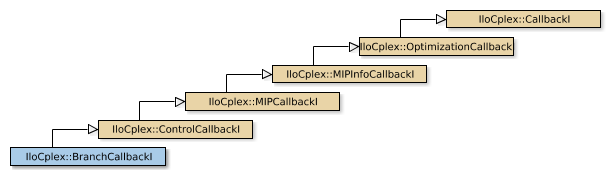
This is an advanced class. Advanced classes typically demand a profound understanding of the algorithms used by CPLEX. Thus they incur a higher risk of incorrect behavior in your application, behavior that can be difficult to debug. Therefore, the team encourages you to consider carefully whether you can accomplish the same task by means of other classes instead.
An instance of the class IloCplex::BranchCallbackI
represents a user-written callback in an application that invokes an
instance of IloCplex
to solve a mixed integer program (MIP).
The user-written callback is called prior to branching at a node in
the branch-and-cut tree during the optimization of a MIP.
It allows the user to query how the invoking instance of
IloCplex
is about to create subnodes at the current node
and gives the user the option to
override the selection made by the invoking instance of
IloCplex.
The user can create zero, one, or two branches.
BranchCallbackI::prune
removes the current node from the search tree.
No subnodes from the current node will be
added to the search tree.BranchCallbackI::makeBranch
tells an instance of IloCplex
how to create a subproblem. You may call
this method zero, one, or two times in every invocation of the
branch callback. If you call it once, it creates one node; it you call it
twice, it creates two nodes (one node at each call).IloCplex::BranchCallBackI::prune
nor IloCplex::BranchCallBackI::makeBranch,
the instance of IloCplex proceeds
with its own selection.IloCplex::BranchCallBackI::prune and
IloCplex::BranchCallBackI::makeBranch in one invocation
of a branch callback is an error and results in unspecified behavior.The methods of this class are for use in deriving a user-written
callback class and in implementing the main method
there.
If an attempt is made to access information not available to an instance of this class, an exception is thrown.
The user must be careful when using this class. Pruning a valid node can prune the optimal solution. Also, choosing a different branching variable can result in placing an invalid bound on a variable, in case the variable was already restricted to other bounds before.
In particular, the user must not branch on variables
that are implied feasible, as defined in
IloCplex::ControlCallbackI::IntegerFeasibility.
Branching on such variables can cut off feasible solutions.
If the user intends to branch on continuous variables,
the user must disable dual presolve reductions. To disable
dual presolve reductions, set the parameter
to control primal and dual reduction type,
IloCplex::Param::Preprocessing::Reduce,
either to the value 1 (one) (that is, CPX_PREREDUCE_PRIMALONLY)
or to the value 0 (zero) (that is, CPX_PREREDUCE_NOPRIMALORDUAL).
Also, if the user intends to branch on
continuous variables,
the user must turn off the linear reduction switch,
IloCplex::Param::Preprocessing::Linear.
By design, the CPLEX branch callback calculates and provides the branching decisions that CPLEX would make in case the user does not create any branches in the callback. Depending on variable selection and other features of your model, the computation of these candidate branches can be time-consuming. Consequently, if you know that you will never use the branching candidates suggested by CPLEX, then you can save time by disabling such features as strong branching.
See Also:
ILOBRANCHCALLBACK0, IloCplex::BranchDirection, IloCplex::Callback, IloCplex::CallbackI, IloCplex::MIPCallbackI, IloCplex::ControlCallbackI, ControlCallbackI::IntegerFeasibility, IloCplex::OptimizationCallbackI
| Method Summary | |
|---|---|
protected | BranchCallbackI(IloEnv env) |
public IloNum | getBranch(IloNumVarArray vars, IloNumArray bounds, IloCplex::BranchDirectionArray dirs, IloInt i) const |
public BranchCallbackI::BranchType | getBranchType() const |
public IloInt | getNbranches() const |
protected Callback::Type | getType() const |
public IloBool | isIntegerFeasible() const |
public NodeId | makeBranch(const IloConstraintArray cons, const IloIntVarArray vars, const IloNumArray bounds, const IloCplex::BranchDirectionArray dirs, IloNum objestimate, NodeData * data=0) |
public NodeId | makeBranch(const IloConstraintArray cons, const IloNumVarArray vars, const IloNumArray bounds, const IloCplex::BranchDirectionArray dirs, IloNum objestimate, NodeData * data=0) |
public NodeId | makeBranch(const IloConstraint con, IloNum objestimate, NodeData * data=0) |
public NodeId | makeBranch(const IloConstraintArray cons, IloNum objestimate, NodeData * data=0) |
public NodeId | makeBranch(const IloIntVar var, IloNum bound, IloCplex::BranchDirection dir, IloNum objestimate, NodeData * data=0) |
public NodeId | makeBranch(const IloNumVar var, IloNum bound, IloCplex::BranchDirection dir, IloNum objestimate, NodeData * data=0) |
public NodeId | makeBranch(const IloIntVarArray vars, const IloNumArray bounds, const IloCplex::BranchDirectionArray dirs, IloNum objestimate, NodeData * data=0) |
public NodeId | makeBranch(const IloNumVarArray vars, const IloNumArray bounds, const IloCplex::BranchDirectionArray dirs, IloNum objestimate, NodeData * data=0) |
public NodeId | makeBranch(IloInt num, NodeData * data=0) |
public void | prune() |
Inherited Methods from MIPCallbackI |
|---|
getCurrentNodeDepth, getObjCoef, getObjCoef, getObjCoefs, getObjCoefs, getType, getUserThreads, MIPCallbackI |
Inherited Methods from OptimizationCallbackI |
|---|
getModel, getNcols, getNQCs, getNrows |
Inherited Methods from CallbackI |
|---|
abort, duplicateCallback, getCplexTime, getDetTime, getEndDetTime, getEndTime, getEnv, getStartDetTime, getStartTime, getType, main |
| Inner Enumeration |
|---|
| BranchCallbackI::BranchType |
| Method Detail |
|---|
This constructor creates a branch callback, that is, a control callback for splitting a node into two branches.
This method accesses branching information for the i-th branch
that the invoking instance of IloCplex
is about to create. The argument i must be between 0
(zero) and (getNbranches - 1); that is, it must be a valid
index of a branch; normally, it will be zero or one.
A branch is normally defined by a set of variables and the bounds for these variables. Branches that are more complex cannot be queried. The return value is the node estimate for that branch.
vars contains the variables for which
new bounds will be set in the i-th branch.bounds contains the new bounds for the
variables listed in vars; that is, bounds[j]
is the new bound for vars[j].dirs specifies the branching direction
for the variables in vars. dir[j] == IloCplex::BranchUp
means that bounds[j] specifies a lower bound for
vars[j].
dirs[j] == IloCplex::BranchDown
means that bounds[j] specifies an upper bound for
vars[j].
This method returns the type of branching
IloCplex
is going to do for the current node.
This method returns the number of branches IloCplex
is going to create at the current node.
This method returns IloTrue if the solution of the
current node is integer feasible.
This method offers the same facilities as the other methods
IloCplex::BranchCallbackI::makeBranch, but for a branch
specified by a set of constraints and a set of variables.
This method offers the same facilities as the other methods
IloCplex::BranchCallbackI::makeBranch, but for a branch
specified by a set of constraints and a set of variables.
This method offers the same facilities for a branch
specified by only one constraint as
IloCplex::BranchCallbackI::makeBranch does for a
branch specified by a set of constraints.
This method overrides the branch chosen by an instance of
IloCplex, by specifying a branch on
constraints. A method named
makeBranch can be called zero, one,
or two times in every invocation of the branch callback. If you call
it once, it creates one node; it you call it twice, it creates two
nodes (one node at each call). If you call it more than twice, it
throws an exception.
cons specifies an array of constraints
that are to be added for the subnode being created.objestimate provides an estimate of the
resulting optimal objective value for the subnode specified by this
branch. The invoking instance of IloCplex
may use this estimate to select nodes to process. Providing a wrong
estimate will not influence the correctness of the solution, but it
may influence performance. Using the objective value of the current
node is usually a safe choice.data allows you to add an object of type
IloCplex::MIPCallbackI::NodeData to the node representing
the branch created by the makeBranch call. Such
data objects must be instances of a user-written subclass of
IloCplex::MIPCallbackI::NodeData.For a branch specified by only one variable, this method offers
the same facilities as
IloCplex::BranchCallbackI::makeBranch for a branch specified
by a set of variables.
For a branch specified by only one variable, this method offers
the same facilities as
IloCplex::BranchCallbackI::makeBranch for a branch specified
by a set of variables.
This method overrides the branch chosen by an instance of
IloCplex. A method named
makeBranch can be called zero, one,
or two times in every invocation of the branch callback. If you call
it once, it creates one node; it you call it twice, it creates two
nodes (one node at each call). If you call it more than twice, it
throws an exception.
Each call specifies a branch; in other words, it instructs the
invoking IloCplex object how to create a subnode from
the current node by specifying new, tighter bounds for a set of
variables.
vars contains the variables for which
new bounds will be set in the branch. bounds contains the new bounds for the
variables listed in vars; that is, bounds[j]
is the new bound to be set for vars[j].dirs specifies the branching direction
for the variables in vars. dir[j] == IloCplex::BranchUp
means that bounds[j] specifies a lower bound for
vars[j].
dirs[j] == IloCplex::BranchDown
means that bounds[j] specifies an upper bound for
vars[j].
objestimate provides an estimate of the
resulting optimal objective value for the subnode specified by this
branch. The invoking instance of IloCplex
may use this estimate to select nodes to process. Providing a wrong
estimate will not influence the correctness of the solution, but it
may influence performance. Using the objective value of the current
node is usually a safe choice.data allows you to add an object of type
IloCplex::MIPCallbackI::NodeData to the node representing
the branch created by the makeBranch call. Such
data objects must be instances of a user-written subclass of
IloCplex::MIPCallbackI::NodeData.This method overrides the branch chosen by an instance of
IloCplex. A method named
makeBranch can be called zero, one,
or two times in every invocation of the branch callback. If you call
it once, it creates one node; if you call it twice, it creates two
nodes (one node at each call). If you call it more than twice, it
throws an exception.
Each call specifies a branch; in other words, it instructs the
invoking IloCplex object how to create a subnode from
the current node by specifying new, tighter bounds for a set of
variables.
The argument vars contains the variables for which
new bounds will be set in the branch.
The argument bounds contains the new bounds for the
variables listed in vars; that is, bounds[j]
is the new bound to be set for vars[j].
The argument dirs specifies the branching direction
for the variables in vars.
dir[j] == IloCplex::BranchUp
means that bounds[j] specifies a lower bound for
vars[j].
dirs[j] == IloCplex::BranchDown
means that bounds[j] specifies an upper bound for
vars[j].
The argument objestimate provides an estimate of the
resulting optimal objective value for the subnode specified by this
branch. The invoking instance of IloCplex
may use this estimate to select nodes to process. Providing a wrong
estimate will not influence the correctness of the solution, but it
may influence performance. Using the objective value of the current
node is usually a safe choice.
The argument data allows
you to add an object of type
IloCplex::MIPCallbackI::NodeData to the node representing
the branch created by the makeBranch call. Such
data objects must be instances of a user-written subclass of
IloCplex::MIPCallbackI::NodeData.
This method overrides the branch chosen by an instance of
IloCplex. A method named
makeBranch can be called zero, one,
or two times in every invocation of the branch callback. If you call
it once, it creates one node; if you call it twice, it creates two
nodes (one node at each call). If you call it more than twice, it
throws an exception.
Each call creates a child node for the current node that is identical
to the branch number that CPLEX is executing and attaches the user object
data to the new child node.
The same index num must not be
used with more than one call of the function.
The argument num
specifies the CPLEX branch to replicate.
The argument data allows you
to add an object of type
IloCplex::MIPCallbackI::NodeData to the node representing
the branch created by the makeBranch call. Such
data objects must be instances of a user-written subclass of
IloCplex::MIPCallbackI::NodeData.
By calling this method, you instruct the CPLEX branch-and-cut
search not to create any child nodes from the current node, or, in
other words, to discard nodes below the current node; it does not
revisit the discarded nodes below the current node. In short, it
creates no branches. It is an error to call both prune
and makeBranch in one invocation of a callback.
Pruning nodes in this way is not compatible with
the method IloCplex::populate because that method
retains fathomed nodes for subsequent use.
This method returns the callback type of the invoking callback object.
| Inner Enumeration Detail |
|---|
IloCplex::BranchCallbackI::BranchType is an enumeration
limited in scope to the class
IloCplex::BranchCallbackI.
This enumeration is used by the
method IloCplex::BranchCallbackI::getBranchType to tell what
kind of branch IloCplex is about to do:
BranchOnVariable
specifies branching on a single variable.BranchOnAny
specifies multiple bound changes and constraints
will be used for branching.BranchOnSOS1
specifies branching on an SOS of type 1.BranchOnSOS2
specifies branching on an SOS of type 2.See Also:
| Fields |
|---|
BranchOnVariable = CPX_TYPE_VAR | |
BranchOnSOS1 = CPX_TYPE_SOS1 | |
BranchOnSOS2 = CPX_TYPE_SOS2 | |
BranchOnAny = CPX_TYPE_ANY |