
| Overview | Group | Tree | Graph | Deprecated | Index | Concepts |
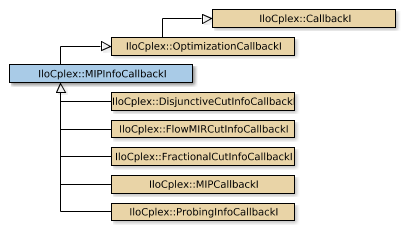
An instance of the class IloCplex::MIPInfoCallbackI
represents a user-written callback in an application that uses an
instance of
IloCplex to solve a mixed integer program
(MIP). IloCplex calls the user-written callback regularly
during the branch-and-cut search.
User-written callbacks of this class are compatible with MIP dynamic search.
This class offers methods for accessing an incumbent solution and its objective value from a user-written callback. It also offers methods for accessing priority orders and progress information, such as the number of nodes solved.
The methods of this class are protected for use in deriving a
user-written callback class and in implementing the main
method there.
If an attempt is made in a user-written callback to access information not available to an instance of this class, an exception is raised. For example, if there is no incumbent, the methods that query about incumbents will throw an exception.
This class also provides the common application programming interface (API) for these callback classes:
See Also:
IloCplex, IloCplex::Callback, IloCplex::CallbackI, IloCplex::DisjunctiveCutInfoCallbackI, IloCplex::FlowMIRCutInfoCallbackI, IloCplex::FractionalCutInfoCallbackI, IloCplex::OptimizationCallbackI, IloCplex::ProbingInfoCallbackI, ILOMIPINFOCALLBACK0
Inherited Methods from OptimizationCallbackI |
|---|
getModel, getNcols, getNQCs, getNrows |
Inherited Methods from CallbackI |
|---|
abort, duplicateCallback, getCplexTime, getDetTime, getEndDetTime, getEndTime, getEnv, getStartDetTime, getStartTime, getType, main |
| Method Detail |
|---|
This constructor creates a callback for use in
an application that uses an instance of IloCplex
to solve a mixed integer program (MIP).
This method accesses the currently best known bound of all the remaining open nodes in a branch-and-cut tree.
It is computed for a minimization problem as the minimum objective function value of all remaining unexplored nodes. Similarly, it is computed for a maximization problem as the maximum objective function value of all remaining unexplored nodes.
For a regular MIP optimization, this value is also the best known bound on the optimal solution value of the MIP problem. In fact, when a problem has been solved to optimality, this value matches the optimal solution value.
However, for the method populate, the value can also exceed
the optimal solution value if CPLEX has already solved the model
to optimality but continues to search for additional solutions.
An instance of IloCplex uses
the cutoff value (the value of the objective
function of the subproblem at a node in the
search tree) to decide when to prune nodes
from the search tree (that is, when to cut off that
node and discard the nodes beyond it). The cutoff value is updated
whenever a new incumbent is found.
This method returns the branch direction previously assigned to
variable var with the method
IloCplex::setDirection or
IloCplex::setDirections.
If no direction has been assigned,
IloCplex::BranchGlobal will be returned.
This method returns the branch direction previously assigned to
variable var with the method
IloCplex::setDirection or
IloCplex::setDirections.
If no direction has been assigned,
IloCplex::BranchGlobal will be returned.
Returns the value of the objective function
of the incumbent solution (that is, the best
integer solution found so far) at the time the invoking callback is
called by an instance of IloCplex while solving a MIP.
If there is no incumbent, this method returns a very large
positive number for a minimization or a very small negative
number for a maximization.
This method returns the slack value for the range specified by
rng for the incumbent.
If there is no incumbent, this method
throws an exception.
This method puts the slack value for each range in the array of
ranges cons into the corresponding element of the array
vals for the incumbent. CPLEX resizes
array vals to match the size of array cons.
If there is no incumbent, this method
throws an exception.
This method returns the value of the
expression expr in the
incumbent solution at the time the invoking callback is
called by an instance of IloCplex while solving a MIP.
If there is no incumbent, this method throws an exception.
Returns the solution value of var in the
incumbent solution at the time the invoking callback is
called by an instance of IloCplex while solving a MIP.
If there is no incumbent, this method throws an exception.
Returns the solution value of var in the
incumbent solution at the time the invoking callback is
called by an instance of IloCplex while solving a MIP.
If there is no incumbent, this method throws an exception.
Returns the value of each variable in the array
vars with respect to the current incumbent
solution, and it puts those values into the
corresponding array vals.
If there is no incumbent, this method
throws an exception.
Returns the value of each variable in the array
vars with respect to the current incumbent
solution, and it puts those values into the
corresponding array vals.
If there is no incumbent, this method
throws an exception.
This method accesses the current relative objective gap.
For a minimization problem, this value is computed by
(bestinteger - bestobjective) / (1e-10 + |bestinteger|)
where bestinteger is the value returned by
IloCplex::MIPInfoCallbackI::getIncumbentValue
and bestobjective is the value returned by
IloCplex::MIPInfoCallbackI::getBestObjValue.
For a maximization problem, the value is computed by:
(bestobjective - bestinteger) / (1e-10 + |bestinteger|)
Returns the identifier of the parallel thread being currently
executed. This number is between 0 (zero) and the value
returned by the method getUserThreads()-1.
This method returns a nonzero value only
for the class IloCplex::MIPCallbackI and its
subclasses. In other words, this method is valid only
for query, diagnostic, and control callbacks. It is
not valid for informational callbacks.
Returns the total number of cuts of the type which
that CPLEX has
added to the model so far during the current optimization.
Returns the total number of iterations executed so far during the current optimization to solve the node relaxations.
Returns the total number of iterations executed so far during the current optimization to solve the node relaxations.
Returns the number of nodes already processed in the current optimization.
Returns the number of nodes already processed in the current optimization.
Returns the number of nodes left to explore in the current optimization.
Returns the number of nodes left to explore in the current optimization.
Returns the branch priority used for the
variable var in the current optimization.
Returns the branch priority used for
variable var in the current optimization.
Returns the requested quality measure of kappa statistics.
This method
applies only to the quality measures of kappa statistics.
For more information about kappa statistics, see the parameter
MIPKappaStats documented in the
CPLEX Parameters Reference Manual.
Returns IloTrue if an integer
feasible solution has been found, or, equivalently, if an incumbent
solution is available at the time the invoking callback is
called by an instance of IloCplex while solving a MIP.
This method returns the callback type of the invoking callback object.