
| Overview | Group | Tree | Graph | Deprecated | Index | Concepts |
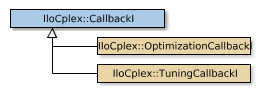
This is the abstract base class for user-written legacy callback classes. It provides their common application programming interface (API). Callbacks may be called repeatedly at various points during an optimization; for each place a callback is called, CPLEX provides a separate callback class (derived from this class). Such a callback class provides the specific API as a protected method to use for the particular implementation.
You do not create instances of this class; rather, you use one of
its child classes to implement your own callback. In order to implement
your user-written callbacks with an instance of IloCplex,
follow these steps:
MyCallbackI, say,
from the appropriate predefined callback class. Your derived
class must inherit from only one predefined callback class; that
is multiple inheritance is not allowed. main routine of your
user-written callback. (All constructors of predefined callback
classes are protected; they can be called only from
user-written derived subclasses.)duplicateCallback.myCallback
that creates an instance of your implementation
class in the Concert Technology environment, so
that the instance and data structures used internally by that
instance are de-allocated by IloEnv::end.
The function that you write should
return the instance as a handle of
IloCplex::Callback.
When you write your callback function, use the placement
operator new to specify the environment, like this:
MyCallback *myCallback = new(env) MyCallback(env, y, 0, 0);
IloCplex::use.
Macros ILOXXXCALLBACKn (for n from 0 to 7) are
available to facilitate steps 2 through 5, where XXX
stands for the particular callback under construction and n
stands for the number of parameters that
the function written in step 5 is to
receive in addition to the environment parameter.
You can use one instance of a callback with only one instance of
IloCplex. When you use a callback with a second instance of
IloCplex,
a copy will be automatically created using the method
duplicateCallback, and that copy will be
used instead.
Also, an instance of IloCplex takes account of
only one instance of a particular callback at any given time. That is, if
you call IloCplex::use more than once with
the same class of callback, the last call overrides any previous one. For
example, you can use only one primal simplex callback at a time, or you can
use only one network callback at a time; and so forth.
There are two varieties of callbacks:
IloCplex. The
information available depends on the algorithm (primal
simplex, dual simplex, barrier, mixed integer, or network) that you are
using. For example,
a query callback can return the current objective value,
the number of simplex iterations that have been completed, and other
details. Query callbacks can also be called from presolve, probing,
fractional cuts, and disjunctive cuts.IloCplex. For example, control
callbacks enable you to select the
next node to process or to control the creation of subnodes (among other
possibilities).Existing extractables should never be modified within a callback. Temporary extractables, such as arrays, expressions, and range constraints, can be created and modified. Temporary extractables are often useful, for example, for computing cuts.
See Also:
ILOBARRIERCALLBACK0, ILOBRANCHCALLBACK0, IloCplex, IloCplex::BarrierCallbackI, IloCplex::BranchCallbackI, IloCplex::Callback, IloCplex::ControlCallbackI, IloCplex::CrossoverCallbackI, IloCplex::UserCutCallbackI, IloCplex::LazyConstraintCallbackI, IloCplex::DisjunctiveCutCallbackI, IloCplex::FlowMIRCutCallbackI, IloCplex::FractionalCutCallbackI, IloCplex::HeuristicCallbackI, IloCplex::IncumbentCallbackI, IloCplex::ContinuousCallbackI, IloCplex::MIPCallbackI, IloCplex::NetworkCallbackI, IloCplex::NodeCallbackI, IloCplex::OptimizationCallbackI, IloCplex::ProbingCallbackI, IloCplex::SimplexCallbackI, IloCplex::SolveCallbackI, IloCplex::TuningCallbackI, ILOCROSSOVERCALLBACK0, ILOBRANCHCALLBACK0, ILODISJUNCTIVECUTCALLBACK0, ILOFLOWMIRCUTCALLBACK0, ILOFRACTIONALCUTCALLBACK0, ILOHEURISTICCALLBACK0, ILOINCUMBENTCALLBACK0, ILOCONTINUOUSCALLBACK0, ILOMIPCALLBACK0, ILONETWORKCALLBACK0, ILONODECALLBACK0, ILOPROBINGCALLBACK0, ILOSIMPLEXCALLBACK0, ILOSOLVECALLBACK0, ILOTUNINGCALLBACK0
| Method Summary | |
|---|---|
public void | abort() |
protected virtual CallbackI * | duplicateCallback() const |
public IloNum | getCplexTime() const |
public IloNum | getDetTime() const |
public IloNum | getEndDetTime() const |
public IloNum | getEndTime() const |
public IloEnv | getEnv() const |
public IloNum | getStartDetTime() const |
public IloNum | getStartTime() const |
public virtual Callback::Type | getType() const |
protected virtual void | main() |
| Method Detail |
|---|
This method instructs CPLEX to stop the current optimization after the
user callback finishes. Note that executing additional
IloCplex callback methods in the callback can
lead to unpredictable behavior. For example, callback methods such
as IloCplex::SolveCallbackI::solve or
IloCplex::BranchCallbackI::makeBranch
can overwrite the callback status and thus enable the optimization
to continue. Therefore, to abort an optimization effectively,
a user should exit the callback by one of
the following ways:
return immediately after the call
of abort. IloCplex::CallbackI and its subclasses after
abort.This virtual method must be implemented to create a copy of the
invoking callback object on the same environment. Typically the following
implementation will work for a callback class called
MyCallbackI:
 IloCplex::CallbackI* MyCallbackI::duplicateCallback() const {

   return (new (getEnv()) MyCallbackI(*this));

 }
This method is called by an IloCplex object in two
cases:
cplex.use(cb) is called for a callback object
cb that is already used by another instance of
IloCplex, a copy of the implementation object of
cb is created by calling duplicateCallback
and used in its place. The method use will return
a handle to that copy.IloCplex
creates copies of every callback that it uses by calling
duplicateCallback.
One copy of a callback is created for each
additional thread being used in the parallel optimizer. During the
optimization, each thread will invoke the copy corresponding to the thread
number. The methods provided by the callback APIs are guaranteed to be
threadsafe. However, when accessing parameters passed to callbacks or
members stored in a callback, it is up to the user to make
sure of thread safety
by synchronizing access or creating distinct copies of the data in the
implementation of duplicateCallback.This method returns a time stamp, useful in measuring elapsed time in seconds.
To measure time spent between a starting point and ending point of an operation, take the result of this method at the starting point; take the result of this method at the end point; subtract the starting time stamp from the ending time stamp; the subtraction yields elapsed time in seconds.
Whether the elapsed time measures wall clock time (also known
as real time) or CPU time depends on the setting of the clock
type parameter ClockType.
The absolute value of the time stamp is not meaningful.
This method returns a deterministic time stamp in ticks.
To measure elapsed deterministic time in ticks between a starting point and ending point of an operation, take the deterministic time stamp at the starting point; take the deterministic time stamp at the ending point; subtract the starting deterministic time stamp from the ending deterministic time stamp.
The absolute value of the deterministic time stamp is not meaningful.
This method returns a deterministic time stamp specifying when
the deterministic time limit will occur.
To compute remaining time in ticks,
subtract the result of
getDetTime
from the result of this method.
The absolute value of the deterministic time stamp is not meaningful.
This method returns a time stamp specifying when
the time limit will occur. To compute remaining time in seconds,
subtract the result of
getCplexTime
from the result of this method.
This computation yields either wall clock time (also
known as real time) or CPU time, depending on the clock type
set by the parameter ClockType. The absolute value
of the time stamp is not meaningful.
This method returns the environment belonging to the
IloCplex object that invoked
the method main.
This method returns a deterministic time stamp specifying when
the solving process was started.
To compute elapsed time in ticks,
subtract the result of
getDetTime
from the result of this method.
The absolute value of the deterministic time stamp is not meaningful.
This method returns a time stamp specifying when
the solving process was started. To compute elapsed time in seconds,
subtract the result of
getCplexTime
from the result of this method.
This computation yields either wall clock time (also
known as real time) or CPU time, depending on the clock type
set by the parameter ClockType. The absolute value
of the time stamp is not meaningful.
This method returns the callback type of the invoking callback object.
This virtual method is to be implemented by the user in a
derived callback class to define the functionality of the callback. When
an instance of IloCplex uses a callback (an instance of
IloCplex::CallbackI or one of its derived subclasses),
IloCplex calls this virtual method main
at the point during the optimization at which the callback is executed.