In a multiserver architecture, roles are associated with OS deployment servers.
The server role of an OS deployment server in a multiserver hierarchy depends on whether the server has its own database and whether targets are replicated.
Server role information is displayed in when a server is selected in the hierarchy.
Single database architecture and multiple database architecture must be considered separately. In the diagrams, servers are grouped according to the database they use.
Single database architecture
In a single
database architecture, there are only two possible server roles as
exemplified in Figure 1:
Figure 1. Single database
architecture 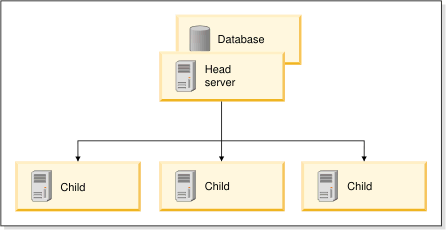
- Head server
- The server at the top of the hierarchy.
- Child
- All other servers.
Multiple database architecture
The structure
of a multiple database architecture is more complex and more roles
can enter into play, as exemplified in Figure 2.
Figure 2. Multiple database
architecture 
- Top parent
- The server at the top of the hierarchy. It manages its database and does not have a parent database.
- Target manager
- A replicated server, with its own database, and which manages its targets, that is, it does not report target status to a parent server.
- Child
- A server without its own database, as in the single database architecture.
- Child (with cache)
- A server with its own database, with full replication, and at the bottom of the hierarchy.