RedHat RHEL release to release comparison
The purpose of this test was to determine how the WebSphere® environment performs on the various levels of RHEL. We wanted to compare RHEL 5.0 with RHEL 4.5.
For these runs we used Trade with the best tuning variations measured on our previous tests (see RHEL 4.5 Trade tuning variations).
Test case description
- Increased network buffer count
- Hardware checksumming
We ran tests using RHEL 4.5 and RHEL 5.0 to the DB2® for Linux® database. These runs set the baseline for future runs comparing different code levels.
DB2 database on Linux
| WebSphere Application Server | Trade Results | DB2 Database | ||||||
|---|---|---|---|---|---|---|---|---|
| Distro | #CPU | %CPU | CPI | #Users | Resp | %ETR | CPU% | %CPU |
| RHEL 4.5 | 8 | 98.35 | 2.11 | 60 | 18 ms | 100.0 | 4 | 40.57 |
| RHEL 5.0 | 8 | 99.07 | 2.13 | 60 | 17 ms | 100.3 | 4 | 47.5 |
Observations
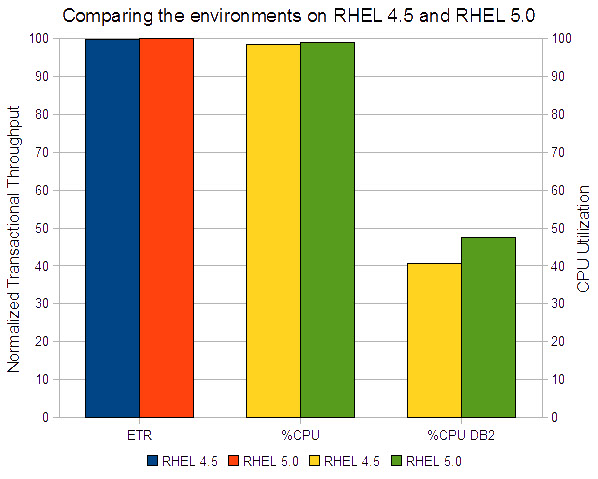
Both the RHEL 4.5 and RHEL 5.0 environments have throughput characteristics which are very close except for the DB2 for Linux CPU utilization. This means that when WebSphere Application Server and the database are on RHEL 4.5, it requires significant less CPU on the database for approximately the same throughput as RHEL 5.0.
Conclusion
From a performance perspective, the performance for the environment with WebSphere Application Server on RHEL 4.5 or RHEL 5.0 is the same. However, the database requires less capacity from eight CPUs when the environment runs on RHEL 4.5. At the moment it is not clear what causes the difference.