Comparison of z/VM 5.3 versus z/VM 5.2
In this section we compare the most interesting parameters from z/VM® 5.2 and z/VM 5.3 when scaling into the memory overcommitment.
Throughput
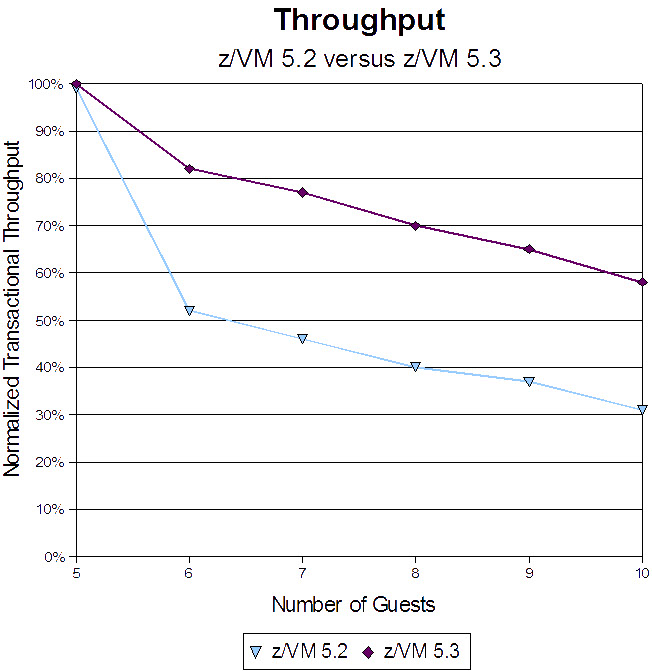
Figure 1 compares the throughput results for z/VM 5.3 with z/VM 5.2. The throughput is normalized to the z/VM 5.3 five guests' results.
Observations
z/VM 5.3 maintains a higher throughput, which ranges from about 60% to about 90% higher than the z/VM 5.2 value. At ten guests, the throughput on z/VM 5.2 is degraded to a little bit above 30% from the throughput of the scenario without memory overcommitment with five guests. Here, z/VM 5.3 reaches a value that is nearly two times higher.
CPU utilization
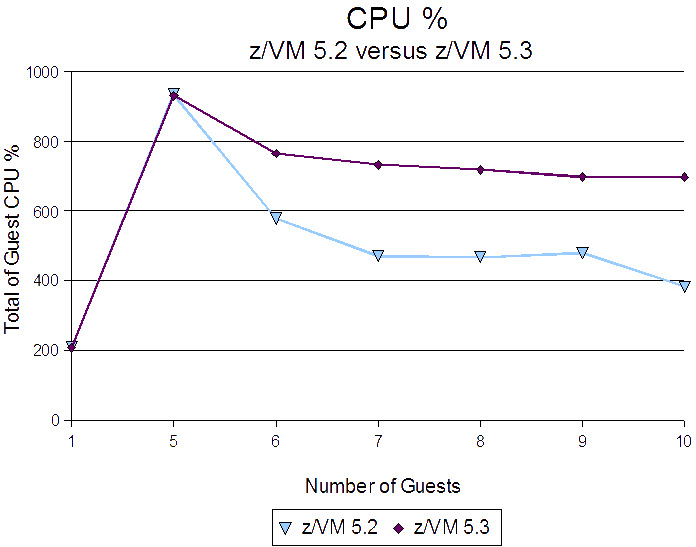
Figure 2 compares the overall CPU utilization (LPAR load) observed with z/VM 5.3 versus z/VM 5.2.
Observations
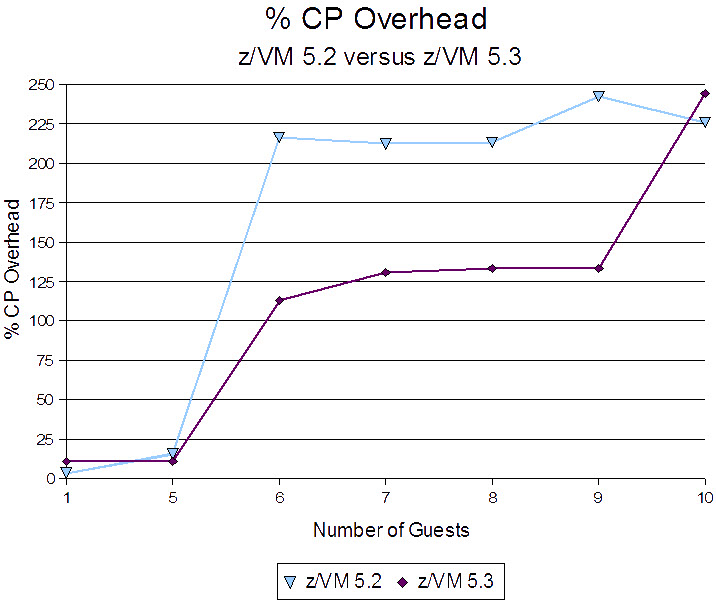
z/VM 5.3 experiences a higher CPU utilization rate as guests are scaled from five to ten (Figure 2) with higher throughput (Figure 1), but the throughput decreases faster than the CPU load, indicating that the effort for managing the lack of storage pages increases. This is better shown in Figure 3, which compares just the overhead observed with z/VM 5.3 versus z/VM 5.2. The overhead is calculated as the difference between the z/VM LPAR load and the guest CPU load.
Observations
In terms of CPU utilization spent for the CP, the overhead for z/VM 5.3 is much lower than z/VM 5.2 for six through nine guests.
DASD paging space
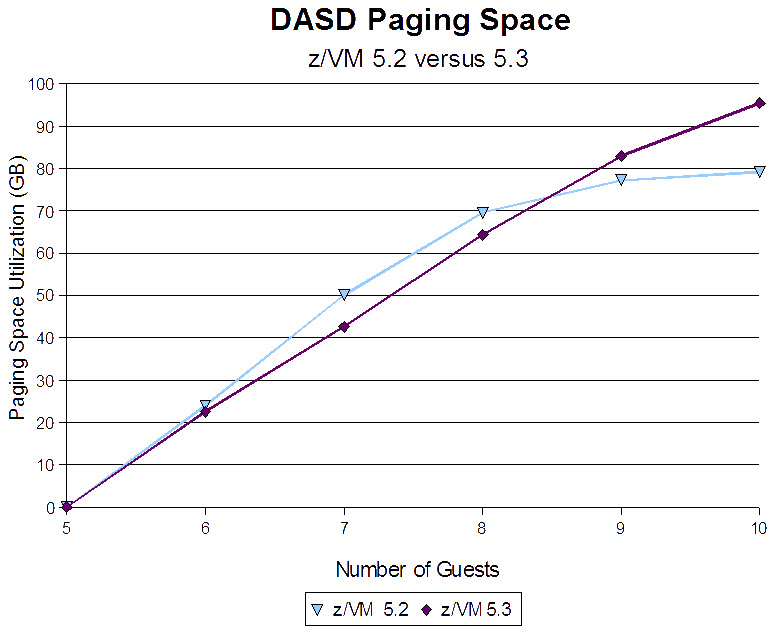
Figure 4 compares the total number of gigabytes of DASD space that are used to hold page frames on z/VM 5.3 versus z/VM 5.2.
Observations
z/VM 5.2 shows a knee at eight guests, while the DASD paging space utilization for z/VM 5.3 continues to increase almost linearly with the number of guests.
Page movement
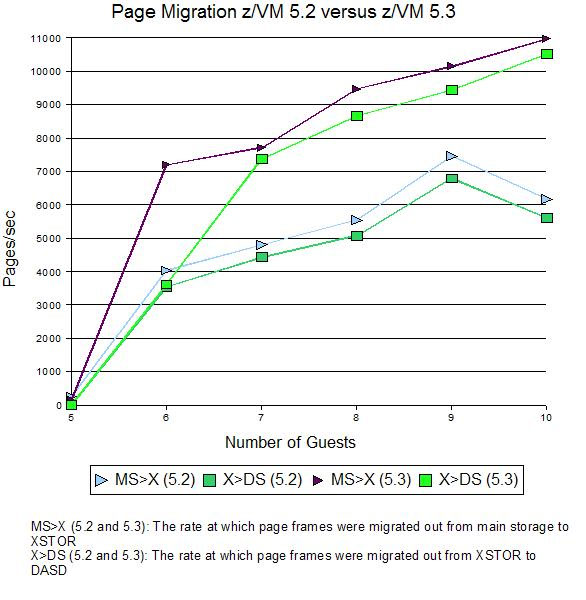
Figure 5 compares the movement between z/VM 5.2 versus z/VM 5.3.
Observations
Figure 5 again demonstrates that, as memory overcommitment increases, z/VM 5.3 handles more page movements from XSTOR to DASD and main storage to XSTOR than z/VM 5.2. At nine guests, z/VM 5.2 has reached its highest page movement and slows down at ten guests.
Conclusion
Throughput degradation on z/VM 5.3 did not decline as much as z/VM 5.2 and we were able to achieve higher percentages of total CPU utilization. Overall paging performance on z/VM 5.3 is better than z/VM 5.2, in terms of higher throughput and less overhead.
Six guests and a memory overcommitment of 33% resulted in a throughput reduction of only 18%. Even at ten guests, the throughput reduction is only 42%, which shows that the memory overcommitment is being handled much more efficiently on z/VM 5.3 than z/VM 5.2. z/VM 5.3 is able to maintain a higher paging movement rate than z/VM 5.2.