Scale guests into memory overcommitment on z/VM 5.3
In these tests we performed the same tests as in zvm52.html, but using z/VM® 5.3. We started with one database server guest and then added four more database server guests for a total of five guests. These five guests used all of the available physical memory. The number of workload driver users was adjusted to reach maximum throughput and the users were distributed evenly among the guests. The guests were scaled from five to ten. We strove to maintain maximum throughput while scaling the guests from five to ten.
Total throughput
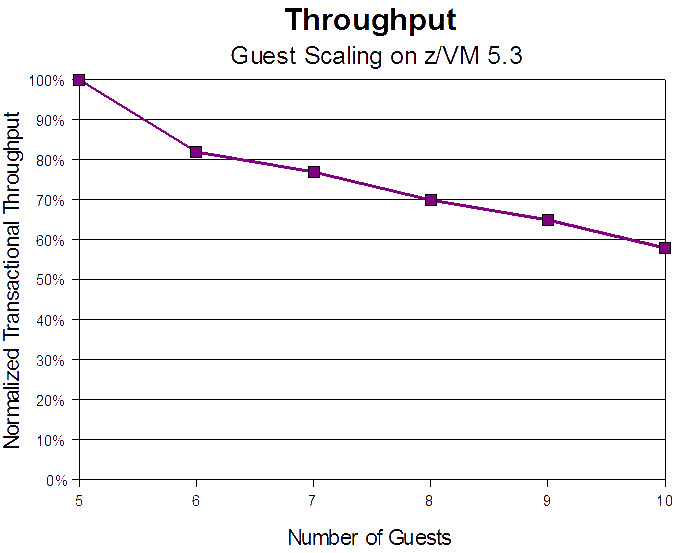
Figure 1 shows the normalized transactional throughput for all guests when scaling the number of guests on z/VM 5.3 into the memory overcommitment.
Observations
Figure 1 shows the effect of memory overcommitment on throughput with a near linear decrease. At ten guests, throughput has deceased by slightly more than 40%.
CPU utilization
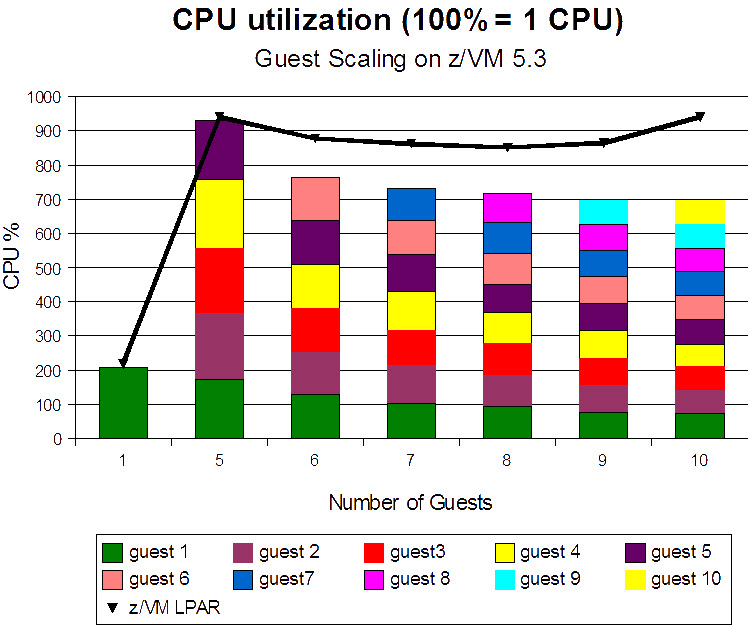
Figure 2 shows the CPU utilization of each guest and the total CPU utilization for the z/VM LPAR for the ten CPUs assigned.
Observations
Figure 2 shows the effect of memory overcommitment on CPU utilization. Adding additional guests results in more z/VM overhead. According to the throughput behavior shown in Figure 1, as more guests are added, there is a near linear decrease in CPU utilization for the guests. The z/VM overhead starts to increase significantly at nine guests.
Page location
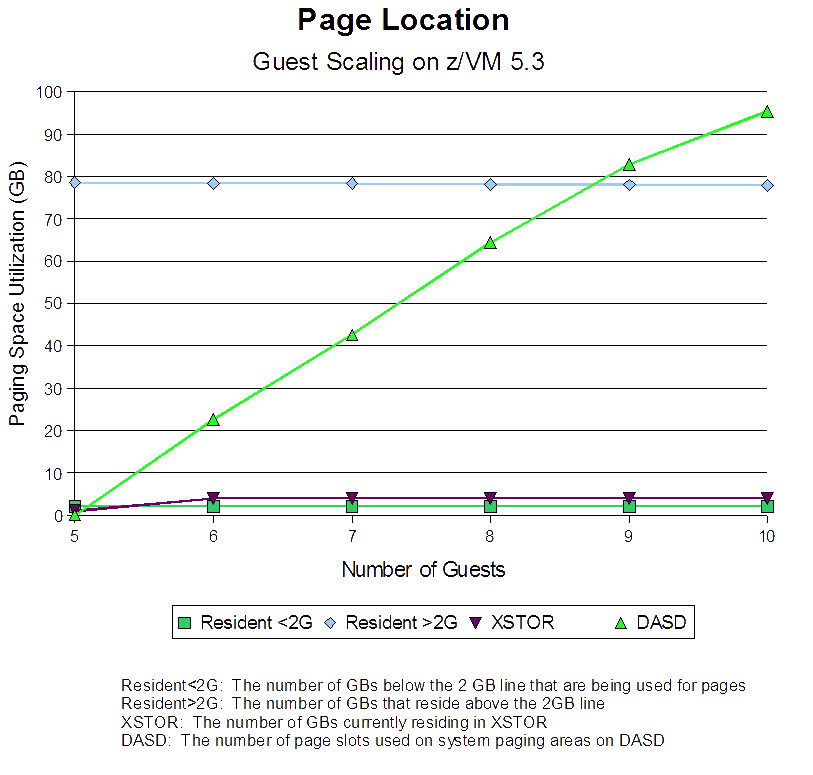
Figure 3 shows the location of page frames associated with guests. The values are a sum of the location of the page frames for each individual guest.
Observations
Figure 3 shows the location of pages in the system as guests are increased from five to ten. The most interesting curve is the utilization of the paging space on DASD. Its increase is near linear at a constant slope. At ten guests there are more pages on DASD than in memory.
Page movement
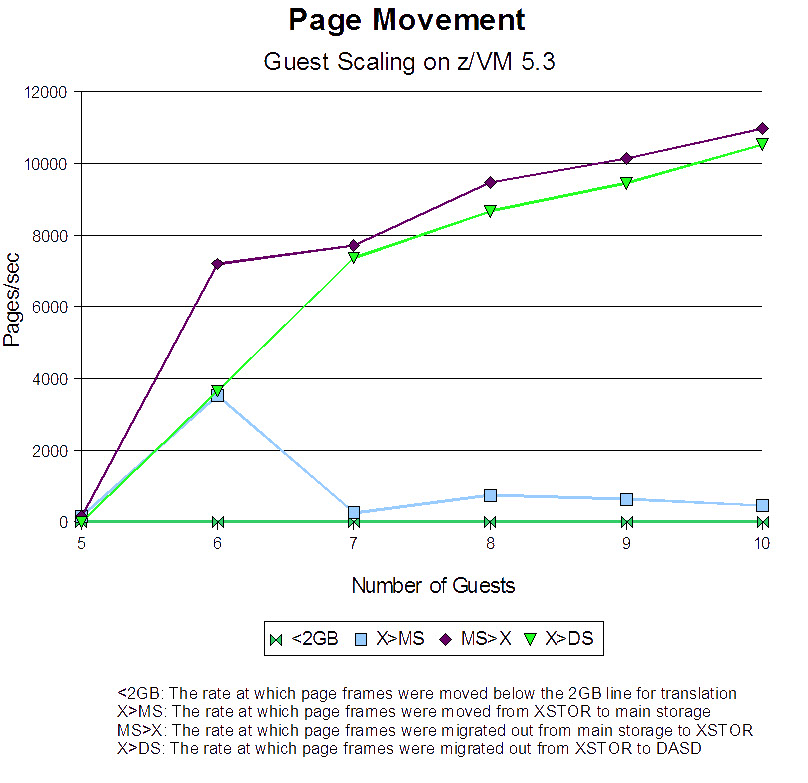
Figure 4 shows the relation of the memory overcommitment on the page movement rate to the various destinations.
Observations
As guests are scaled from five to ten, the page movement rates from main storage to XSTOR and from XSTOR to DASD increase. The movement rates continue to increase all the way up to ten guests.
Conclusion
The total system memory of 80 GB (20,971,520 pages) is overcommitted as follows:
| Number of Guests | Pages Not in Memory (= paged out) | Real Overcommit (pages used: memory) - 1 | Planned Overcommit (virtual : physical) - 1 | Throughput % From Baseline | |
| XSTOR | DASD | % | % | % | |
| 5 | 263193 | 0 | 1 | 0 | baseline |
| 6 | 1031469 | 5905366 | 33 | 20 | 82 |
| 7 | 1030564 | 11152384 | 58 | 40 | 77 |
| 8 | 1033732 | 16862208 | 85 | 60 | 70 |
| 9 | 1034246 | 21728256 | 109 | 80 | 65 |
| 10 | 1034667 | 25014272 | 124 | 100 | 58 |
At six guests, the throughput has decreased to 82% of the five guests' value. With the addition of more guests, throughput declines at an almost linear rate and at ten guests, throughput has decreased to 58%. As guests are added, z/VM 5.3 overhead also increases. This time the real overcommitment is 24% higher than the planned overcommitment. It appears that the paging algorithm for z/VM 5.3 decides to move pages out to DASD more often, which seems to be an advantage for this workload.