Using Geographically Dispersed Parallel Sysplex (GDPS)
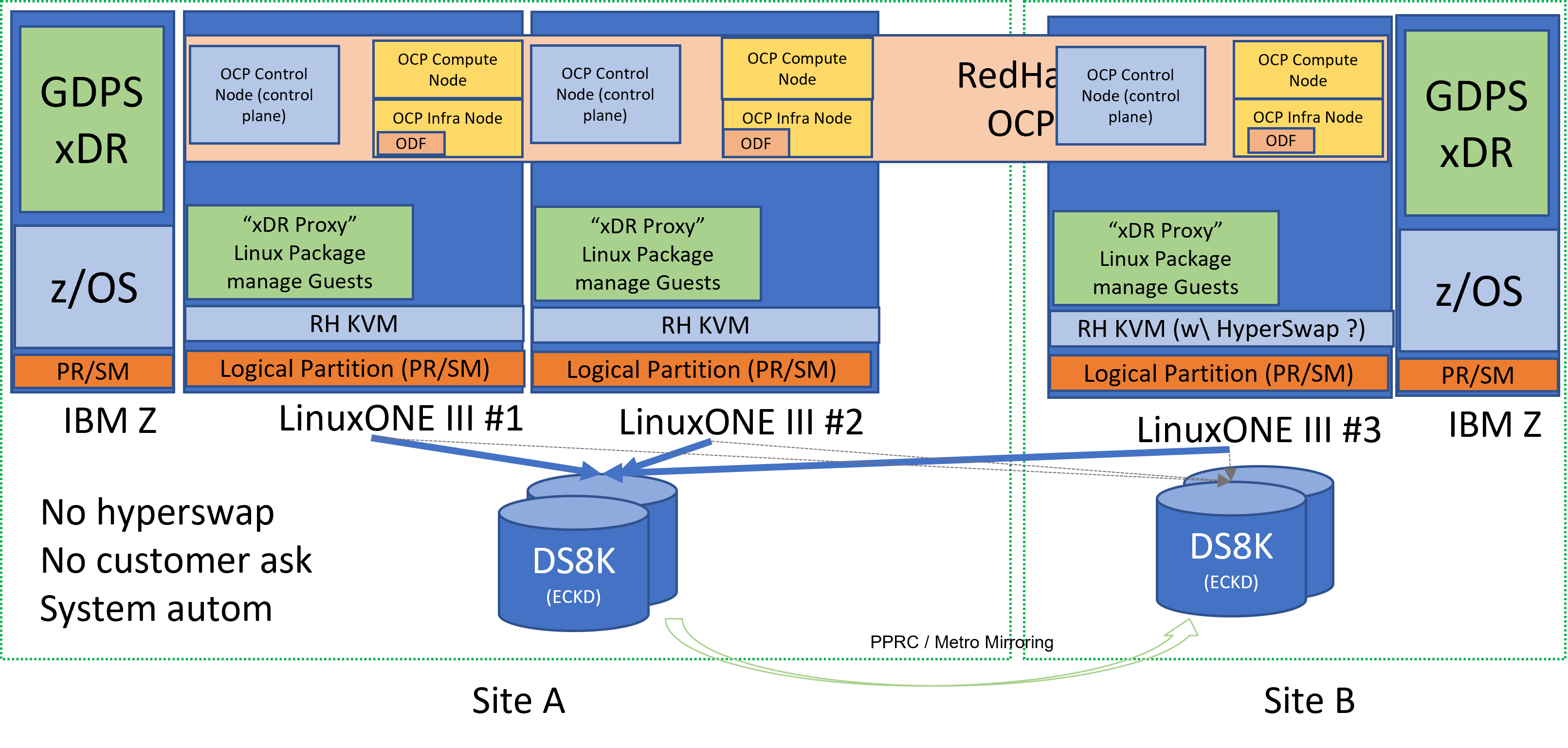
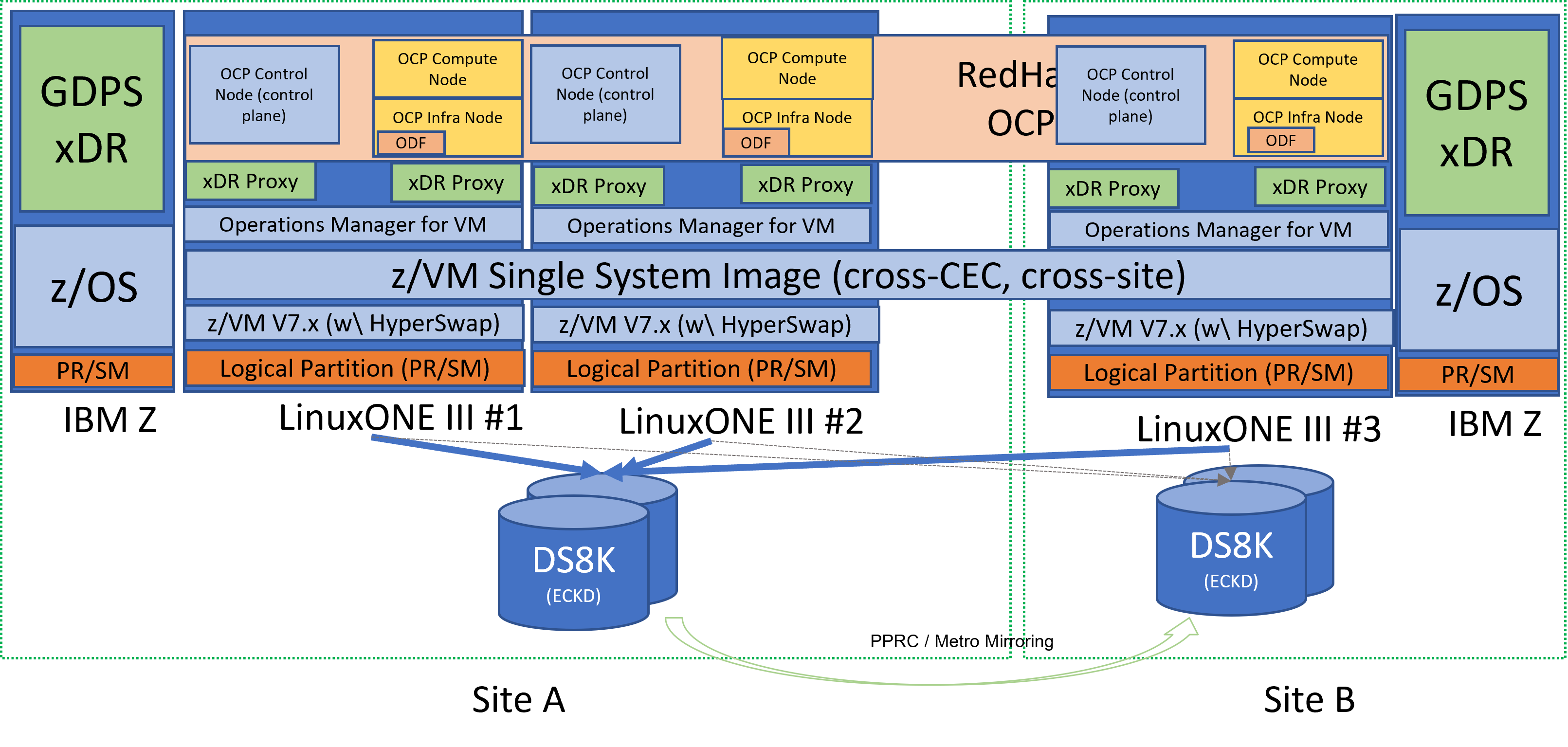
While regional and metro DR's implemented as open source software running on Red Hat OpenShift, it is also possible to add disaster recovery to the hardware layers of the system.
Geographically Dispersed Parallel Sysplex (GDPS) is a powerful and highly scalable solution by IBM, which mirrors physical storage between data centers. GDPS can run either on a z/OS system or within an appliance.
GDPS can control Red Hat OpenShift nodes to be restarted, manage network failures, and perform disk mirroring (ECKD/FICON/DASD only).
GDPS can also be used for multi-site replication and failover if there is the outage of one site.
Depending on the distance between the data centers, there are multiple options for setting up GDPS.
- GDPS Metro
- Based on the IBM Metro Mirror synchronous disk mirroring technology.
- GDPS Global - XRC
- Based on the IBM Extended Remote Copy (XRC) asynchronous disk mirroring technology (also called IBM z/OS Global Mirror).
- GDPS Global - GM
- Based on the IBM System Storage Global Mirror technology, which is a disk subsystem-based asynchronous form of remote copy.
GDPS features sophisticated options to ensure data consistency. In a metro-distance setup, the application execution can be forced to wait for an acknowledgment before proceeding to the next task. GDPS Global includes capabilities for a background sync to ensure consistency.
- GDPS is fully tested and supported for Red Hat OpenShift Container Platform applications running on IBM Z. Nevertheless, formal support for using GDPS with stateful workload using IBM Fusion Data Foundation on IBM® LinuxONE is not available yet. For IBM zCX, GDPS is formally supported as it uses VSAM LDS as the local disks.
- GDPS is limited to the use of ECKD/FICON/DASD disks only.
For details on GDPS, refer to this IBM Redbooks: IBM GDPS: An Introduction to Concepts and Capabilities