RM data synchronization
Each FTM SWIFT instance has its own RMDS, in which it stores its RM data. If you use several instances, you can set them up in such a way that their RM data is automatically synchronized. This lets you centrally manage one set of RM data and arrange for this data to be shared among all instances that need it. All instances that are to share RM data in this way must use the same BICs, which are configured by COs of type DnfBic8Map.
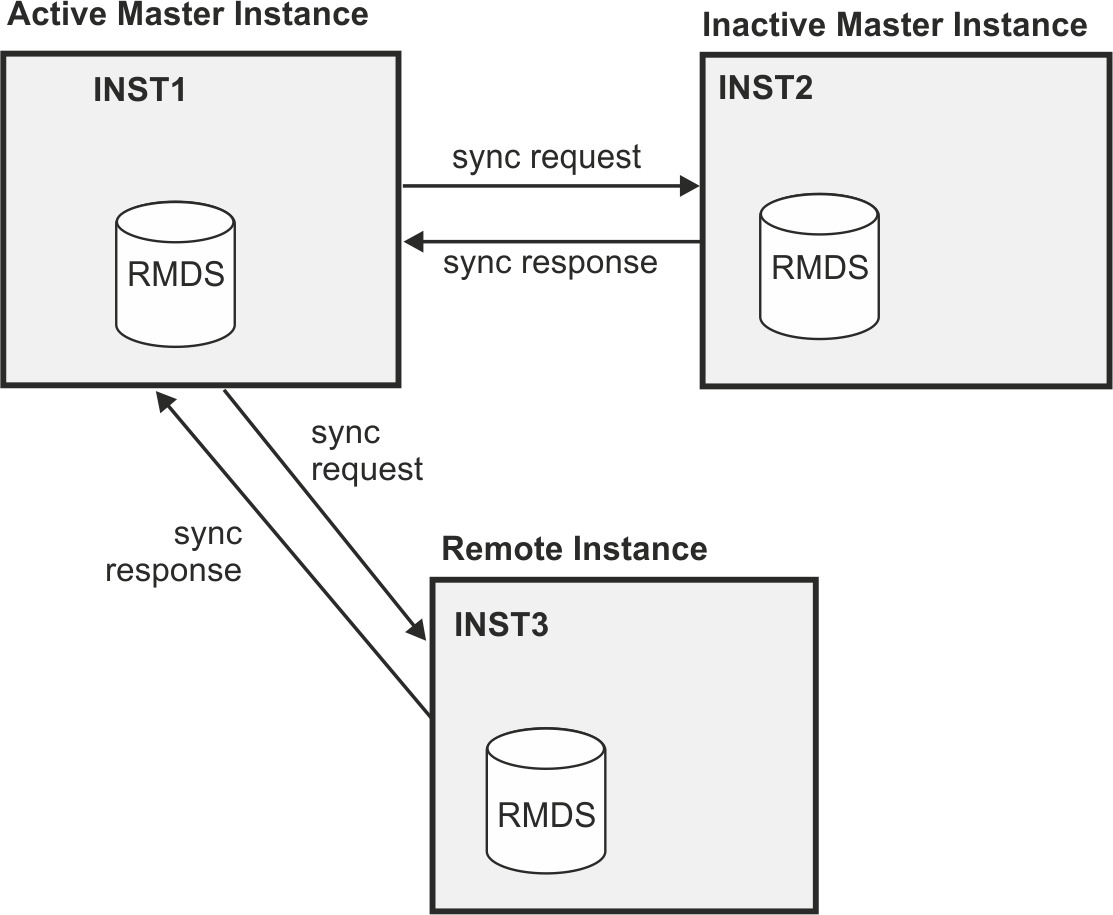
Each instance that is to be able to act as the source of shared RM data is called a master instance. An instance is a master instance when at least one CO of type DniRemoteInstance has been configured for it. Each CO of this type provides the master instance with the information it needs to synchronize its RM data with one remote instance. When the RM data in the RMDS of a master instance changes, the master instance sends synchronization requests to the remote instances. A remote instance uses the information contained in a synchronization request to automatically synchronize its RM data with that of the master instance.
There are situations in which you might want to configure more than one master instance. For example, you might want to set up one main instance and a second, backup instance, both of which are able to serve as sources of centrally managed RM data.
Use the RMA of only one master instance at a time. The master instance whose RMA is currently being used is called the active master instance. Because only one RMA is in use, only the RM data of the active master instance will change, so only that instance will send synchronization requests to remote instances. To change which master instance is active, stop using the RMA of one master instance and begin using the RMA of another.
Before RM data is automatically synchronized for the first time, and if certain synchronization errors occur, the RM data must be synchronized manually. This is done by exporting the RM data from the active master instance and importing it to all remote instances.
Figure 1 shows a typical setup for RM data synchronization.