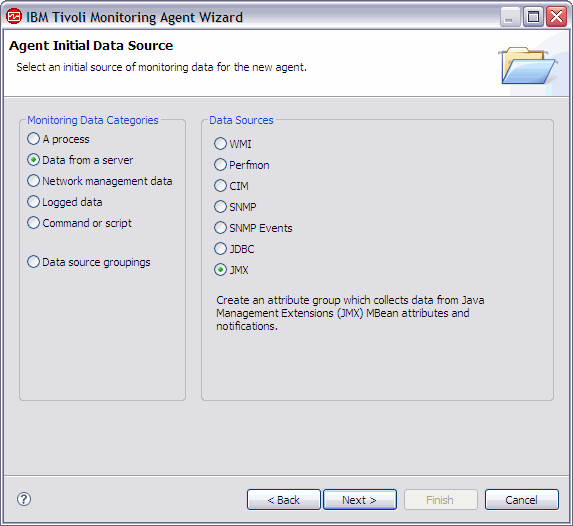
After you have defined the data source, you can use the browse function to pre-populate your attribute list. You can then add to, remove from, or modify the attributes that the browser inserted. The names for these attributes can be long and difficult to type correctly. Using the Browse option is an easy way to input the correct name.

- MBean pattern
- Displays the MBean pattern.
- Global JMX Options
- Displays the level of support (Figure 102).
Support is provided for the following JMX servers:
- Java 5 platform MBean Server. Connection is made using the JSR-160 connector. Notifications and monitors are supported.
- WebSphere® Application Server, version 6 and later. Connectors are provided for both SOAP and RMI protocols. JMX Monitors are not supported because MBeans cannot be created by a remote agent.
- WebSphere Community Edition and other Apache Geronimo-based application servers. Connection is made through standard JSR-160 connectors. JMX notifications and monitors are supported in versions 1.1 and later.
- JBoss Application Server, version 4.0 and later. See the following link to an item in the Troubleshooting appendix if you need support for JMX Monitors.
- WebLogic Server, version 9 and newer. Connector is provided for T3 protocol.

- To create a new connection to an MBean Server, click the plus (+) icon to add a new connection or to edit an existing connection. The following window (Figure 103) is displayed when no connections have been defined:
- After clicking the plus (+) icon to add a connection, the JMX Connection Selection page (Figure 104) is displayed:
- Use the MBean Server Connection Wizard to connect to an MBean server. The new connections listed on the page are selections you can make to create a new connection. You can use the list of existing connections to reconfigure an existing connection. Select one of the new connection types and click Next to begin creating a new connection.
- After selecting a connection type, you might be asked to select
a more specific type of connection. On the page above, two templates
based on the "Standard JMX Connections (JSR-160)" connection type
are shown. Select the template that is most appropriate for your
MBean server and click Next.
The Connection Properties page (Figure 106) contains the details on how to connect to an MBean server. This page needs to be completed with details about your MBean server.
(Optional) Select Set as agent configuration defaults if you want the defaults for JMX to be copied from these properties. For example, the default JBoss base paths is C:\jboss-4.0.2.
After you have specified the properties needed to connect, click Test Connection to ensure that the connection can be established. If the connection is not successful, correct the necessary properties.
When the connection is successful, click Finish to return to the browser that will begin using the connection you just configured.
The Java class path information in the Connection Properties page contains three fields that should be completed as necessary to connect to an MBean server that requires java classes that are not included in the Java 5 runtime environment. Normally, the MBean server you need to connect to should be installed on the same system as the Agent Builder. In this case, specify the directory where the application containing the MBean server was installed as the Base Paths field. The Jar Directories field should then list the directories relative to the Base Paths directory that contain the jar files needed to connect to the MBean server. The Class Path field can be used to include specific jar files. The jar files listed in the Jar Directories field do not need to be listed separately in the Class Path field.
Any of the fields can contain more than one reference; just separate the entries by a semicolon. These values are the same values that are needed when configuring the agent. See JMX configuration for additional information about these fields.


- MBean Key Properties area (upper left) - This is collection of every unique Object Name key found from all the MBeans on the server. The [Domain] entry is special because it is not really a key, but it is treatedt as an implied key for the value of the MBean's domain. When you select an item from this list, the JMX Browser finds all of the MBeans that contain that key property and displays the list of values of that key property in the list on the right. When you check a key property, it is included in the Object Name pattern for the data source.
- Selected Key Property Values area (upper right) - Shows the values of the currently-selected MBean Key Property from all MBeans. Selecting one of these values will check the MBean key property and update the Object Name Pattern that is displayed in the text field below with the MBean key property name and value.
- A table listing all MBeans matching the Object Name Pattern (center)
- As you select Key Properties and Values from the MBean Key Properties
and Selected Key Property Values lists, you will see the Object Name
Pattern update and the list of MBeans in this table will change to
reflect the list of MBeans that match the pattern you have currently
selected. If you have a pattern that is not matching any MBeans,
you can clear entries in the MBean Key Properties list by clicking
the check box next to a key being used by your pattern and removing
the check mark. Also, you can manually edit the pattern to find the
MBeans you are looking for. The pattern *:* selects all MBeans.
You can use this table to browse the MBeans from the server and decide which ones contain the data you want to monitor. To help browse a potentially large number of MBeans, you can sort by any key attribute (from the context menu or by clicking on a column header). You can also show any key attribute in any column by selecting "Show Key Property" from the context menu. When you see a key property value in the table that identifies MBeans you want to monitor, right-click on that value and choose Select only MBeans with Key Property from the context menu.
- A table containing details for a selected MBean - The JMX Browser shows you information about a single MBean. To see details for an MBean, you select the MBean from the table showing the list of MBeans matching the current filter. The key information about the MBean is the list of Attributes, Operations, and Notifications it defines.
To create a data source from the JMX Browser, use the four panels described above to build an Object Name Pattern that matches a set of MBeans that each contains the monitoring data you want to collect. For example, if you wanted to monitor data from all of the ThreadPool MBeans, you would do the following:
- Select type from the MBean Key Properties panel. Selecting type causes the values in the Selected Key Properties Values to be updated to list all unique values from the type key of any MBean.
- Select ThreadPool from the list of values for the type key. After selecting ThreadPool, the type key property name is checked in the MBean Key Properties panel and the Object Name Pattern is updated to "*:type=ThreadPool,*". The list of MBeans is also updated to show only the MBeans that match this pattern.
- Select one of the MBeans from the MBean list to see the attributes, operations and notifications available for the MBean. If your MBean list contains more MBeans than you want to monitor, you must continue this procedure of selecting key properties and values until you have the Object Name Pattern that identifies the set of MBeans you want to monitor. You can also display a context menu in the MBean list to update the Object Pattern with key property values shown in the table.
- Select whether JMX monitors are supported by this agent. See the next section for a description of JMX monitors. If you want JMX monitor attribute groups and Take Action commands to be created, check Include JMX monitor attribute groups and take actions.
- Select the types of MBean servers your agent will connect to when it is deployed. There are several vendor-specific types of servers listed, along with a generic JSR-160-Compliant Server for standards-based servers. You can select as many as needed, but you should only select server types that support the MBeans that are being monitored. You must select at least one. If you select more than one, at agent configuration time you are prompted to specify which type of server you want to connect to.

The JMX Agent-Wide Options window shows the types of application servers that the Agent Builder supports. If you previously selected Set as agent configuration defaults on the Connection Properties page, the type of application server that you browsed to is automatically selected.


The default value of the property, JBoss base paths, has the same value that was entered in the JMX browser in Step Figure 107.
