Question & Answer
Question
Answer
The Windows Application Package component contains the ODBC driver, OLEDB provider, ADO.Net provider, ActiveX components, and API support ported from the older IBM i Access for Windows client.
The Linux and macOS Application Packages provide an ODBC driver that works with the unixODBC project. This product replaces the older Linux client with a new and greatly improved ODBC driver.
Note: At the time of this writing, MS Excel for Mac does not integrate with the required unixODBC driver manager.
Technique #1: Use public RPM repositories (IBM i and Linux only)
See the open source documentation site for more details.
Technique #2: Download from IBM website
The 'Downloads for IBM i Access Client Solutions' link on the IBM ACS home page provides a simple way to download clients. Including the base client, the Linux and macOS ODBC driver packages, and the Windows Application Package for English 64-bit systems:
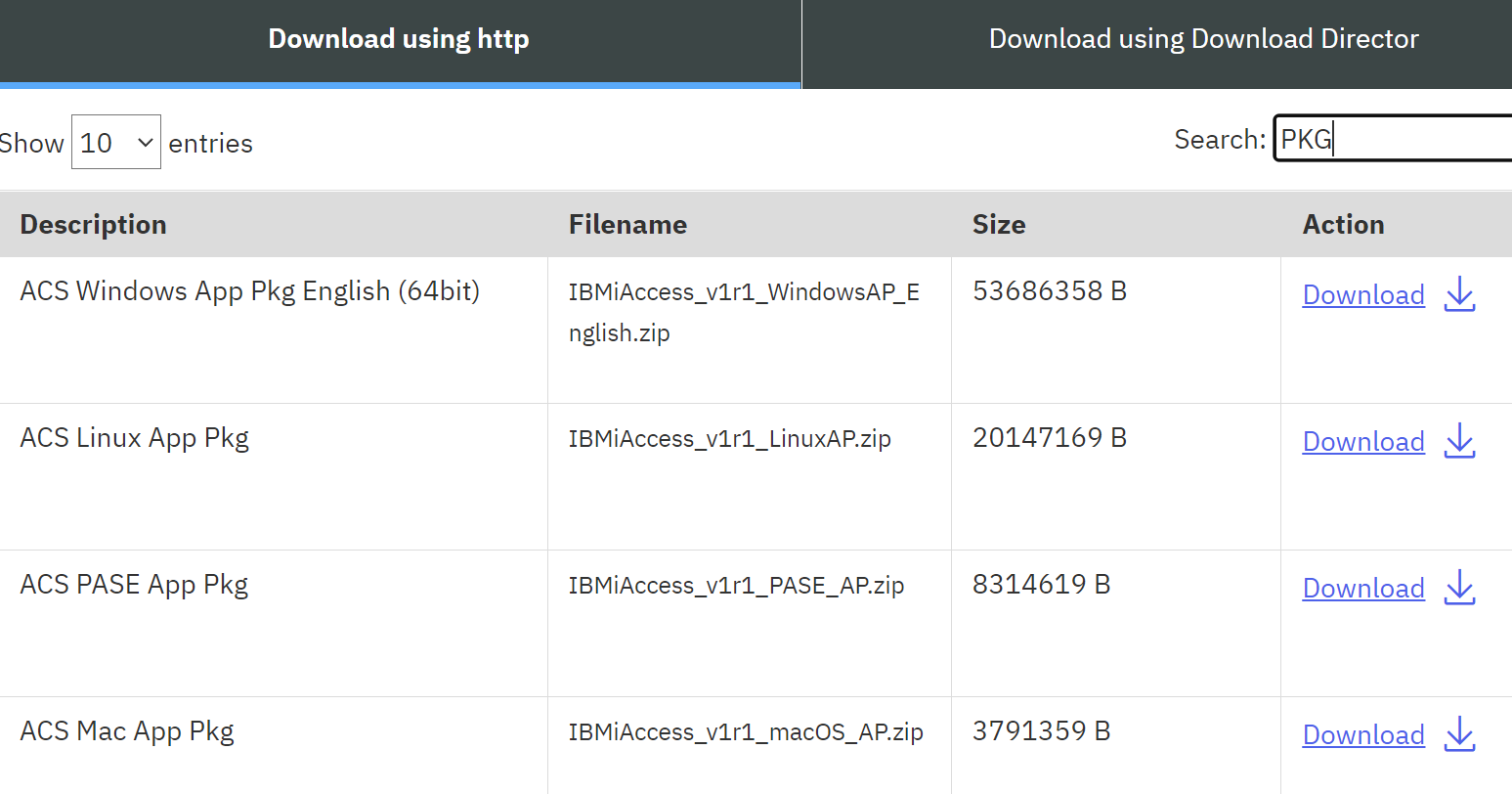
Accessing the downloads does require an IBM.com user ID and password.
To get other Windows languages or an installation image for a 32-bit Windows system, download them through IBM's Entitled Systems Support (ESS) or request the product from your IBM Business Partner. For more information about downloading the clients from ESS, see the instructions in technote, Obtaining IBM i Access Client Solutions.
The IBM ACS ODBC driver is designed to access all currently supported versions of IBM i.
The following PowerShell script can be used to test ODBC DSN connectivity to IBM i:
# Replace YourDSNname, YourUSRPRF, and YourPWD with appropriate values
$dsnName = "YourDSNname"
$UIDval = "YourUSRPRF"
$PWDval = "YourPWD"

# Create the connection string using the DSN
$connectionString = "DSN=$dsnName;UID=$UIDval;PWD=$PWDval;"

# Create and open the connection
try {
    $connection = New-Object System.Data.Odbc.OdbcConnection
    $connection.ConnectionString = $connectionString
    $connection.Open()
    Write-Host "ODBC connection using DSN '$dsnName' was successful!" -ForegroundColor Green
    $connection.Close()
} catch {
    Write-Host "ODBC connection failed:" $_.Exception.Message -ForegroundColor Red
}
Save the above into a file named "testODBC.ps1", and execute it from within PowerShell using:
./testODBC.ps1
Related Information
Was this topic helpful?
Document Information
Modified date:
20 June 2025
UID
nas8N1022156