Flashes (Alerts)
Abstract
In Db2 11.5.4 (Nebula), users will be able to use five new Federation Performance enhancements—enhancements you don't want to miss.
Content
- Federation Interpartition Parallelism;
- Federation FMP Enhancement;
- Federation Fetch Clause FFNR Pushdown;
- Federation NoSQL Wrapper Pushdown; and
- Bulk Insert for Oracle
Learn more about each feature below.
Inter-partition parallelism
Introduction
Inter-partition parallelism refers to the process of dividing a single query into multiple parts that run in parallel on different partitions of a partitioned database. Inter-partition parallelism aims to increase the nickname query performance. Inter-partition parallelism takes full advantage of the power of the cluster, it can request all applicable partitions to serve one SQL query at the same time.

Performance improvement
If inter-partition parallelism is enabled, then the data will be distributed to other partitions.
- When a federation server receives a query that references a remote table, the query will be split and executed on multiple partitions. Multiple database clients fetch data from the same remote table simultaneously. In other words, the federation server uses parallel fetching

Parallel fetching leverages the Db2 DPF infrastructure and exploits resources across all applicable database partitions. In parallel fetching, a single query is split into multiple parts and then every database partition will execute the partial query. When compared to serial fetching, parallel fetching implements parallel processing of data in multiple partitions at the same time thereby increasing the performance significantly.
SUPPORT_PARALLELISM is a server option and NICKNAME_PARALLEL is a new registry variable option value that have been added for this feature.

Introduction
The FMP buffer size determines the data volume that is fetched from the data source in a single processing cycle. To reduce the processing time for fetching data from the data source, the default Federation FMP buffer size has been increased from 32 KB to 2 MB which is the optimal value to improve performance based on internal testing.

Performance improvement
This enhancement improves the federation nickname query performance by optimizing the block fetching buffer size. Buffer size enhancement benefits all nickname queries.

Federation FETCH Clause (FFNR) Pushdown
Introduction
The FETCH FIRST n ROWS (FFNR) clause sets the maximum number of rows that can be retrieved from the data source. Only n rows are retrieved, regardless of the number of rows that the result set might otherwise contain.

The following table shows various server options like nested_tab_expr_w_fetch_n_rows that controls the pushdown behaviour depending on the capability of FETCH clause handling of different data sources:

Performance improvement
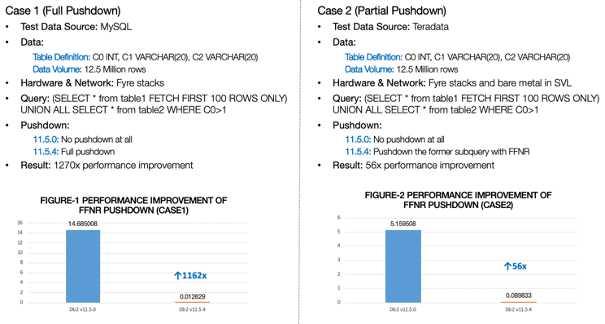
If the data source has enough capability to handle the FETCH clause, federation will push down the entire SQL query to the remote data source for retrieving data. If the data source has limited capability to handle the FETCH clause, federation will push down partial SQL to the remote data source for query execution and optimal performance.
This enhancement enables federation to push down the largest portion of SQL with the FETCH clause as shown in the following examples:
- Case 1: Entire SQL query with FETCH can be pushed down (as shown below)
- Case 2: Partial SQL query with FETCH can be pushed down (as shown below)
- Case 3: Partial SQL without FETCH can be pushed down (FETCH is executed locally)
Federation NoSQL Wrapper Pushdown Framework
Introduction
NoSQL database systems are distributed, non-relational databases designed for large-scale data storage and NoSQL wrappers are designed to access different kind of NoSQL data sources. MongoDB is one of the most popular NoSQL or non-relational databases.
Performance Improvement
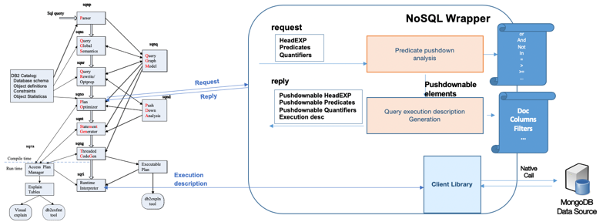
In Db2 Version 11.5.4, you can now reduce data transfer by pushing down predicates to MongoDB data sources through NoSQL wrapper. Comparing to federation pushdown analysis, which was designed for relational data sources, a new framework is created in the NoSQL wrapper for handling pushdown in non-relational data sources.
- Interacting with the Db2 plan optimizer with predicates that can be pushed down to create an access plan.
- Responding with 'query execution description' in remote native API, for using in execution of queries during runtime.
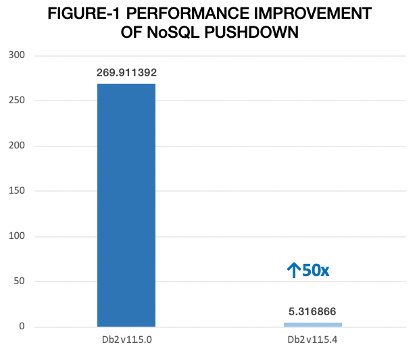
The following graph illustrates the performance improvement test result with the following use case:
- Test Data Source: MongoDB
- Data: 10M records in MongoDB collection
- Query: SELECT col1_int from nickname1 WHERE col_int<200
- Result: 50x performance improvement
Introduction
Inserting data is also a common use scenario of Federation technology, and the Bulk Insert functionality is also improved when the user is using Federation to insert data into an Oracle data source in v11.5.4.
The Bulk Insert scenarios includes:
- Insert operation with multiple rows selected from a source table
- Insert operation with multiple values in SQL directly
To enable the Bulk Insert functionality, the user can specify the server option of ENABLE_BULK_INSERT to "Y". The function also requires the array bind functionality of the Oracle OCI client to work together with the Federation. The user will get better performance improvement when the buffer is large enough to contain more values during the insert processing.
Performance Improvement
The following graph illustrates the performance improvement test result with the following use case:
- Data source: Oracle
- Data:
- Table definition: CREATE TABLE LOCAL_TABLE1 (c0 int. c1 char(10), c3 varchar(40), c4 double precision, c5 (timestamp)
- Data format: ('1','AAAAA','AAAAASSSSSDDDDDFFFFFGGGGGHHHHHJJJJJ','-0.99','1974-11-23-12.12.12.12.123451')
- Data volume: 1 million rows
- Table definition: CREATE TABLE LOCAL_TABLE1 (c0 int. c1 char(10), c3 varchar(40), c4 double precision, c5 (timestamp)
- Query: INSERT INTO ORACLE_TABLE SELECT * from LOCAL_TABLE1;
- Result: 84x performance improvement

Federation Transformation
Federation Server has gone through many innovative transformations in the past few years. It provides 'Federation Everywhere' capability across all the IBM on-prem and on-cloud Common SQL Engine offerings including Db2, BigSQL, Db2 Warehouse, Db2 Warehouse on Cloud, and IIAS, etc. Federation Server also becomes a core component of the IBM Data Virtualization technology as it provides its sophisticated SQL optimization and pushdown capability. As discussed in this blog, Federation Server has transformed itself with many new performance enhancements to provide a better user experience. There is still more to come on our roadmap.

Was this topic helpful?
Document Information
Modified date:
23 July 2020
UID
ibm16248349