Partial Correlations Table
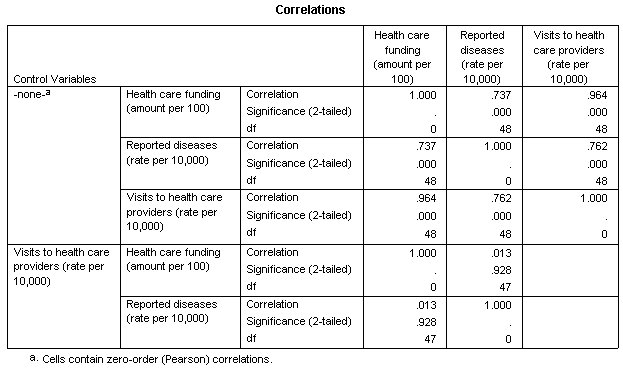
In this example, the Partial Correlations table shows both the zero-order correlations(correlations without any control variables) of all three variables and the partial correlation of the first two variables controlling for the effects of the third variable.
The zero-order correlation between health care funding and disease rates is, indeed, both fairly high (0.737) and statistically significant(p < 0.001). The partial correlation controlling for the rate of visits to health care providers, however, is neglibile (0.013)and not statistically significant (p = 0.928.)
One interpretation of this finding is that the observed positive "relationship" between health care funding and disease rates is due to underlying relationships between each of those variables and the rate of visits to health care providers: Disease rates only appear to increase as health care funding increases because more people have access to health care providers when funding increases, and doctors and hospitals consequently report more occurrences of diseases since more sick people come to see them.
Going back to the zero-order correlations, you can see that both health care funding rates and reported disease rates are highly positively correlated with the control variable, rate of visits to health care providers. Removing the effects of this variable reduces the correlation between the other two variables to almost zero. It's even possible that controlling for the effects of some other relevant variables might actually reveal an underlying negative relationship between health care funding and disease rates.