Socket Interface to Network Facilities
This section explains the socket interprocess communication (IPC) facilities.
The socket interprocess communication (IPC) facilities, illustrated by the Operating System Layer Examples figure (Figure 1), are layered on top of networking facilities. Data flows from an application program through the socket layer to the networking support. A protocol-related state is maintained in auxiliary data structures that are specific to the supporting protocols. The socket level passes responsibility for storage associated with transmitted data to the network level.
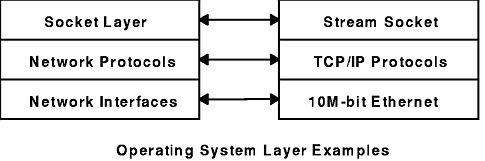
Some of the communication domains supported by the socket IPC facility provide access to network protocols. These protocols are implemented as a separate software layer logically below the socket software in the kernel. The kernel provides ancillary services, such as buffer management, message routing, standardized interfaces to the protocols, and interfaces to the network interface drivers for the use of the various network protocols.
User request and control output subroutines serve as the interface from the socket subroutines to the communication protocols.