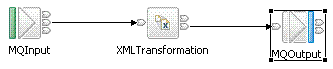
El ejemplo XSL Transform muestra cómo se puede transformar un mensaje XML utilizando un nodo XSLTransform y una hoja de estilo XSL.
La ubicación de la hoja de estilos que se usa para la transformación de XML puede especificarse de varias formas:
La hoja de estilo que se utiliza en este ejemplo se parece al ejemplo siguiente:
<?xml version="1.0" encoding="ISO-8859-1"?>
<xsl:stylesheet version="1.0" xmlns:xsl="http://www.w3.org/1999/XSL/Transform">
	<xsl:template match="/">
	<SaleEnvelope>
		<xsl:for-each select="/SaleEnvelope/SaleList">
			<SaleList>
			<xsl:for-each select="Invoice">
				<xsl:if test="not(contains(Surname,'Shop'))">
					<Statement>
						<xsl:attribute name="Type">Monthly</xsl:attribute>
						<xsl:attribute name="Style">Full</xsl:attribute>
						<Customer>
							<Initials>
								<xsl:for-each select="Initial">
									<xsl:value-of select="."/>
								</xsl:for-each>
							</Initials>
							<Name><xsl:value-of select="Surname"/></Name>
							<Balance><xsl:value-of select="Balance"/></Balance>
						</Customer>
						<Purchases>
							<xsl:for-each select="Item">

                  <Article>
                    <Desc><xsl:value-of select="Description"/></Desc>
                    <Cost><xsl:value-of select='format-number((number(Price)*1.6),"####.##")'/></Cost>
                    <Qty><xsl:value-of select="Quantity"/></Qty>
                  </Article>

                </xsl:for-each>
              </Purchases>
              <Amount>
                <xsl:attribute name="Currency">
                  <xsl:value-of select="Currency" />
                </xsl:attribute>
                <xsl:call-template name="sumSales">
                  <xsl:with-param name="list" select="Item"/>
                </xsl:call-template>
              </Amount>
            </Statement>
          </xsl:if>
        </xsl:for-each>
        </SaleList>
      </xsl:for-each>
    </SaleEnvelope>
    </xsl:template>

    <xsl:template name="sumSales">
      <xsl:param name="list" />
      <xsl:param name="result"  select="0"/>

      <xsl:choose>
        <xsl:when test="$list">
          <xsl:call-template name="sumSales">
            <xsl:with-param name="list"
              select="$list[position()!=1]"/>
            <xsl:with-param name="result"
              select="$result + number($list[1]/Price)*number($list[1]/Quantity)*1.6"/>
          </xsl:call-template>
        </xsl:when>
        <xsl:otherwise>
          <xsl:value-of select='format-number(number($result),"####.##")'/>
        </xsl:otherwise>
      </xsl:choose>
    </xsl:template>

</xsl:stylesheet>
Esta hoja de estilo se utiliza para transformar el mensaje XML siguiente (que se proporciona en el ejemplo como XMLT_sample_msg.mbtest):
<SaleEnvelope>
 <Header>
  <SaleListCount>1</SaleListCount>
 </Header>
 <SaleList>
  <Invoice>
   <Initial>K</Initial>
   <Initial>A</Initial>
   <Surname>Braithwaite</Surname>
   <Item>
    <Code>00</Code>
    <Code>01</Code>
    <Code>02</Code>
    <Description>Twister</Description>
    <Category>Games</Category>
    <Price>00.30</Price>
    <Quantity>01</Quantity>
   </Item>
   <Item>
    <Code>02</Code>
    <Code>03</Code>
    <Code>01</Code>
    <Description>The Times Newspaper</Description>
    <Category>Books and Media</Category>
    <Price>00.20</Price>
    <Quantity>01</Quantity>
   </Item>
   <Balance>00.50</Balance>
   <Currency>Sterling</Currency>
  </Invoice>
  <Invoice>
   <Initial>T</Initial>
   <Initial>J</Initial>
   <Surname>Dunnwin</Surname>
   <Item>
    <Code>04</Code>
    <Code>05</Code>
    <Code>01</Code>
    <Description>The Origin of Species</Description>
    <Category>Books and Media</Category>
    <Price>22.34</Price>
    <Quantity>02</Quantity>
   </Item>
   <Item>
    <Code>06</Code>
    <Code>07</Code>
    <Code>01</Code>
    <Description>Microscope</Description>
    <Category>Miscellaneous</Category>
    <Price>36.20</Price>
    <Quantity>01</Quantity>
   </Item>
   <Balance>81.84</Balance>
   <Currency>Euros</Currency>
  </Invoice>
 </SaleList>
 <Trailer>
  <CompletionTime>12.00.00</CompletionTime>
 </Trailer>
</SaleEnvelope>
El diagrama siguiente muestra el flujo de mensajes que se utiliza para transformar el mensaje XML. Para obtener información más detallada, abra XMLT_Sample_flow.msgflow en el editor Flujo de mensajes y examine cada nodo.