Physical functions, virtual functions, and ports
For the RoCE Express adapters, depending on the physical slot at which the network adapter is plugged, the adapter is managed through one of the PCI resource groups.
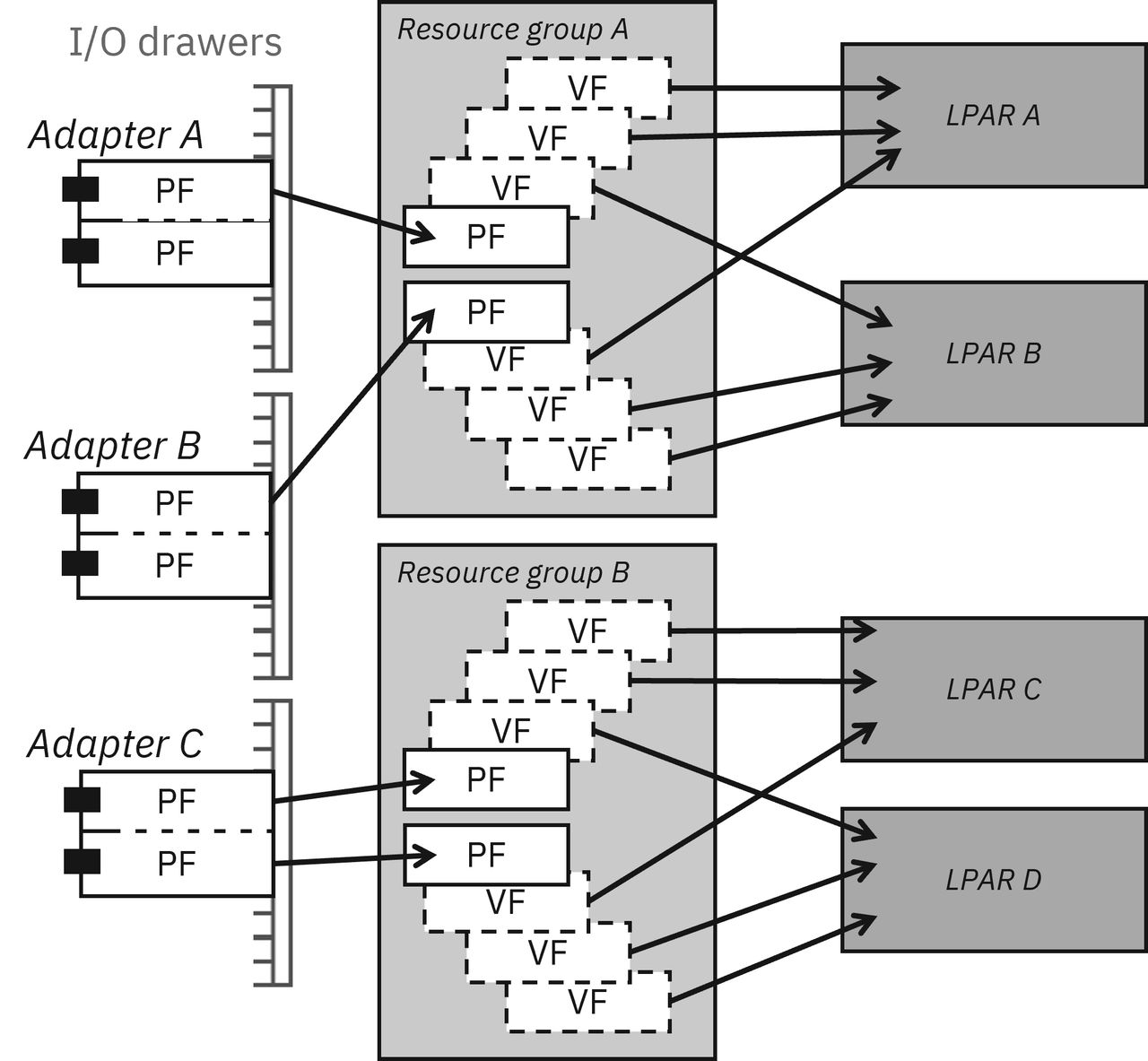
Each physical function(PF) has multiple virtual functions (VFs). The hardware administrator can make these virtual functions eligible for LPARs or DPM partitions. For the Network Express in direct mode, LPARs control the PFs to which they are assigned.
RoCE Express and Network Express in hybrid mode can only use VFs directly in Linux® on IBM Z®, therefor PFs are not accessible for these adapters. Only Network Express in direct mode can access PFs.
| Feature | Physical adapter ports | Ports per PF | Maximum VFs per PF |
|---|---|---|---|
| Network Express in hybrid mode | 2 | 1 | 123 |
| Network Express in direct mode (function type NETD) | 2 | 1 | 127 |
| RoCE Express3 | 2 | 1 | 63 |
|
RoCE Express2.1 |
2 | 1 | 63 |
| RoCE Express (see Note) | 2 | 2 | 31 |
As of RoCE Express2 and RoCE Express3, all PCI functions that are associated with the same physical function share one of the physical adapter ports.