Scaling the number of FICON channels per ISFC logical link
The results so far show very clearly that the amount of FICON® channels is the most important parameter to speed up the relocation process. This section addresses the question as to whether the relocation and quiesce times can be even more reduced if the amount of FICON channels is further increased.
Figure 1 shows the scaling of the relocation and quiesce times when up to seven FICON channels and "straight" FCTC connections are used.
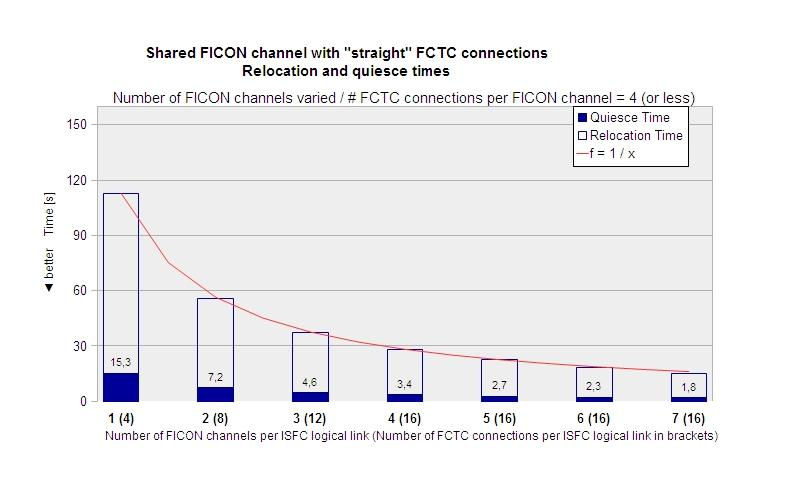
For the test cases reflected in Figure 1, the number of FCTC connections per FICON channel were configured as follows:
- For configurations with four or less FICON channels, four FCTC connections per FICON channel were configured; the number of FCTC connections for the ISFC logical link overall is the sum of the FCTC connections from the FICON channels.
- With five FICON channels or more, always the maximum of sixteen FCTC connections were configured for the ISFC logical link . These were distributed over the FICON channels, as follows:
- With five FICON channels, four FICON channels were configured with three FCTC connections each, and one FICON channel was configured with four FCTC connections
- With six FICON channels, four FICON channels were configured with three FCTC connections each, and two FICON channels were configured with two FCTC connections each
- With seven FICON channels, five FICON channels were configured with two FCTC connections each, and two FICON channels were configured with three FCTC connections each
Observation
The relocation as well as the quiesce time scale inversely linear with the number of FICON channels from which FCTC connections are configured into the ISFC logical link. In other words, if the (normalized) relocation time is 1 when only one FICON channel is used, it is about 1/2 with two FICON channels used, 1/3 with three FICON channels used, and so forth.
Conclusion
As long as a sufficient number of FCTC connections from each FICON channel is used, the observed inverse linear dependency can be expected. That means that the performance of the relocation process scales linear with the amount of FICON channels. For example, the relocation time when four FICON channels are used is four times faster than with one FICON channel.