Influence of striping of FCTC devices numbers over FICON channels
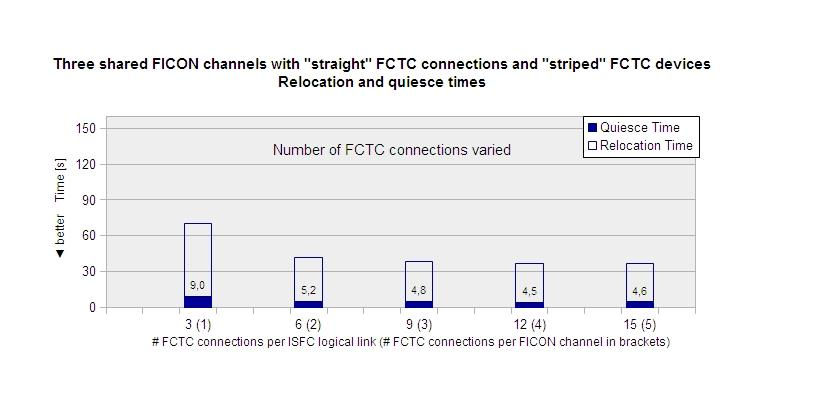
Figure 1 shows how the relocation and the quiesce times scale when three shared FICON® channels are used, but the FCTC device numbers are assigned in a “striped” manner (see ISFC logical link configuration on how to assign FCTC device numbers to FICON channels in a “striped” manner). The amount of FCTC connections configured for the ISFC logical link is varied.
Observation
The relocation and quiesce time quickly converge towards a constant value as two or more FCTC connections per ISFC logical link are used.
Conclusion
When comparing the results from ISFC logical link configuration using FCTC connections with "striped" FCTC device number assignment with those of the corresponding configuration using FCTC connections with a sequential FCTC device number assignment (compare Figure 1 with Figure 2), no significant impact can be observed.
However, the effects of striping FCTC device numbers become more apparent when observing the data rates achieved by an ISFC logical link. This is detailed in Influence of striping of FCTC devices numbers over FICON channels.