Workload generation
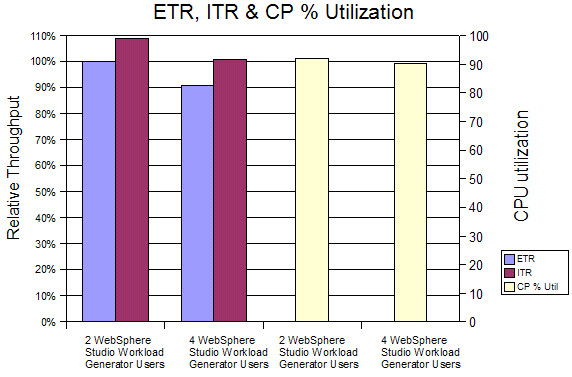
For measurements with WebSphere® on Linux® on System z™, 60 WebSphere Studio Workload Simulator users were used, divided equally between two WebSphere Studio Workload Simulator systems (30 users each). To study the effect of the number of workload generators, a run was performed where four client systems were used. 60 workload generators were divided equally among systems (15 clients each).
Observations
The transaction throughput decreases by nearly 10%, which was not expected. However, the processor utilization on the server remained the same, which was expected. The CPU usage is also unexpectedly high, much higher than the increase in cycles per instruction, which results in a decreasing ITR.
Conclusion
Distributing the same workload over more client systems reduces the transaction throughput. It was expected that the opposite would be true because contention on the client side should be reduced. Theoretically, the server should see exactly the same workload, even if the clients were slower to generate the workload. Because this is not the case, it indicates significantly decreasing ITR. It seems that it makes a difference for WebSphere Application Server that data structures from the same user on the same host are shared and they are not shared if the user logs on from different client machines.