Memory allocation
Many of the CARMA API functions require that either the RAM or
the CARMA client allocate memory to store function results or parameters
that are passed between the RAM and the CARMA client. For all functions
other than extractMember and putMember,
a one dimensional array will need to be allocated by the RAM and freed
by the client to store sets of instance information, member information,
and other information. The following diagram illustrates how the RAM
should allocate this array:
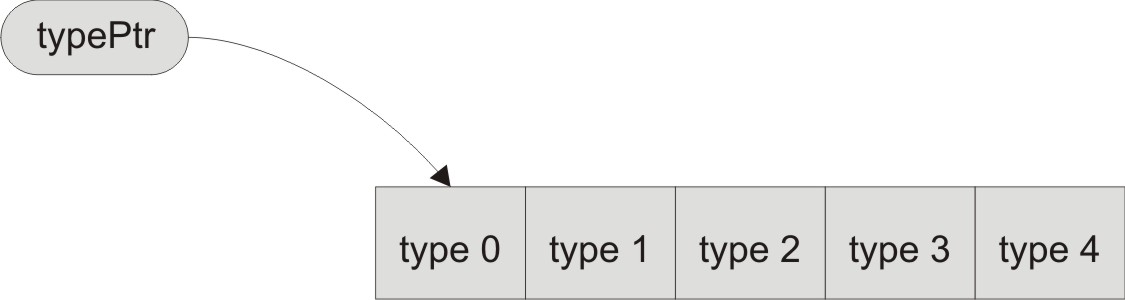
Each element in the array depicted above is of data structure type type. typePtr is
a type pointer (of type type*) that
serves as a handle to the newly allocated memory. In C, this memory
can be allocated with the following code:
typePtr = (type*) malloc(sizeof(type) * numElements);where numElements is the number of array indices
that need to be created. The memory typePtr points
to must be freed by the client once it is no longer needed.
The putMember and extractMember functions
use two-dimensional arrays to transfer member contents, with each
array row containing one of the member's records. For extractMember,
the RAM should allocate the array and the CARMA client should free
the array. For putMember, the CARMA client should
both allocate and free the array. In both cases, the array should
be allocated as illustrated in the following diagram:
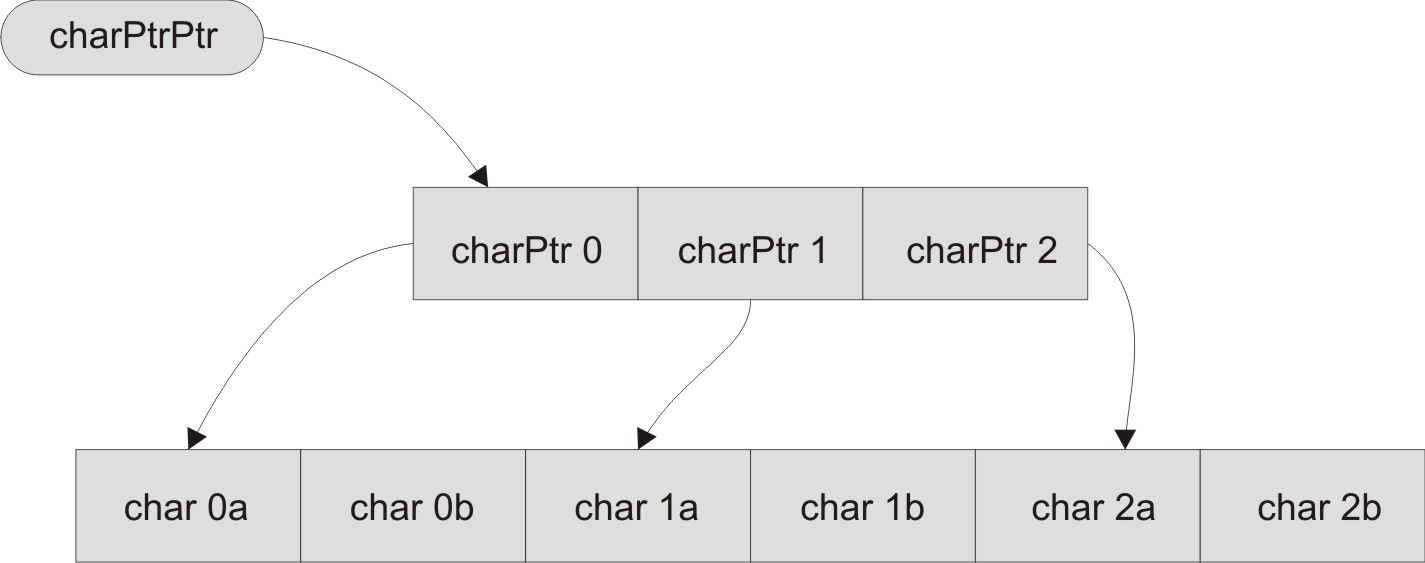
charPtrPtr is a pointer to a char pointer
(it is of type char**) that serves as a handle to
an array of char pointers (elements of type char*).
The data for the two-dimensional character array is actually stored
in a one-dimensional character array; the idea of rows and columns
is purely conceptual. The array of char pointers
is used to provide handles to the first element in each row of the
"two-dimensional" array. Thus, in the illustration, the first row
of the two-dimensional array consists of elements 0a and 0b, with
0a being the first element of that row; the second row consists of
elements 1a and 1b, with 1a being the first element of that row; and
so on.
To allocate a two-dimensional array such as the ones required for
the extractMember and putMember functions,
the CARMA client must first create charPtrPtr. In
C, use the following declaration:
char** charPtrPtr;If the CARMA client is allocating the two-dimensional character
array (as is the case for the putMember function)
the array can now be allocated. In C, the CARMA client should use
the following code:
charPtrPtr = (char**) malloc(sizeof(char*) * numRows);
*charPtrPtr = (char*) malloc(sizeof(char) * numColumns * numRows);
for(i = 0; i < numRows; i++)
   (charPtrPtr)[i] = ( (*charPtrPtr) + (i * numColumns) );
where numRows is the number of rows and numColumns is
the number of columns in the two-dimensional array. The first line
allocates the array of char pointers (one pointer
for each row in the two-dimensional array), the second line allocates
the array that holds the data for the two-dimensional array, and the for loop
assigns each of the char pointers in the char pointer
array to a row in the two-dimensional array.
If the RAM is allocating the two-dimensional character array (as
is the case for the extractMember function) an extra
step is required before the array can be allocated: charPtrPtr needs
to be passed by reference to the RAM as extractMember's contents parameter;
that is, a pointer to charPtrPtr needs to be passed.
This is necessary so that the client has a handle to the two-dimensional
array after the RAM has allocated the array. Suppose that the RAM
receives a parameter named contents of type char*** in
the RAM function that will allocate the two-dimensional array. The
RAM should then allocate the two-dimensional array, using contents as
a handle to the array. In C, the RAM should use the following code
to allocate the two-dimensional array:
*contents = (char**) malloc(sizeof(char*) * numRows);
**contents = (char*) malloc(sizeof(char) * numColumns * numRows);
for(i = 0; i < numRows; i++)
   (*contents)[i] = ( (**contents) + (i * numColumns) );
where numRows is the number of rows and numColumns is
the number of columns in the two-dimensional array. The first line
allocates the array of char pointers (one pointer
for each row in the two-dimensional array), the second line allocates
the array that holds the data for the two-dimensional array, and the for loop
assigns each of the char pointers in the char pointer
array to a row in the two-dimensional array.
Regardless of who allocated the array, the CARMA client must free
the two-dimensional character array in both the extractMember and putMember functions.
In C, the CARMA client should use code similar to the following:
free(charPtrPtr[0]);
free(charPtrPtr);
This frees the data array before freeing the char pointer
array, thus avoiding a memory leak.