Storage for multi-architecture hybrid cloud topologies
Requirements for software defined storage
Data and AI solutions constitutes of massive amounts of unstructured data, primarily in the form of files or objects that must be dealt with by IT. The challenges include - providing adequate amounts of storage in hybrid cloud topologies on demand as well as ensuring sophisticated data protection. Containerized workloads add another set of needs for seamless integration.
- Scale and perform from small to large deployments. Storage needs to be efficient, offering caching but avoiding unnecessary data copies.
- Share data across boundaries and computing units and networks in a way, which makes the data consumable by the applications.
- Ensure resilience, such as procedures for disaster recovery.
- Manage local, distributed, and cloud storage in a consistent way.
In such solutions one can’t simply plug hard disk drives into boxes. Well, yes, eventually somebody needs to do this somewhere. But that is not the point. The point is to create a fabric of shared logical storage units. Software-defined storage is all about virtualizing storage and making it available to the workload, which fulfils dynamic business needs. This versatile fabric adds a level of abstraction to decouple the physical hardware, which can reside anywhere, from the consuming workload. This fabric can span virtual machines, hardware, networks, and even computer architectures. It creates the flexible storage foundation for true hybrid workloads.
The advantage of software-defined storage is to provide storage that survives disasters, scales with the customer workload, and is simple to provision for use. Software-defined storage also provides the capability of sharing of data across system boundaries across distributed applications, like containerized Red Hat OpenShift Container Platform workload.
IBM Fusion
Let's have a closer look on IBM’s flagship offering for container-native software-defined storage: IBM Fusion. IBM Fusion is based on Red Hat® OpenShift® and includes two options for storage infrastructure, which can be combined as needed:
- The first option is IBM Storage Scale, which is based on GPFS file Storage.
- The other option is IBM Fusion Data Foundation, which is also known as Red Hat OpenShift Data Foundation and is based on open source Ceph® storage.
IBM Fusion focuses on consumability, for example it features common operational procedures for disaster recovery or deployment, regardless which storage infrastructure you have chosen. In addition, IBM Fusion adds services of its own. For example, a backup/restore service, which can protect the data that is stored in the underlying infrastructure.
It’s worth mentioning that IBM Fusion as an IBM product includes licenses to use both infrastructure options and allows you to deploy both IBM Storage Scale as well as IBM Fusion Data Foundation in the same data center. There is support for IBM Z and IBM LinuxONE as well as for IBM zCX Foundation for Red Hat OpenShift, in case you want to run this software directly on IBM z/OS®.

IBM Storage Scale
IBM Storage Scale excels when dealing with large amount of unstructured data, which is globally distributed. The perfect scenarios for AI, Big Data Analytics, or any other high-performance workload. IBM Storage Scale just scales amazingly well!
As a global data platform, Scale makes data available wherever it's needed, without redundant copies, which would be hard to manage. Nice features allow to define multiple tiers of data access. IBM Storage Scale implements high availability and reliability with no single point of failure. Administrators can configure the file system so that it automatically remains available if a disk or server fails. IBM Storage Scale can speed up time-to-results and maximize utilization by providing parallel access to data and shared disks, improving scalability for high-performance workloads. In addition, IBM Storage Scale can automatically spread data across multiple storage devices. It optimizes available data utilization and delivers high performance where needed.
IBM Storage Scale is platform independent. It can run on IBM Z®, IBM LinuxONE, IBM Power Systems, and on x86 machines. The attached storage can be from IBM and/or other vendors. This flexibility can reduce costs and improve energy efficiency.
Another aspect to highlight is the large number of supported protocols, which can be used by application when dealing with storage: IBM Storage Scale offers native, high-performance, and scalable access to file and object data via almost all standard storage protocols, including OpenStack®, Swift, Amazon S3, CIFS, NFS, HDFS, and Red Hat® OpenShift Container Platform via the Containers Storage Interface (CSI).
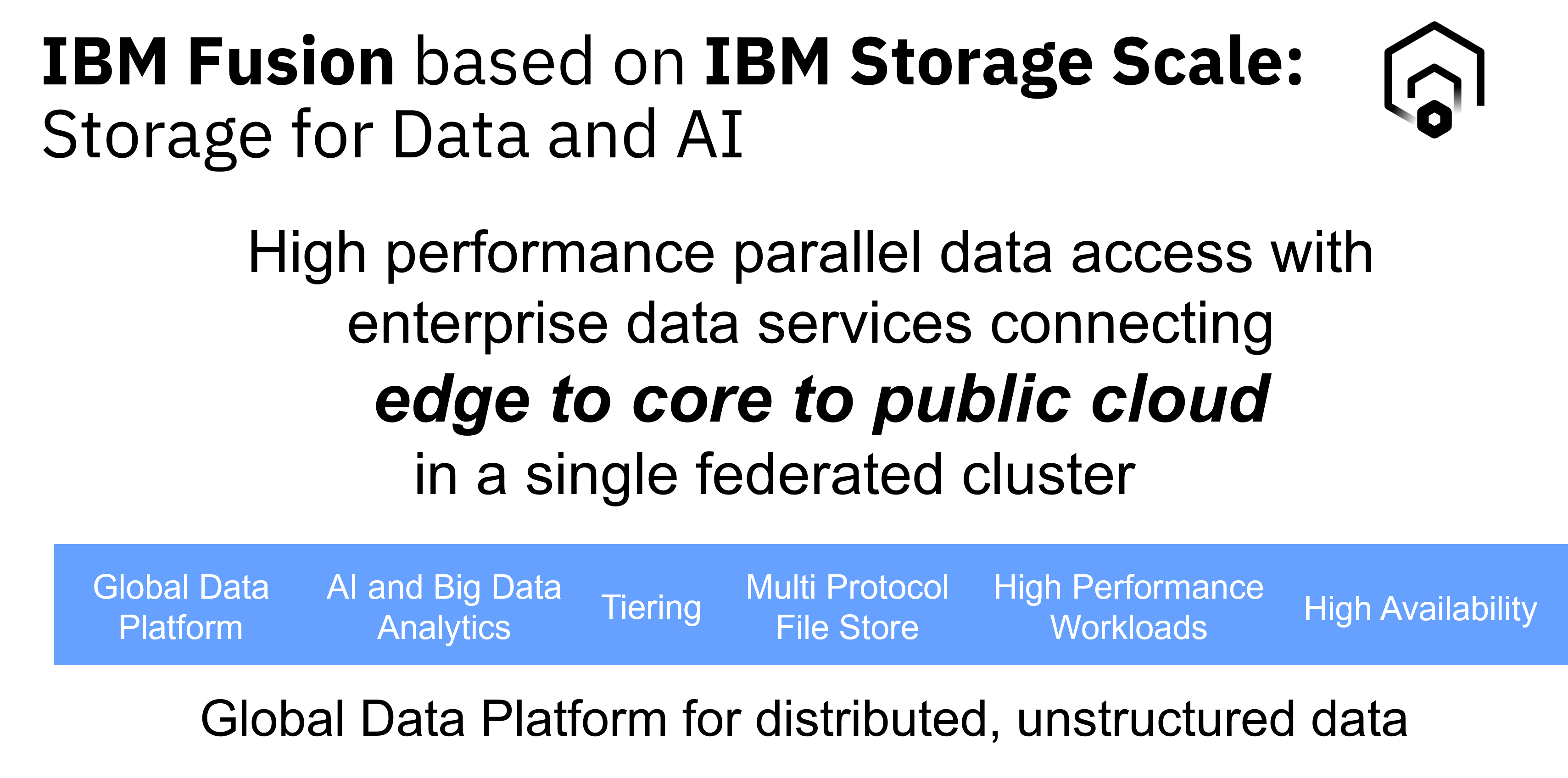
Here is an attempt to describe Storage Scale in one sentence: “high-performance parallel data access with enterprise data services connecting edge to core to public cloud in a single federated cluster”
Running IBM Fusion on IBM Z and LinuxONE hardware
One more consideration when choosing your software-defined storage infrastructure is the choice of the hardware platform. While IBM Fusion and IBM Storage Scale are available on several hardware platforms with more or less the same set of features, there are clear benefits when running on IBM Z and LinuxONE
- The resilience of IBM Z and LinuxONE is second to none, by featuring 99.99999% platform uptime, due to hardware, which is designed for reliability.
- Compliance, sustainability, and multi tenancy by EAL5+ certified virtualization adds to the value of the platforms.
- By consolidating multiple applications on a single versatile server, administration and orchestration become simpler and more efficient.
- For containerized workload using container-native storage, the IBM Z and LinuxONE platforms excel with impressive vertical as well as scalability. You can easily scale up to millions of containers and thousands of Linux guests in one physical server to meet even unexpected peak load.
- In combination with Red Hat OpenShift, the administration of your workload is based on standard Kubernetes practices and hides hardware specifics. You can take advantage of all benefits of the splendid platforms, while IBM Fusion can be used in a platform agnostic way with common industry skills.
IBM Storage Scale for Linux on IBM Z implements a clustered file system and has many features beyond common shared data access. It includes data replication, policy-based storage management, and multi-site operations. It provides superior capabilities of resiliency, scalability, and high performance for data and file management - built upon IBM General Parallel File System (GPFS™).