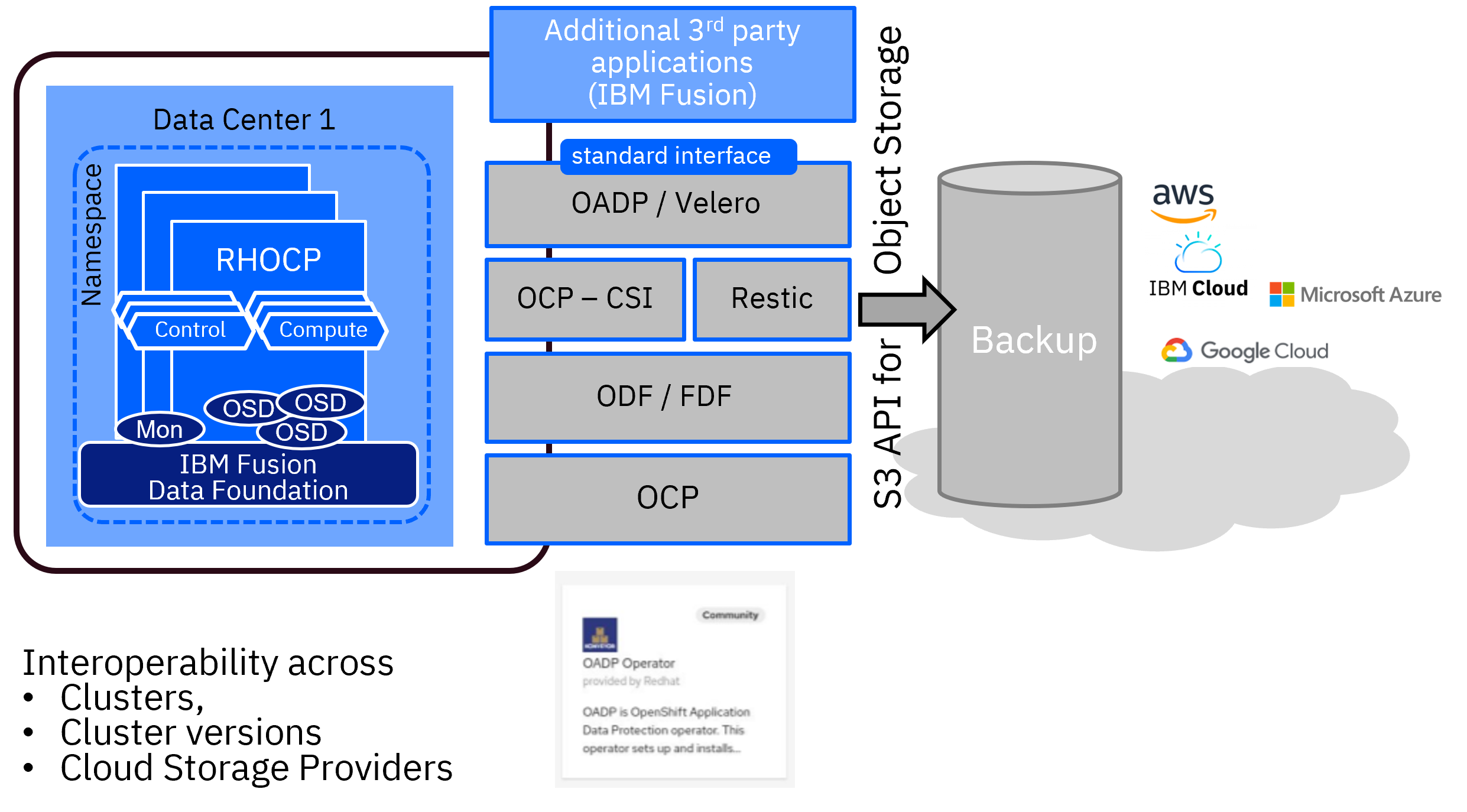
Velero, CSI Snapshots, and Restic
Both IBM Fusion and OADP use a set of open source components when creating a backup of an application namespace.
- The open source component Velero implements the backup of Kubernetes resources.
- A snapshot of persistent volumes is based on Container Storage Interface (CSI). A prerequisite is a Red Hat OpenShift cluster that supports either a native snapshot API or CSI snapshots (which is true for use with IBM Fusion Data Foundation)
- The metadata of a persistent volume is copied to an object store in the cloud as part of the CSI volume snapshot.
- The actual content of a CSI volume snapshot is an image stored as an archive file locally in the cluster from which it is produced. In a second step, OADP’s data mover (based on VolSync) copies the CSI volume snapshot content to an object store in the cloud as well.
- The target location in which the backup is safely stored is typically a S3-compatible object store offered by a cloud provider. For example,, an IBM Cloud Object Store, Amazon Web Services, Microsoft Azure, or Google Cloud Platform. It is also possible to use the NooBaa Multicloud Object Gateway, which is included in IBM Fusion Data Foundation. Additional custom OADP plug-ins can implement further backup target locations, such as NFS.
If CSI snapshots are not an option, there is an alternate approach based on the Restic open source project. Restic is a file system copying technique that is used by OADP in case the cluster does not support CSI APIs. Restic backups copy both volume data and Kubernetes metadata to an S3-compatible object store.