Memory Consumption in GRUB
Linux on IBM Power Systems runs in virtualized environments that are enabled by PowerVM, which allows multiple logical partitions (LPARs) to run different operating systems on the same physical system. Each Linux LPAR uses partition firmware (PFW) as the firmware layer. During system startup, PFW initializes the startup process by loading the GRUB bootloader, which then loads the Linux kernel.
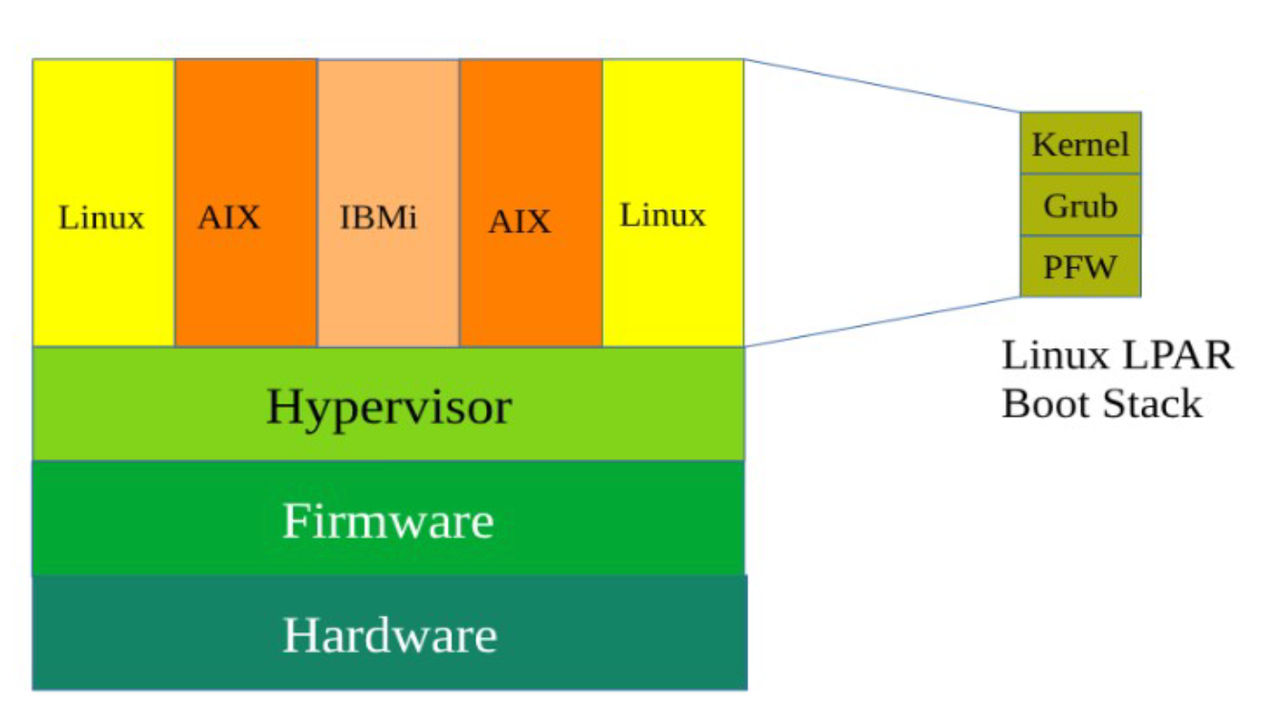
On IBM Power Systems, especially within the virtualized PowerVM environment, boot time memory management relies heavily on PFW, a crucial component responsible for providing fundamental runtime services to individual LPARs. PFW plays a central role in initializing system resources during startup.
A key component in this process is the real mode area (RMA), a fixed, contiguous block of physical memory that PFW reserves for each LPAR. Before the main memory becomes available, the system accesses this memory directly to support early-stage operations, including firmware execution, system initialization, and bootloader activities.
The GRUB bootloader uses the RMA to load its modules, the vmlinuz , and the
initramfs, and to manage heap memory for boot-time execution. During testing on
RHEL 9.5, PFW reserves 512 MB of RMA per LPAR, with GRUB having access to approximately 375 MB of
this space for its operations.
| Approximately 137 MB |
PFW GRUB’s core.elf |
| 128 MB |
Loading Loading Linux early memory allocations (not explicitly reserved) |
| Approximately 247 MB |
GRUB Heap Initialization and Expansion (initialized to 32 MB at the start.) |
|
Approximately 137 MB |
Portion claimed by PFW for its own use, and for the GRUB core binary. |
|
128 MB |
Implicitly left free for the loader to load the |
|
Approximately 247 MB |
To initialize and expand GRUB’s heap memory. Initially, 32 MB of RMA is allocated for the heap. |
Analyzing RMA consumption during startup helps uncover how GRUB manages memory on PowerVM LPARs. Understanding this behavior is essential for debugging boot-time issues, optimizing early memory usage, and can ensure consistent system stability across diverse hardware configurations.
The following sections explore specific startup scenarios to highlight how GRUB uses RMA and what factors influence the RMA consumption. This information helps to clarify the memory management strategy of GRUB during Linux startup on IBM Power Systems.
Analyze RMA consumption
RMA usage can be monitored during system startup by capturing the Available RMA and Available Heap values at key stages.
To track the RMA consumption during boot, the Available RMA and Available Heap are calculated at each of the following stages:
- Before and after heap initialization.
- Before and after verifying the integrity of the
vmlinuz. - Before and after loading the
vmlinuz. - Before and after loading the
initramfs. - Before GRUB hands control over to Linux.
Computing available RMA
The grub_machine_mmap_iterate function helps in computing the Available RMA. This function reads the firmware-provided memory map, iterates through the available memory regions (/memory/available) and calls the provided callback function for each of these regions. Instead of calling a callback function, the code can be tweaked to accumulate the available memory across all regions to compute the total Available RMA.
grub_uint64_t
get_available_rma (void)
{
  grub_ieee1275_phandle_t root;
  grub_ieee1275_phandle_t memory;
  grub_uint32_t available[128];
  grub_ssize_t available_size;
  grub_uint32_t address_cells = 1;
  grub_uint32_t size_cells = 1;
  int i;
  grub_uint64_t total_size;

  /* Determine the format of each entry in `available'.  */
  grub_ieee1275_finddevice ("/", &root);
.
.
.
  /* Decode each entry and calculate total available RMA.  */
  i = 0;
  total_size = 0;
  available_size /= sizeof (grub_uint32_t);
  while (i < available_size)
    {
      grub_uint64_t address;
      grub_uint64_t size;

      address = available[i++];
      if (address_cells == 2)
       address = (address << 32) | available[i++];

      size = available[i++];
      if (size_cells == 2)
       size = (size << 32) | available[i++];

      total_size += size;
    }

  if(total_size > 0)
         return total_size;

  return grub_errno;
}
Computing available heap
The grub_mm_dump function helps in computing the Available Heap. This function displays information about all the memory regions in the heap, covering both allocated and free blocks of memory by iterating over individual memory blocks within each region. The grub_mm_base is a pointer to the head of the linked list linking these memory regions. Free blocks are detected, and their sizes are summed to determine the heap space available within a given region.
void
display_heap_stats (void)
{
  grub_mm_region_t r;
  grub_size_t total_heap_F = 0;
.
.
.
  for (r = grub_mm_base; r; r = r->next)
    {
      grub_mm_header_t p;
      grub_size_t heap_F = 0;

      grub_dprintf ("benchmark_rma", "Region %p\n\n", r);
      for (p = (grub_mm_header_t) ALIGN_UP ((grub_addr_t) (r + 1),
                                            GRUB_MM_ALIGN);
           (grub_addr_t) p < (grub_addr_t) (r+1) + r->size;
           p++)
        {
          switch (p->magic)
            {
            case GRUB_MM_FREE_MAGIC:
	      grub_size_t current_free_block = (p->size << GRUB_MM_ALIGN_LOG2);
	      heap_F += current_free_block;
.
.
.
            }
        }
        total_heap_F += heap_F;
        grub_dprintf ("benchmark_rma", "Free Heap region %p: %" PRIuGRUB_SIZE " bytes (%" PRIuGRUB_SIZE " MB)\n", r, heap_F, heap_F >> 20);
    }
The computation and display of Available RMA and the Available Heap are done at the following points within the GRUB execution flow:
System configuration
The RMA consumption data is captured during the normal startup sequence for Linux kernel v5.14 on
RHEL 9.6. The size of the vmlinuz is 47 MB and the size of the
initramfs is 59 MB.
| Boot stage sequence 1 | Boot stage description | Secure Boot Disabled | Secure Boot Enabled |
|---|---|---|---|
|
1 |
grub_claim_heap (before grub_machine_mmap_iterate) |
Available RMA: 375 MB |
Available RMA: 375 MB |
|
2 |
grub_claim_heap (after grub_machine_mmap_iterate) |
Available RMA: 343 MB |
Available RMA: 343 MB |
|
3 |
grub_cmd_linux (before loading |
Available RMA: 343 MB |
Available RMA: 343 MB |
|
4 |
grub_ieee1275_mm_add_region (before grub_machine_mmap_iterate) (44.53 MB heap request) |
Not Applicable |
Available RMA: 343 MB Free Heap region 0x41d750: 16 bytes Free Heap region 0x4000: 2.76 MB Free Heap region 0x520130: 6.87 MB Free Heap region 0x92e5000: 21.11 MB Total Free Heap: 30.74 MB |
|
5 |
grub_ieee1275_mm_add_region (after grub_machine_mmap_iterate) (46 MB heap allocated) |
Not Applicable |
Available RMA: 297 MB Free Heap region 0x41d750: 16 bytes Free Heap region 0x4000: 2.76 MB Free Heap region 0x520130: 6.87 MB Free Heap region 0x92e5000: 67.11 MB Total Free Heap: 76.74 MB |
|
6 |
grub_linux_load64 (before grub_machine_mmap_iterate) |
Available RMA: 343 MB linux_size before padding: 47 MB linux_size after padding: 48 MB |
Available RMA available: 297 MB linux_size before padding: 47 MB linux_size after padding: 48 MB |
|
7 |
grub_linux_load64 (after grub_machine_mmap_iterate) |
Available RMA: 295 MB |
Available RMA: 249 MB |
|
8 |
grub_elfXX_load |
Available RMA: 295 MB |
Available RMA: 249 MB |
|
9 |
grub_ieee1275_mm_add_region (before grub_machine_mmap_iterate) (1 MB heap request) |
Available RMA: 295 MB Free Heap region 0x4000: 0.196 MB Free Heap region 0x51fb10: 0.03 MB Free Heap region 0x92e5000: 0.002 MB Total Free Heap: 0.227 MB |
Not Applicable |
|
10 |
grub_ieee1275_mm_add_region (after grub_machine_mmap_iterate) (32 MB heap allocated) |
Available RMA: 263 MB Free Heap region 0x4000: 0.196 MB Free Heap region 0x51fb10: 0.029 MB Free Heap region 0x92e5000: 0.002 MB Free Heap region 0xd89d210: 31.99 MB Total Free Heap: 32.22 MB |
Not Applicable |
|
11 |
grub_cmd_linux (after loading |
Available RMA: 263 MB Free Heap region 0x4000: 0.229 MB Free Heap region 0x51fb10: 0.029 MB Free Heap region 0x92e5000: 0.002 MB Free Heap region 0xd89d210: 30.68 MB Total Free Heap: 30.94 MB |
Available RMA: 249 MB Free Heap region 0x41d750: 16 bytes Free Heap region 0x4000: 0.228 MB Free Heap region 0x520130: 0.027 MB Free Heap region 0x92e5000: 44.69 MB Total Free Heap: 44.94 MB |
|
12 |
grub_cmd_initrd (before loading initrd) |
Available RMA: 263 MB size of initrd = 59 MB |
Available RMA: 249 MB size of initrd = 59.38 MB |
|
13 |
grub_cmd_initrd (after grub_linux_claimmap_iterate) |
Available RMA: 204 MB |
Available RMA: 190 MB |
|
14 |
grub_cmd_initrd (after loading initrd) |
Available RMA: 204 MB Free Heap region 0x4000: 0.291 MB Free Heap region 0x51fb10: 0.029 MB Free Heap region 0x92e5000: 0.002 MB Free Heap region 0xd89d210: 30.62 MB Total Free Heap: 30.95 MB |
Available RMA: 190 MB Free Heap region 0x41d750: 16 bytes Free Heap region 0x4000: 0.29 MB Free Heap region 0x520130: 0.27 MB Free Heap region 0x92e5000: 44.62 MB Total Free Heap: 44.94 MB |
|
15 |
grub_linux_boot (before jumping to linux) |
Available RMA: 204 MB Free Heap region 0x4000: 0.294 MB Free Heap region 0x51fb10: 0.029 MB Free Heap region 0x92e5000: 0.002 MB Free Heap region 0xd89d210: 30.62 MB Total Free Heap: 30.95 MB |
Available RMA available: 190 MB Free Heap region 0x41d750: 16 bytes Free Heap region 0x4000: 0.293 MB Free Heap region 0x520130: 0.027 MB Free Heap region 0x92e5000: 44.62 MB Total Free Heap: 44.94 MB |
|
Note: 1You must follow the boot stage in sequential order.
|
|||
| Approximate Scenario | Final Available RMA | Final Available Heap |
|---|---|---|
|
Secure Boot Disabled |
204 MB |
30.95 MB (30.62 MB is contiguous) |
|
Secure Boot Enabled |
190 MB |
44.94 MB (44.62 MB is contiguous) |
Out of memory scenarios
On a PowerVM LPAR, GRUB might run out of memory while loading the initramfs
image. The following scenarios outline specific conditions that trigger this issue:
RHEL DVD installations
The out of memory issue affects RHEL DVD installations from version 9.4 through version 9.6, where the version of GRUB being used was 2.06. While investigating this issue, an observation revealed the circumstances under which GRUB exhausts available memory during boot.
A dual reservation of memory is observed for the vmlinuz and
initramfs images, once in the heap and once in the available RMA. In regular
scenarios, GRUB reserves memory for both vmlinuz and initramfs
outside the heap, within the available RMA. GRUB then loads these images into the reserved space.
However, in affected scenarios, GRUB additionally reserves memory for the same images inside the
heap, before making reservations in the available RMA, resulting in duplicate memory
reservations.
This dual reservation occurs even when Secure Boot is disabled or the Trusted Platform Module (TPM) device is inactive, conditions during which GRUB should reserve memory only once. As a result, the heap depletes prematurely, leading to an out of memory error.
A comparison between DVD-based installations and standard startup sequences highlights a key difference: the DVD-based installation flow registers the TPM verifier, while the standard boot path does not register the TPM verifier. The additional component appears to trigger the redundant memory reservation.
Analyzing the TPM verifier behavior
The TPM verifier reads files such as vmlinuz and initramfs into
heap memory, measures them, and uses the verified content as a backing buffer for file access.
Before GRUB version 2.12, loading the TPM module also results in registering the TPM verifier even
when no TPM is present or when the TPM is disabled. This behavior causes unnecessary heap memory
allocation and triggers heap expansion to accommodate the measurement process.
Because the system lacks access to the TPM in these cases, GRUB discards the measurements. However, the heap still expands, consuming space from the available RMA. This unnecessary memory usage contributes to boot-time memory exhaustion.
In GRUB 2.12 and later, a fix has been included to prevent the TPM verifier from
registering when the TPM is absent or disabled. This change eliminates redundant memory reservations
during the loading of vmlinuz and initramfs. As a result, RHEL 10,
which includes GRUB 2.12, does not encounter the out of memory issue during DVD-based installations
on PowerVM LPARs.
Impact of initramfs size growth
Another key factor contributing to the out of memory issue during DVD installation is the
increase in the size of the initramfs image, from 88 MB in RHEL 9.3 to 133 MB in
RHEL 9.4. Although dual memory reservation still occurs in RHEL 9.3, the smaller
initramfs size does not trigger memory exhaustion. The larger image in RHEL 9.4,
combined with redundant reservations, pushes the system beyond the available memory limits.
More RMA usage with secure boot and trusted boot
Enabling Secure Boot or Trusted Boot significantly increases GRUB's RMA consumption. GRUB
allocates heap memory to hash the vmlinuz and initramfs images for
integrity verification. Although GRUB frees this memory after verification, the heap might become
fragmented.
Fragmentation reduces the availability of large, contiguous memory blocks that are required for subsequent operations, such as further hashing or final image loading. When both Secure Boot and Trusted Boot are enabled, GRUB might read the same images up to three times: for integrity verification; for boot-time measurements; and for actual loading into memory.
Due to fragmentation, GRUB might fail to allocate a sufficiently large contiguous block for the second or third read, increasing the risk of memory exhaustion.
Mitigation through increased RMA reservation
A fix has been included in GRUB to increase the RMA reservation for PowerVM LPARs from 512 MB to 768 MB. This change helps ensure that more real memory is available during startup, reducing the risk of memory exhaustion.
The updated reservation accommodates the increased memory requirement that is caused by larger
initramfs images and complex boot scenarios involving Secure Boot, TPM, FADump, and
DVD-based installations. The master branch of GRUB includes this fix, and is scheduled for
availability in the next major release.
Red Hat and SUSE have already integrated this fix into their current releases, which includes RHEL 9.6, RHEL 10, SLES 15 SP7, and SLES 16, effectively resolving the out of memory issue in these environments.