
Using Sterling Intelligent Promising Inventory Visibility as the inventory management system (phase 2)
How is the availability picture published?
The availability picture is usually published by Sterling Intelligent Promising Inventory Visibility REST API calls. Alternatively, you can subscribe to the availability events supported by Sterling Intelligent Promising Inventory Visibility to retrieve the availability picture. As availability is pre-calculated in Sterling Intelligent Promising Inventory Visibility, you can retrieve the availability information quickly.
For more information, see Events.
How is the default Sterling Intelligent Promising Inventory Visibility integration implemented?
The following diagram illustrates the implementation of default Sterling Intelligent Promising Inventory Visibility
integration.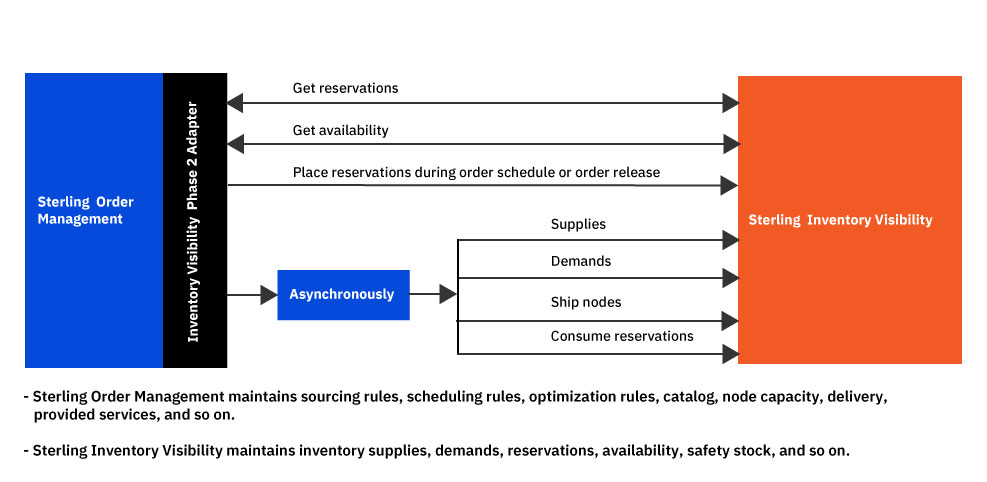
- For synchronous calls, Sterling Order Management System calls Sterling Intelligent Promising Inventory Visibility REST
APIs such as Availability and Reservations by using the
IVInvokeRestAPIservice. - For asynchronous calls to send supply and demand updates to Sterling Intelligent Promising Inventory Visibility,
Sterling Order Management System calls
IVPostSuppliesAsynchronouslyandIVPostDemandsAsynchronouslyservices to post the supply and demand messages synchronously to a JMS queue.
IV_ADJUST_IS and IV_ADJUST_ID integration servers get
started, the integration servers read messages from IBM MQ and updates the supply and demand changes
to Sterling Intelligent Promising Inventory Visibility by using the Sterling Intelligent Promising Inventory Visibility REST APIs.- The IV_ADJUST_IS and IV_ADJUST_ID integration servers are automatically started.
- The
IVInvokeRestAPI,IVPostSuppliesAsynchronously, andIVPostDemandsAsynchronouslyservices are meant only for integration purpose. Therefore, do not modify or invoke these services in custom code.
If you capture an order with
OrderLineReservation that contains a Sterling Intelligent Promising Inventory Visibility reservation
ID, the reservation is converted to the respective demands that are associated with the order.
| Sterling Order Management System attribute | Sterling Intelligent Promising Inventory Visibility attribute |
|---|---|
| OrganizationCode | shipnode |
| Latitude | latitude |
| Longitude | longitude |
If you delete a ship node in Sterling Order Management System, the deletion is not synchronized. You need to manually delete the ship node in Sterling Intelligent Promising Inventory Visibility.
Scheduling or releasing an order
While scheduling or releasing an order, Sterling Order Management System checks for real-time availability in Sterling Intelligent Promising Inventory Visibility, determines an optimized solution, and blocks inventory synchronously in Sterling Intelligent Promising Inventory Visibility for a short interval. The block on inventory is released either automatically after the short interval has elapsed or when the actual demands are updated in Sterling Intelligent Promising Inventory Visibility through a asynchronous process, whichever occurs first.
- Rationale
- In parallel processing scenarios, multiple orders may compete for the same limited inventory during scheduling or release. In such cases, one order may fail to secure a temporary reservation and be placed on backorder. The system can then re-evaluate alternative sourcing options for this order through subsequent processing.
- Recommendation
- Disable the Cancel Order for Inventory Shortage rule and instead configure an order monitoring rule to cancel backordered orders after a defined time threshold. This approach allows the system sufficient time to evaluate alternate fulfillment options while still ensuring that aged backorders are addressed appropriately.
- Tag processing
- Processing of tag items can be enabled by setting the property
iv_integration.inventory.enableTagSupporttotrue.