Control blocks
The control blocks used in task-related user exit control are the exit program control block (DFHEPB), the task interface element (DFHTIEDS).

Field CSAUETBA in the CSA points to the user exit table (UET); UETHEPBC in the UET points to the first exit program block (EPB); and EPBCHAIN in each EPB points to the next EPB in the chain.
- The address of the exit’s entry point (EPBEPN)
- The address of the global work area
- The halfword length of the global work area
- The halfword length of the task-local work area.
One EPB is associated with each enabled task-related user exit program or entry name.
EPBs used for global user exits and for task-related user exits are held on the same EPB chain.
The task-related user exit’s global storage is optional. It is associated with an individual enabled task-related user exit program or entry name. Several task-related user exit programs or entry names can share the same global storage.
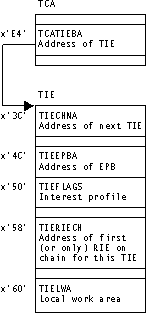
The task interface element (TIE) is associated with each associated pair of CICS® task and task-related user exit. The first time a CICS task passes control to a particular task-related user exit, a TIE is created. The TIE lasts until task termination.
Note that all TIEs relating to a single task are chained together (more than one TIE is set up when a single CICS task makes use of more than one task-related user exit). The TIEs corresponding to a single EPB (that is, to a single task-related user exit program or entry name) are not chained together.
A global user exit may only use global storage; a task-related user exit may use both global storage and task-local work area.
Field TCATIEBA in the TCA points to the first TIE, and TIECHNA in each TIE points to the next TIE in the chain.
The TIE holds information relevant to all invocations of the task-related user exit for the task concerned. For example, TIEFLAGS holds information concerning the events for which the task-related user exit should be invoked, for example, API calls, syncpoint, and task start.