Outgoing Event Gateway queue
The outgoing Event Gateway queue receives enriched events from the Event Gateway stitchers (main event enrichment) and from the plug-ins. In order to minimize the number of updates and hence minimize the load on the ObjectServer, updates to the Object Server are placed in a queue, aggregated, and sent to the ObjectServer at a specified interval. The default is 5 seconds.
The outgoing Event Gateway queue receives enriched events from both the Event Gateway stitchers (main event enrichment) and from the plug-ins, as shown in the following diagram.
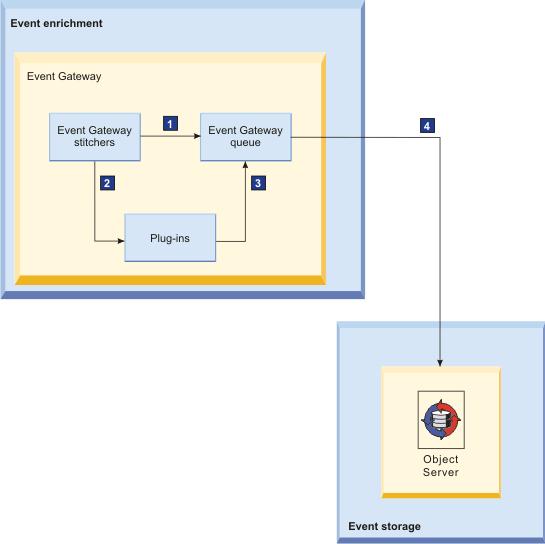
- 1 Standard enriched events placed on Event Gateway queue
- Following standard event enrichment, the Event Gateway stitchers place enriched data on the Event Gateway queue.
- 2 Events passed to plug-ins
- If the Event Gateway stitchers return a value of 1, then the related events are passed to the plug-ins for further enrichment. Plug-ins select the events to enrich based on the associated event map and event state.
- 3 Events enriched by the plug-ins are placed on Event Gateway queue
- The plug-ins place the events that they have enriched on the Event Gateway queue.
- 4 Enriched events sent to the ObjectServer
- Every 5 seconds enriched event data is sent to the ObjectServer. The interval of 5 seconds is configurable.
By default, the Event Gateway stitchers enrich the event
by populating the NmosManagedStatus, NmosEntityId, NmosObjInst, and
NmosDomainName fields. These events are placed on the Event Gateway
queue and wait for the next update. Meanwhile, the event is passed
to the RCA plugin. The RCA plugin enriches the event by populating
the NmosSerial and NmosCauseType fields and then places these events
on the Event Gateway queue. Both of these updates arrive on the Event
Gateway queue within one 5 second interval. Consequently rather than
performing two upates, the Event Gateway is able to queue the data
up so only one update of the ObjectServer is performed for all of
these fields.