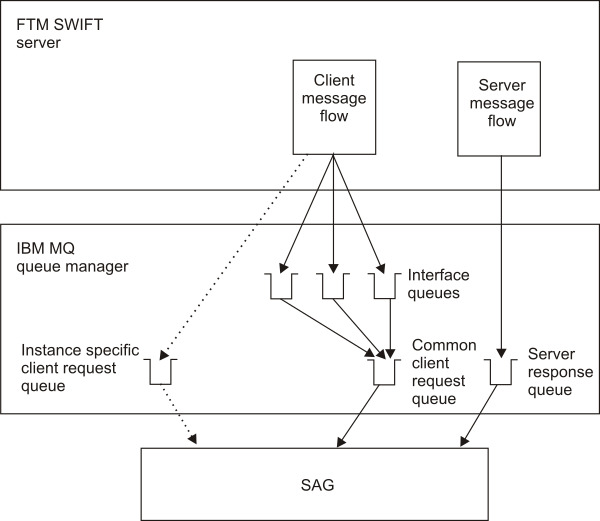
SAG input queues
Each SAG can have the following input queues:
- Instance-specific client request queue
- When
an application or service wants a particular SAG to process a request
message, it specifies, in the message, the name of the instance-specific
client request queue for that SAG. This is an input queue with a name
of the form prefix.sag.SPECIFIC.CLIENT.REQUEST,
where:
- prefix
- The prefix used for queue names within an FTM SWIFT instance.
- sag
- The name of the SAG that is to process the messages in this queue.
- Common client request queue
- If an application does not care
which SAG processes a request message, it does not specify, in the
message, the name of an instance-specific request queue. This causes
the message to be put into an interface queue with a name of the form instance.ou.SAG_CLUSTER,
where:
- instance
- The name of the FTM SWIFT instance.
- ou
- The name of the OU on whose behalf the message is to be processed.
- prefix
- The prefix used for queue names within an FTM SWIFT instance. This prefix is set during customization.
- sagClusterName
- The name of the SAG cluster that is to process the messages in this queue. This name is set during customization of FTM SWIFT. For more information about SAG clusters, see SAG clusters.
- Server response queue
- This
is an input queue into which a server send process puts response messages
that the SAG is to send to a message partner via the SIPN. Because
the servers response must be handled by the same SAG that handled
the request, and because OUs do not play a role in server request
processing, this queue is not an interface queue. This queue
has a name of the form prefix.sagname.SERVER.RESPONSE,
where:
- prefix
- The prefix used for queue names within an FTM SWIFT instance. This prefix is set during customization.
- sagname
- The name of the SAG that is to process the messages in this queue. This name is set during customization of FTM SWIFT.
These queues are shown in Figure 1.