Object Lifecycle Analysis
The FTM objects identified in the detailed sequence diagrams are orchestrated using finite state machine (FSM) models. Working from the detailed sequence diagrams, candidate states can be identified for each of these objects. Object lifecycle diagrams have been created for these objects and, for clarity, are separated by sending bank and receiving bank. Some object lifecycle diagrams can be re-used by both the sending and receiving bank.
Sending bank
For the sending bank, the following object lifecycle diagrams are used:
The Outgoing Payment Batch object lifecycle diagram (shown in the SEPA Credit Transfer primary flow section) is used by the Corporate To Bank scenario.

The Received Outgoing Payments Transaction object lifecycle diagram (shown in the SEPA Credit Transfer primary flow section) is used to transition the original settled transaction.
The Outbound Acknowledgment Batch object lifecycle diagram (shown in the SEPA Credit Transfer primary flow section) is also used to coordinate the sending of the acknowledgment back to the sending bank.
The Outgoing Payments Bulking Service Participant object lifecycle diagram (shown in the SEPA Credit Transfer primary flow section) is also used to coordinate the bulking process.
The Bulked Outgoing Payments Outbound Batch object lifecycle diagram (shown in the SEPA Credit Transfer primary flow section) is also used.

The Inbound CVF Acknowledgment Transaction object lifecycle diagram (shown in the SEPA Credit Transfer primary flow section) is also used.
The Inbound DRR Transaction object lifecycle diagram (shown in the SEPA Credit Transfer primary flow section) is also used.
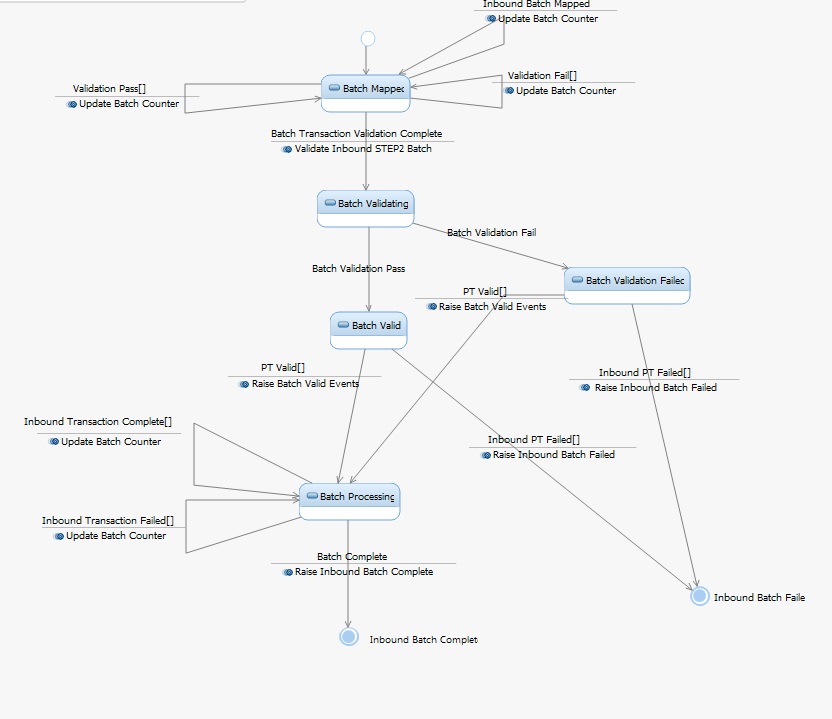

The Received Incoming Payments Batch object lifecycle diagram (shown in the SEPA Credit Transfer primary flow section) is also used in the coordination of the SCF (pacs.0004) from STEP2.
The Received Incoming Payments Transaction object lifecycle diagram (shown in the SEPA Credit Transfer primary flow section) is also used in the coordination of the SCF (pacs.0004) from STEP2.
Receiving bank
For the receiving bank, the following object lifecycle diagrams are used:
The Received Incoming Cancellation/Resolution Batch object lifecycle diagram in Figure 3 is also used by the Receiving Bank in the coordination of the SCF (camt.056).

The Outgoing Payment Batch object lifecycle diagram (shown in the SEPA Credit Transfer primary flow section) is used by the payment return (pacs.004) scenario.
The Received Outgoing Payments Transaction object lifecycle diagram (shown in the SEPA Credit Transfer primary flow section) is also used by the payment return (pacs.004) scenario.
The Outgoing Payments Bulking Service Participant object lifecycle diagram (shown in the SEPA Credit Transfer primary flow section) is also used to coordinate the bulking process.
The Bulked Outgoing Payments Outbound Batch object lifecycle diagram (shown in the SEPA Credit Transfer primary flow section) is also used to coordinate the outbound Resolution of Investigation and also the Outbound Return batches.
The Bulked Outgoing Cancellation/Resolution Transaction object lifecycle diagram in Figure 2 is used by the Receiving Bank for the outbound Resolution of Investigation scenario.
The Bulked Outgoing Payments Outbound Transaction object lifecycle diagram (shown in the SEPA Credit Transfer primary flow section) is also used by outbound return scenario.