Mirroring physical partitions
To improve the availability of the logical volume, you allocate one, two, or three copies of a physical partition to mirror data that is contained in the partition.
If a copy is lost due to an error, the other undamaged copies are accessed, and the AIX® operating system continues processing with an accurate copy. After access is restored to the failed physical partition, AIX resynchronizes the contents (data) of the physical partition with the contents (data) of a consistent mirror copy.
The following figure shows a logical volume composed of two logical partitions with three mirrored copies. In the diagram, each logical partition maps to three physical partitions. Each physical partition should be designated to reside on a separate physical volume within a single volume group. This configuration provides the maximum number of alternative paths to the mirror copies and, therefore, the greatest availability.
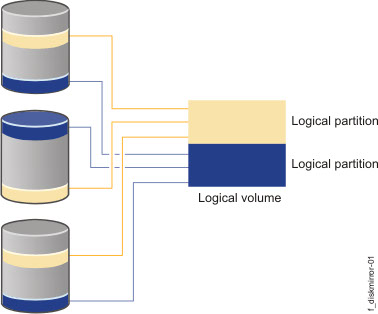
The mirrored copies are transparent, meaning that you cannot isolate one of these copies. For example, if you delete a file from a logical volume with multiple copies, the deleted file is removed from all copies of the logical volume.
The following configurations increase data availability:
- Allocating three copies of a logical partition rather than allocating one or two copies
- Allocating the copies of a logical partition on different physical volumes rather than allocating the copies on the same physical volume
- Allocating the copies of a logical partition across different physical disk enclosures instead of the same enclosure, if possible
- Allocating the copies of a logical partition across different disk adapters. rather than using a single disk adapter
Although using mirrored copies spanning multiple disks (on separate power supplies) together with multiple disk adapters ensures that no disk is a single point of failure for your cluster, these configurations might increase the time for write operations.
Specify the superstrict disk allocation policy for the logical volumes in volume groups for which forced varyon is specified. This configuration:
- Guarantees that copies of a logical volume always reside on separate disks
- Increases the chances that forced varyon will be successful after a failure of one or more disks.
If you plan to use forced varyon for the logical volume, apply the superstrict disk allocation policy for disk enclosures in the cluster.
For more information about forced varyon, see the section Using quorum and varyon to increase data availability.