Layer 7 routing
You can use a Layer 7 or Content Based Routing capable load balancer to meet the same domain requirement.
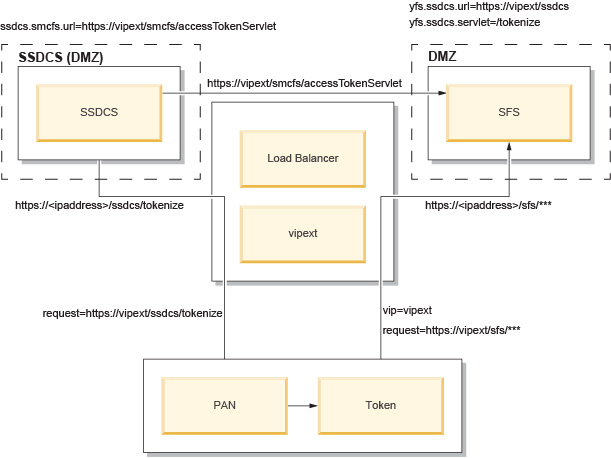
| Diagram Key: Abbreviation | Product or Application |
|---|---|
| ssdcs | Sterling™ Sensitive Data Capture Server |
| sfs | Sterling Field Sales |
In the diagram above, requests from the browser are sent to a load
balancer to the virtual IP (VIP) https://vip.acme.com. The load balancer
is configured to route the traffic to either the Sterling Sensitive Data Capture Server or Sterling Order Management System Software applications
based on the URI shown to the right of the host and port. For example,
if the load balancer is an F5 Big-IP, you could set up the following
iRule to route requests to the appropriate load balancing pool (of
servers) based on the URI.
when HTTP_REQUEST {
       set uri [HTTP::uri]
       if (uri starts_with “/ssdcs”) {
           		pool pool_ssdcs
       } elseif (uri starts_with “/smcfs”) {
            	pool pool_smcfs
       } else {
             pool pool_smcfs
       }
}
In this example, the Distributed Order Management and Sterling Sensitive Data Capture Server applications are deployed with the context root /smcfs and /ssdcs, respectively. During the normal course of interaction, the F5 iRule will route all HTTP requests with the URL https://vip.acme.com/smcfs to the pool of Distributed Order Management application servers. When the iFrame at the browser sends a tokenization request to https://vip.acme.com/ssdcs, the Layer 7 routing load balancer will send the request to the pool of Sterling Sensitive Data Capture Server servers.
You must configure the following parameters in the Sterling Order Management System Software applications
and Sterling Sensitive Data Capture Server:
- yfs.ssdcs.url — This parameter provides the Sterling Order Management System Software applications with the location of the Sterling Sensitive Data Capture Server.
- ssdcs.smcfs.url — The corresponding parameter tells the Sterling Sensitive Data Capture Server where to find a Sterling Order Management System Software application to verify that the tokenization request came from a valid user.